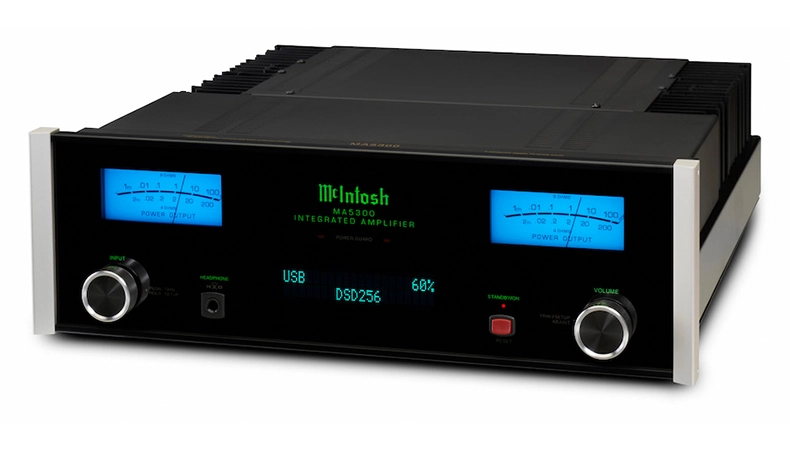
McIntosh has a big announcement for a little amplifier: the MA5300 integrated amplifier is the company's smallest yet, measuring 44cm x 15cm x 56cm (or about the size of a throw pillow for the interior decorators among you).
That doesn't mean it's compact when it comes to connections. There are six analogue inputs (four unbalanced, one balanced and one moving magnet) and six digital inputs - including two each for coaxial and optical. There is also a USB connection, and a port specifically for McIntosh MCT series SACD/CD players.
They're all housed within a replaceable DA1 digital audio module - so as technology develops you can keep your amp up to date - which has an eight-channel, 32bit digital-to-analogue converter capable of supporting DSD256 and DXD 384kHz files.

The company has also garnished the amplifier with a smattering of other features, including "McIntosh Monogrammed Heatsinks" that apparently eliminate warm-up time (meaning the amplifier is ready to go as soon as you switch it on) and new control microprocessors McIntosh says improves overall system operation.
That all sounds good on paper, so hopefully it'll translate to impressive sound quality once we get it in our testing rooms. But if you just can't wait that long you can place orders for the £6750 amplifier with McIntosh dealers. Shipping is expected to start in November.
MORE:
What Hi-Fi? Awards 2017 - all the winners revealed!
Record-breaking turntables category for What Hi-Fi? Awards 2017
Onkyo Music gets redesign, makes finding hi-res music easier
The best What Hi-Fi? deals of the month
10 of the best film scenes to test surround sound
