
Cambridge Audio is "ready for the fight." So it said when we asked it about going head to head with KEF in the wireless speaker system market.
As Cambridge's first all-in-one active speaker system, the L/R X is a direct challenger to the Award-winning KEF LS 50 Wireless II. Both products offer a pair of standmount speakers capable of amplification and streaming skills, doing away with the need for separates while also incorporating digital music listening.
Cambridge might be full of fighting talk, but is the flagship L/R X model up for the challenge?
Cambridge Audio L/R X vs KEF LS50 Wireless II: price

The L/R series comes in three variants: the entry-level L/R S (which is a pair of powered speakers with Bluetooth streaming), mid-range L/R M and flagship L/R X. The latter is what we're dealing with here, and it will cost £1799 / $2299 (around AU$3600) when it goes on sale this summer.
That's cheaper than the KEF LS50 Wireless II's RRP £2199 / $2499 / AU$4295. Though the KEF system's price does vary – it often costs as little as £1799 in the UK depending on the finish and retailer, and has dropped as low as £1499 during the peak sales period. As the system gets older, more discounts are likely.
Cambridge Audio L/R X vs KEF LS50 Wireless II: design & build
Like the LS50 Wireless II, the L/R X speakers have a clean, minimalist look that's designed to blend into your décor rather than leap out as a statement piece. Though maybe not if you opt for the bold orange finish. We weren't able to try out the LED underlighting during our hands-on, as it wasn't ready yet, but it should be a nice touch to elevate the L/R X above much of the competition in the design department.
Despite being the largest model in Cambridge's line-up, the L/R X aren't so big they'll take up all of the space in your room, and they can still go seriously loud if you crank the volume up to eleven.
A 28mm version of Cambridge's new Torus tweeter lurks inside – bigger than the usual 25mm size we see in the majority of speakers. This extra surface area should mean 25 per cent more air displacement, according to the manufacturer.
The L/R X also have twin 12.7cm woofers and a pair of side-mounted 15cm passive radiators, the latter of which aim to deliver deeper and louder bass from the modestly-sized cabinet.
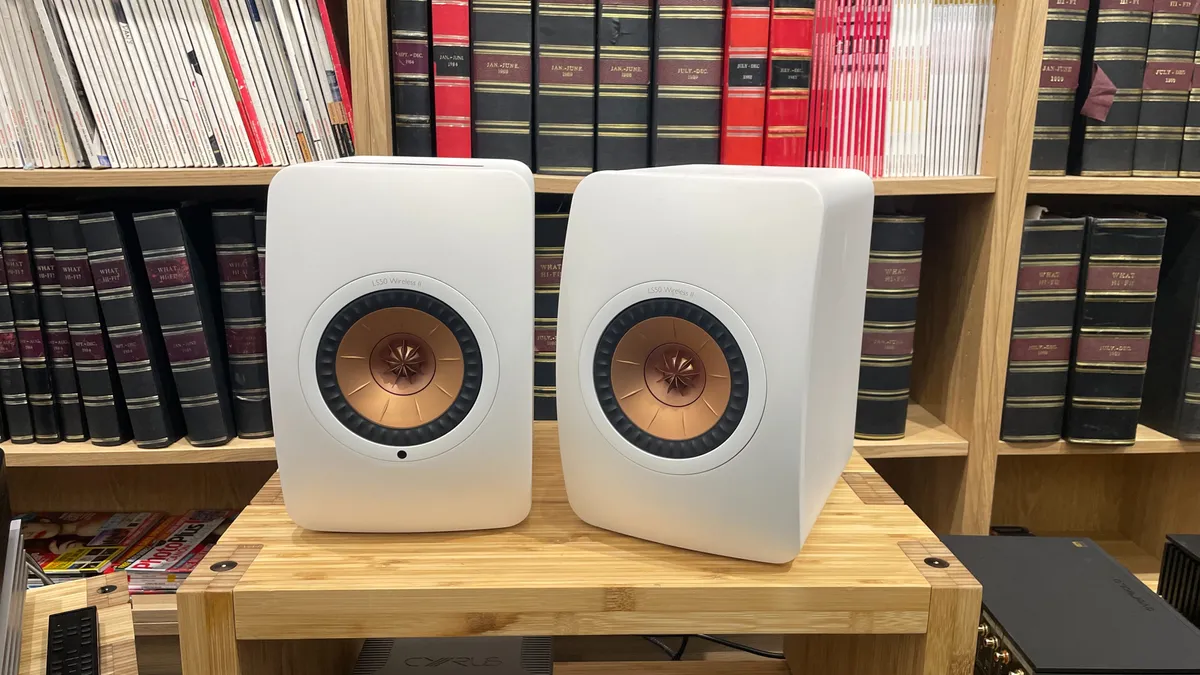
The L/R X have a more angular look than the LS50 Wireless II, which are nigh-on identical to their LS50 forebears, but we're fans of their slightly more bulbous aesthetic, like they're bulging with sonic tech just waiting to delight.
There's also the contrasting Uni-Q driver array, a signature of almost all of KEF's speakers, consisting of a 25mm aluminium tweeter and a 13cm aluminium mid/bass. That's supported by KEF's 'Metamaterial Absorption Technology' (MAT) which, essentially, uses a maze-like disc to absorb sound waves that radiate from the rear of the tweeter dome for cleaner highs.
They've inspired a lot of imitators since they first launched, which is a sign of how significant the LS50 Wireless II have been and remain.
Their design is practical as well as good looking, with threaded inserts in the corners letting them lock onto KEF's S2 Floor Stands (which cost around £400 / $449 / AU$800 extra per pair).
Cambridge Audio L/R X vs KEF LS50 Wireless II: features

Cambridge Audio wins the battle of power, with 400W per channel of Class D amplification, compared with the KEF LS50 Wireless II's 380W. But of course, there's a lot more to sound quality than sheer oomph.
The L/R X lets you connect the speakers together wired via USB-C, or wirelessly using WiSA HT tech. Both methods support 24-bit/96kHz resolution, which isn't quite as high as the KEF LS50 Wireless II's resolution of 24-bit/192kHz via an Ethernet cable.
In terms of connections, the L/R X boasts a separate USB-C port, RCA stereo and optical inputs, plus a moving magnet phono stage for plugging in a turntable and HDMI eARC for hooking up your TV. There's also a subwoofer output if you want to up the bass with a dedicated woofer.
The KEF system also has all these, minus the USB-C option.
That's physical connections, but what about streaming? The L/R X have Cambridge's StreamMagic Gen 4 platform, which includes UPnP streaming, AirPlay 2, Google Cast, Spotify Connect, Amazon Music, Deezer, Tidal Connect, Qobuz Connect and internet radio. There's also Bluetooth for local streaming and an Ethernet port for a more stable internet connection than wi-fi. Oh, and it's Roon Ready too, for music management using that platform. That's a lot of features.
KEF brings a similar suite of features via its KEF Connect app, including AirPlay 2, Google Chromecast and Bluetooth 5.0. So on paper at least, there really is very little to separate them.
We've used KEF's app extensively over the years, and have found it a breeze. As we wrote in our LS50 Wireless II review: "Loading dense service libraries, navigating its clean and logical interface and switching inputs proves a pleasant and reliable experience." If Cambridge wants to top it, it will have its work cut out.
Cambridge Audio L/R X vs KEF LS50 Wireless II: sound

Of course, the million dollar question is: how do they compare in terms of sound?
We've only heard the Cambridge Audio L/R X in its maker's demo space, rather than our dedicated listening room, and what we heard might not be the finished product. The L/R range isn't due for release until the summer, during which time it could have changed significantly. Since we heard it in Cambridge Audio's London HQ, for example, the firm has fine tuned the audio to reduce some top-end harshness at higher volumes.
But our first impressions were of a clear, clean and rhythmically sound performer. That 400W per channel makes it go very loud for a system of its size, and it retains plenty of textural detail in the process. It displays a good level of musicality, with plenty of space around the distinct-sounding instruments.
The L/R X showed considerable dynamic headroom at loud volumes, and as we hopped between musical genres in our demo – from Alice In Chains to a techno cover of Come Together – a picture emerged of clarity, scale and snappiness regardless of the track chosen or volume it's played at.
We also detected a slightly hard, bright edge among higher frequencies from time to time, but we can't confirm this until we've carried out our own extensive testing in our own listening rooms, especially as this is something which Cambridge has vowed to look at.
Cambridge Audio was so sure of its system that it actually played it side by side with the KEF LS50 Wireless II, albeit very briefly. The L/R X seemed to go louder than KEF's system, although obviously we can't draw any concrete conclusions outside of our own test rooms. Let's be honest, there's a lot more to a system than pure volume.
The original KEF LS50 Wireless gained entry to the What Hi-Fi? Hall of Fame, and the sequel has won an Award for a phenomenal six years running, so we know it sounds superb, but it's worth noting its many, many strengths to gauge exactly what Cambridge is up against.
KEF's Metamaterial Absorption Technology (MAT) helps achieve a clean treble, distinct mids and well-defined bass notes. There's more room within the presentation compared to its predecessor, with more detail and greater separation between instruments.
Listening to Adrienne Lenker's Symbol, the LS50 Wireless II "lay bare more intricacies in the guitar work, while disclosing the distinctive fragilities in her vocal," we wrote in our review. And these characteristics aren't unique to this track. "Similar sharpness and attention to detail is evident as we switch to Peter Broderick's Moment, the piano sequence aching with meticulously written melody as the LS50 Wireless II more deftly define the start and finish of notes."
They have a dose of extra punch too, and more agility, but these extra capabilities never come at the expense of subtlety. Cambridge Audio, the ball is in your court.
Cambridge Audio L/R X vs KEF LS50 Wireless II: early verdict
It's too early to say whether Cambridge Audio has managed to dethrone KEF. Trumping a six-time What Hi-Fi? Award-winner is no easy feat, but the L/R X certainly looks ready to give it a good go: it's a nicely designed, well thought out system that offers many of the same features as KEF's finest.
With similar premium price points, truly, Cambridge is bringing the fight.
But if any music system is up for it, it's the LS50 Wireless II. With multiple Awards to its name, a proven excellent sonic performance, and regular price drops, it's a very tough act to beat. We'll update this with our full verdict once we've reviewed the L/R X in due course.
MORE:
Read our Cambridge Audio L/R X hands-on review
And our KEF LS50 Wireless II review
KEF wireless speaker systems compared, from LSX II to LS60 – which one should you buy?

