Early Verdict
Cambridge Audio's L/R X wireless stereo speaker system looks like an exciting prospect on paper, offering a compact, all-in-one format that (hopefully) sounds as good as it looks. Our first impressions are that it sounds clear, texturally detailed and is capable of going surprisingly loud, but we'll need more time to delve deep into the L/R X's capabilities and make comparisons with its rivals before making a definitive assessment.
Reasons to buy
- +
Sounds clear, assertive and detailed in our demo
- +
Capable of going loud and proud
- +
Packed with streaming features
- +
Good connectivity, including HDMI eARC and MM phono stage
- +
Appear to be nicely made and finished
Reasons to avoid
- -
Sounded a little hard-edged during our first listen
- -
Up against strong competition
- -
We need more testing time for a final verdict
Why you can trust What Hi-Fi? Our expert team reviews products in dedicated test rooms, to help you make the best choice for your budget. Find out more about how we test.
Cambridge Audio's entry into a new market sector is undeniably exciting. The new L/R range of wireless stereo speaker systems represents a brave new expansion for Cambridge, and while there's strong competition about from the likes of KEF and Triangle, the market for feature-laden, all-in-one speakers with streaming capabilities and built-in amplification is certainly ripe.
We've had the chance to listen to the new range's most premium model, the L/R X, at Cambridge's London headquarters in December, with a view to discovering whether the hi-fi brand's considerable pedigree and heritage can translate from amplifiers and music streamers to this versatile speaker system format.
The competition for the flagship Cambridge L/R X (priced at £1799 / $2299, out in summer 2026) comes predominantly from the Award-winning KEF LS50 Wireless II speaker system, whose price varies from £2199 to £1799 depending on the finish and retailer chosen.
With the appeal of do-it-all compact systems only set to grow, Cambridge's expansion therein could prove to be a savvy strategy for a whole new audience beyond traditional hi-fi. It just needs to make sure that the sound performance is up to scratch.
Build and design

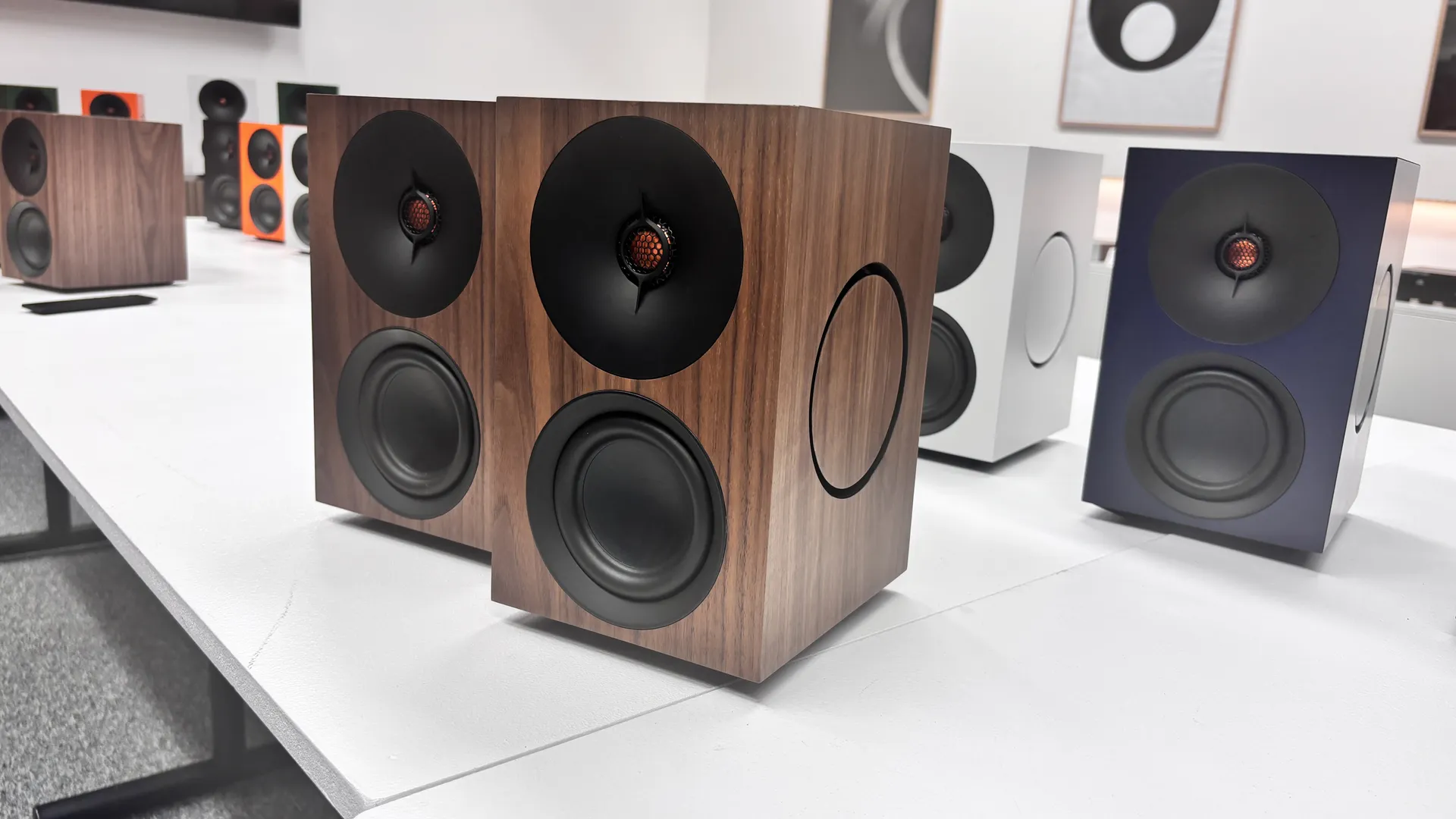
The new speakers opt for a clean, minimalist design that, depending on your preferences, can be daubed in a choice of colours ranging from pristine white to a bold, arresting orange. The L/R X also features some rather nifty LED underlighting if you're keen to set the mood, though this feature wasn't available to witness during our demonstration.
These speakers are the largest in the lineup, yet they don't appear so vast that they'd look out of place in a relatively modest listening space. Their reasonably compact size belies their ability to go seriously loud when the time calls for it, thanks to their considerable 800 watts of total power (that's 400W per channel), courtesy of Class D amplification.
Unique to the X model, you can choose between a USB-C wired or a fully wireless (WiSA HT technology) interconnect between the two speaker units themselves. Both methods support playback up to 24-bit/96kHz resolution.

The L/R X features Cambridge’s patented Torus tweeter, which as the name suggests, uses a ring-shaped design with a tapered horn inside the rear chamber. The Torus tweeter uses a dual radius configuration, with a flatter top and steeper sides, and a generous rear chamber for better clarity and direction.
The L/R X uses a 28mm Torus tweeter, with Cambridge promising that this increased surface area results in 25 per cent more air displacement than the more traditional 25mm dome size we see in most speakers.
Alongside, you get twin 12.7cm woofers working with a pair of side-mounted 15cm passive radiators, the latter of which have been chosen in pursuit of deeper, louder bass from a relatively modest cabinet size.
Features
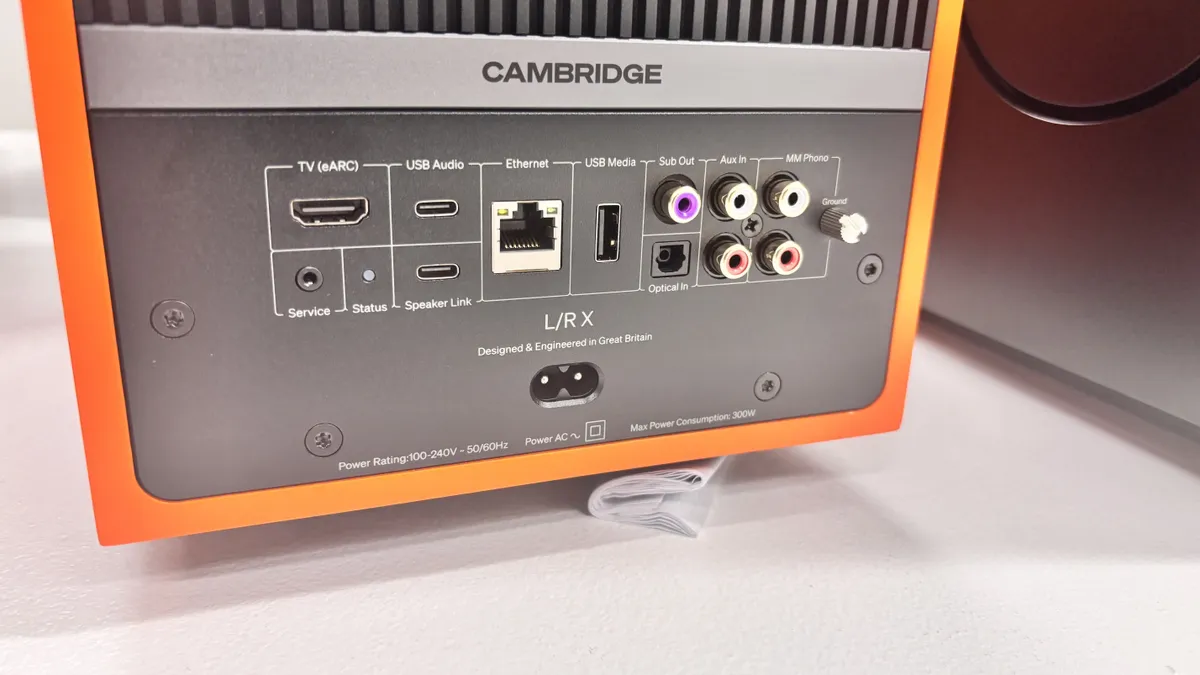
Around the back of the left speaker unit you’ll discover two USB-C ports – one for handling audio and the other for the wired speaker interconnect – as well as RCA stereo and optical inputs.
The L/R X also has a built-in moving magnet phono stage for plugging a turntable in directly, while a HDMI eARC input is available for connecting the speakers to your TV. If you want greater bass, there is also a subwoofer output.
For all your streaming needs, the L/R X features Cambridge’s current StreamMagic Gen 4 platform, which gives you access to UPnP streaming, AirPlay 2, Google Cast, Spotify Connect, Amazon Music, Deezer, Tidal Connect, Qobuz Connect and internet radio. We've generally found the StreamMagic platform and app easy to get along with in the past, so we're hoping for a similarly smooth experience when we get hold of our own test samples for a full review.
You'll naturally spend most of your time listening to the L/R X via wi-fi, but standard Bluetooth is on the menu for listeners who just need a quick and simple way to get their tunes firing. Along with wi-fi, there is also a wired Ethernet port available for a more stable connection.
Sound

During our launch preview at Cambridge's HQ in London, we managed to enjoy a decent amount of listening time with the L/R X, but we also need to make some important disclaimers at this point.
We listened to the L/R X in an unfamiliar demo space that is different to our dedicated What Hi-Fi? listening rooms, for a short period and without the comparative rivals against which we normally judge sound quality. Any concrete assessments, therefore, are reserved for when we can get a review sample of the L/R X into our own listening rooms and assess them under our own controlled conditions.
It's also worth noting that our initial experience may not be fully reflective of the finished product, either. Since our demo, Cambridge has made some audio tuning tweaks to the L/R X, including adding two filters in a bid to take a little top-end harshness out at higher volumes.
With that in mind, our demo ran the musical gamut, from peppy pop to ear-melting heavy metal (often with the volume cranked firmly towards the red zone), so we do have an initial idea of what the L/R X is capable of.
All songs during the demo were streamed using Spotify Lossless (24-bit/44.1kHz) from an Android smartphone.
Our first impressions are of a clear, clean and rhythmically sound performer, one which is capable of bringing out ample helpings of textural detail while going loud and proud in the process. The first track we’re served is Prince’s 1+1+1 is 3, and we note how the track’s funky underpinnings are well serviced by L/R X’s sharp and punchy sense of rhythm.
It’s always a nice surprise to hear Alice in Chains pulled out during a hi-fi demo, and an even nicer one when the grunge gods are given such a generally positive rendition. The L/R X seems to bring admirable detail and musicality to No Excuses, offering a great feeling of space and clear delineation around instruments and the track’s intertwining vocal strands.
To showcase how the L/R can handle large-scale dynamics, we are treated to Hans Zimmer’s Mountains from the Interstellar soundtrack.
There’s no question that, as the volume is cranked to eleven, the L/R X has considerable dynamic headroom – how naturally it shifts between more subtle dynamic fluctuations, however, requires further investigation on our end.
Not many stones are left unturned in the music department, and whether it’s Steely Dan’s Peg or a techno rendition of Come Together courtesy of Urbandawn and Tyson Kelly, our overall impressions don’t alter much – all of that clarity, scale and snappiness remain in evidence no matter the track chosen or the volume at which the system is played.

Certain quirks or potential limitations also remain consistent from tune to tune. It might be that this is an early sample we're listening to, or the loudness at which many of songs are demoed, but we do detect a slightly hard, bright edge that threatens to detract from our listening fun.
Whether it’s the lean snare on Peg or Prince’s vocals on 1+1+1 is 3, we’re left wondering if this excessive brightness could be a potential sticking point.
Again, further testing and running in – and possibly some tinkering with the speakers’ EQ settings – will reveal a more concrete answer, and this might well be something that Cambridge's subsequent tuning has rectified. The L/R X may also sound more forgiving when given a run out in our own test rooms, especially when they're granted more time to run in and warm up.
Most of the demonstration is performed in isolation, although there's a brief period during which the KEF LS50 Wireless II are wheeled out in order to demonstrate how much louder the L/R X can go when compared with their closest rivals, a head-to-head that's performed using Bleed from Within's headbanging In Place of Your Halo.
Yes, the Cambridge system wins out easily in the volume stakes, yet we'll need more dedicated time to gauge which speaker system wins out when it comes to the finer subtleties of rhythmic cohesion, dynamic prowess and overall emotional impact.
That’s a head-to-head we are looking forward to exploring in more depth when we get a full review sample in for testing. For now, the L/R X has left quite the impression, and it's always a good sign that, rather than having had our fill after an hour, we're curious to hear more.
Initial verdict

We can certainly see the appeal of all-in-one speaker systems such as this, and it's high time that more hi-fi brands joined this category. The likes of the KEF LS50 Wireless II and LSX II LT, and the cheaper but also Award-winning Triangle AIO Twin, demonstrate the appeal of proper hi-fi heritage housed in a modern, easy-to-integrate and lifestyle-friendly format.
Cambridge Audio's L/R X initial performance, ample feature set and compact design footprint, even in our limited demo time, has given us a solid impression of the new system's potential, but whether the L/R X has the full range of talents to topple the current class-leaders will require a good deal more investigating.
MORE:
Read our KEF LSX II LT review
And the KEF LS50 Wireless II review
Check out the best hi-fi systems we have tested and rated

What is a hands on review?
'Hands on reviews' are a journalist's first impressions of a piece of kit based on spending some time with it. It may be just a few moments, or a few hours. The important thing is we have been able to play with it ourselves and can give you some sense of what it's like to use, even if it's only an embryonic view.
