
Even if you don't have loads of cash to spend on your hi-fi system, you don't have to settle for poor-quality sound. There's great value available from a range of affordable speakers, with the best models filling your room with superb stereo music that's better than a one-box wireless speaker can provide.
We've filtered through our reviews of the best cheap speakers – bookshelf speakers, floorstanders and desktop powered speakers – to create this selection of our favourite performers under £500.
Whether you're building a separates hi-fi system, adding speakers to a microsystem or just want better sound for your TV, take your pick from our list of the best budget speakers that we've tested and can heartily recommend.
Our list spans brands such as Ruark, Elac, Dali and Wharfedale, demonstrating how many fantastic budget hi-fi speakers currently exist. We've tested every pair in our dedicated listening rooms, so you know you're getting our genuine expert recommendation.
You can read more about our speaker testing process here.
19th October: We've labelled our 2026 Award winners, added the Dali Sonik 1 as our new best budget standmounts, and replaced the Wharfedale Diamond 12.3 with their Diamond 12.3i follow-ups.

I'm the Hi-Fi and Audio Editor of What Hi-Fi? and have been testing stereo speakers for the better part of a decade, from floorstanders to bookshelf models, and across all budgets. While hi-fi can be an expensive endeavour, our picks of the best budget speakers here show you can get a whole lot of performance even when you're on a tight budget. When testing budget speakers, I look for build quality (it should still be made to a certain standard), compatibility (how easy it is to place in your room and use with partnering kit) and, most importantly, sound quality. Clarity, detail, rhythmic drive, dynamics, scale and musical cohesion – these speakers may be affordable, but they should still get your feet tapping and appeal to your emotions with all music.
The best budget hi-fi speakers overall


If you're in the UK (£299) or Australia (AU$599), the Dali Kupid are easily some of the most affordable speakers you'll find on this list. They're a smidge more expensive for US buyers at $600, but not so much that we don't consider them to represent great value no matter where in the world you get them.
A lot about the Kupid is small. They've got a small price and a small footprint, weighing in at just 5.8kg, and while they've also got a low sensitivity of 83dB, we didn't find them particularly tricky to drive during our tests.
That small size, meanwhile, works to their advantage, as they can be placed on desks, cabinets, bookshelves, TV stands or large windowsills rather than on dedicated speaker stands, making them well-suited to those with limited space. You can also mount them on the wall if you so desire thanks to their included wall brackets and fixing screws.
Whatever you choose to do, there's one area in which the Kupid aren't so small, and that's with regard to their sonic personality. Instead, they offer a lively, nimble presentation that is packed with enthusiasm and brio, and while you won't get a huge amount of bass, their expressive midrange is enough to make up for it.
They're great with rhythms, too. As we said in our review, the Dalis "exhibit a knack for snappy timing and agile rhythm (and) have a fleet-footed quality that zips along with all kinds of tracks in an engaging manner".
Dynamically, the Kupid can pull out the ebbs and flow of tracks with conviction, while also revealing subtler moments with a deft hand. They're able to bring out the drama of more challenging tunes, and while they may be small and nimble, we rarely feel as though the Dali aren't immersing us in the music we feed them.
As we summarised in our review's verdict: "A great choice for small, modern music systems, the entertaining Dali Kupid speakers will win over many hearts".
Read our full Dali Kupid review
The best budget standmount hi-fi speakers


When we tested Dali’s outstanding Sonik 5 floorstanding speakers, all we wanted to do was find out how their standmounted counterparts performed. Those counterparts are the Dali Sonik 1, and they're every bit as talented as their floorstanding siblings.
The Dali Sonik 1 are the smallest standmounters in the Sonik range, measuring just 27.4 x 16.2 x 23.1cm (hwd), so they'll have no trouble fitting into smaller rooms.
The speakers house a 13cm mid/bass driver, tuned with a rear port, and the same 29mm lightweight woven fabric soft dome tweeter as featured on the Sonik 5 floorstanders. The mid/bass diaphragms use Dali’s proprietary mix of fine-grain paper pulp reinforced with wood fibres for a blend of rigidity, improved damping and lighter weight.
The mid/bass drivers use Dali’s patented Soft Magnetic Composite technology in the motor system to reduce distortion, optimising detail and dynamic performance.
The result is speakers of real skill and articulation. They could do with a touch more punch, but for detail and expressiveness, the Sonik 1 are an absolute pleasure.
As we wrote in our review: "Dynamically, the Sonik 1 handle intricate shifts, such as the decay of vocal reverb in You Sun Nah’s Kangwondo Arirang, with sensitivity and grace, bringing the track’s most delicate minutiae to the surface with an immersive, intricate sound".
Eloquent and expressive across the frequency range, the compact Dalis are a joy from top to bottom.
Read our full Dali Sonik 1 review
The best budget floorstanders


Wharfedale's Diamond 12.3i aren't a huge departure from the Diamond 12.3 that came before them. That's no bad thing, as the outgoing speakers were some of the best budget floorstanders of their time, and a mainstay on this particular rundown.
Aside from new finishes, the new speakers look pretty much the same as before, with a 2½ way design where the upper 13cm driver handles the midrange and bass, leaving the lower one to add a bit of muscle only at the lowest frequencies.
Both of the larger drivers – a 13cm mid/bass and 13cm bass unit – use Wharfedale’s Klarity diaphragm material. Klarity is the company’s marketing name for mica-loaded polypropylene, a material claimed to offer a good balance between stiffness, damping and light weight. A 25mm textile dome tweeter handles anything above the 2.2kHz crossover frequency.
At 97.5cm tall and just 18cm wide, these Diamond floorstanders are compact enough to fit into most rooms without dominating, and in the UK at least, that’s a big plus. They're less forgiving than their predecessors, though, so you'll need to be a bit more careful about the distance you place them from a wall.
Get that right, and handsome sonic riches will be your reward. Wharfedale's new 'i' range trades on a big, bold sound, evidenced by the Diamond 12.3is' dramatic retelling of John William's iconic Indiana Jones theme. Dynamically, they really know how to show off, while their bass reproduction kicks a little harder and deeper than before.
As we wrote in our review: "Given a song like De La Soul’s YUHDONTSTOP, the 12.3i are a fun listen, rendering the group's vocal flow with enthusiasm and clarity. Vocal and instrumental textures come through well, certainly better than any rival floorstander we’ve heard".
At this price, there's not much out there to worry these Wharfedale towers. They remain a cut above the rest, and that makes them an excellent buy at their modest outlay.
Read our full Wharfedale Diamond 12.3 review
The best budget desktop speakers


Ruark's petite and stylish MR1 line has always been easy to recommend, with the third-generation Mk3 boxes only continuing that legacy.
Building upon the Award-winning MR1 Mk2 , the MR1 Mk3 offer a significant step up in performance, as well as more inputs and a sleeker design, with only a £50 rise in price in the UK.
The cabinets have been given a refined facelift but retain the classy design and lovely build quality, complete with the intuitive and tactile RotoDial controller with which you can easily control volume, inputs and Bluetooth pairing. They're a tad bigger than their predecessors, but they'll still fit neatly on either side of your laptop or onto a small desk, bookshelf or TV stand.
The third-gen speakers feature Class D amplification with 25W of power per channel, as well as a bigger mid/bass driver. They're also gained a moving magnet phono stage for plugging in a turntable directly, as well as a USB-C input for connection to laptops and smartphones.
The speakers can handle hi-res files up to 24-bit/192kHz, while Bluetooth aptX HD is supported.
That phono stage is a huge plus, and one of our main reasons for recommending the Mk3 so strongly. The quality on display is excellent, and we've rarely heard such a convincing case for powered speakers to be paired with a turntable.
Pair them with, say, a Rega Planar 1 or the pricier Planar 3 and you'll get a clear, well-defined and confident sound that far outstrips what the rival Elac Debut ConneX DCB41 can manage.
Elsewhere, the Ruark speakers sound powerful, punchy and dynamic, and while they're not massive units, they're able to stay composed at louder volumes. Rhythmically and dynamically, the Ruarks are hugely entertaining, with ample detail and subtlety combined with a well-realised soundstage.
They certainly sound considerably bigger and more spacious than their predecessors, too, and our only minor niggle is that the muscular bass could do with a hint more subtlety.
Still, as we said in our review: "Their user-friendly design and lively presentation make them an appealing pair of powered speakers, and that talented built-in phono stage makes them well-suited to creating a neat and tidy turntable system". Nice.
An outstanding choice if you're low on space and/or you want to build an affordable, easy-to-use vinyl setup.
Read our full Ruark MR1 MK3 review
The best budget speakers for a TV
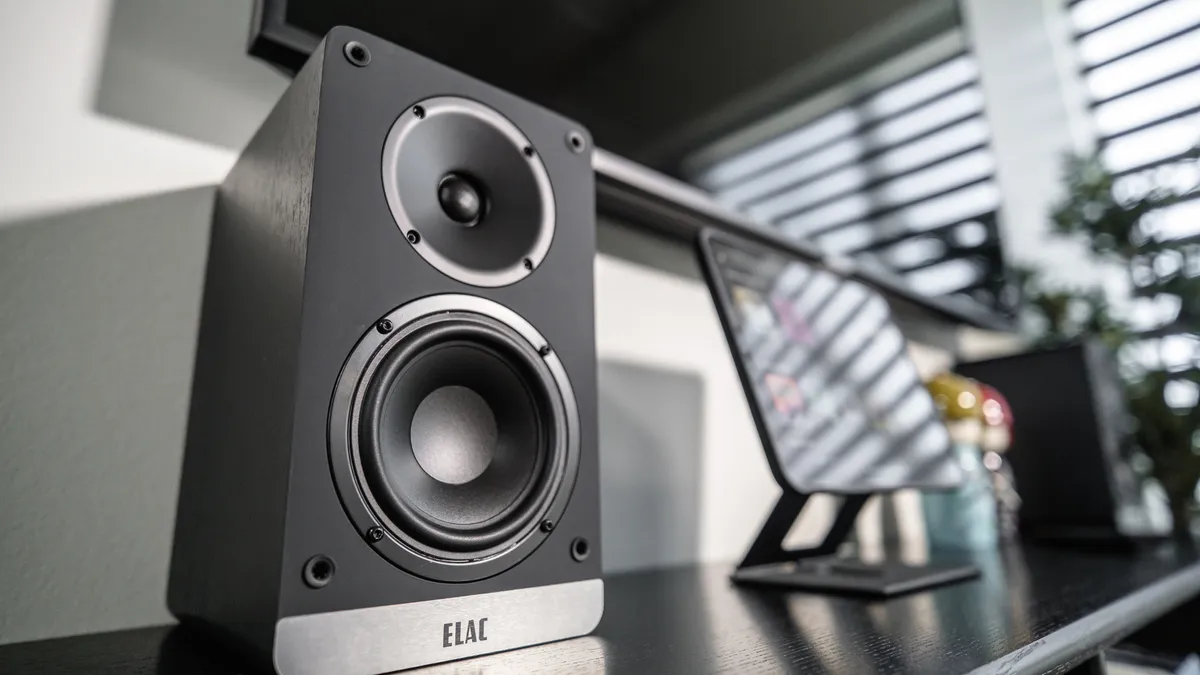


It’s possible to spend upwards of £1000 on a pair of powered speakers, but if you’re operating on a more modest budget Elac’s Debut ConneX DCB41 is a compact, great-sounding system at a fraction of the cost.
All the amplification is built into one master speaker, with a supplied cable to connect it to its passive sibling. There are no native streaming capabilities onboard, but you do get aptX Bluetooth for wirelessly connecting to a phone or laptop, with wired inputs including a pair of stereo RCAs, USB, optical and HDMI. There’s even a built-in moving magnet phono stage.
Each speaker is equipped with a 10cm mid/bass unit and a 19mm soft dome tweeter, so while they won’t quite reach party volumes, the overall performance is clear, balanced and insightful, with plenty of detail and control.
The digital inputs offer the best sound, and the phono stage is only good enough for occasional use – the Ruark MR1 Mk3s are a better powered pair for turntable use.
But there are no significant areas of weakness, thanks to their "nicely judged presentation" and "informative, enjoyable" character. These are speakers that fade into the background, leaving the music to take the limelight. They're a great alternative to soundbars as TV speakers, too.
Read our full Elac Debut ConneX DCB41 review
Also consider
Monitor Audio 50 7G: The new Bronze standmounts aren't the most relaxed-sounding speakers, but they're beautifully made, terrifically tuned and boast a great sense of fun. If you like a pair of speakers that are relentless in their pursuit of fun and vivacity, these slightly pricier speakers are worth checking out.
Fyne Audio F5E: They don't quite hit the heights of some of their more expensive companions, but Fyne's budget boxes showcase impress stereo imaging and a balanced, mature presentation.
Wharfedale Diamond 12.1: We still have a lot of love for the Diamond 12.1. While newer models are clearer and more dynamic, these still showcase a pleasingly detailed, fluid nature and are unfussy with partnering. They'll have huge appeal for those looking for a truly budget hi-fi speaker, and with such a competitive price tag, they're still hard to ignore.
Q Acoustics 3010i: One of the most likeable and forgiving speakers at this ultra-budget price. But that doesn't mean Q Acoustics has cut corners on sound: rich detail, energetic presentation and the kind of refinement we're amazed to see at this price level. These speakers have an enjoyable balance and work well when put in corners and close to the wall, too.
Q Acoustics 5010: The Q Acoustics 5010 are clear, nicely integrated speakers with impressive pedigree, even if they’re up against some stellar rivals at this level. Still, at their price of around £399 / $749, they're far from a poor choice if clarity and detail resolution are high on your agenda.
Elac Debut 3.0 DB53: The Debut 3.0 DB53 heralded a new generation for Elac, bringing a distinctive sonic style that granted greater bass punch and increased overall clarity at the expense of their predecessors’ more forgiving, nuanced approach. With the right equipment, they're still a very capable pair of standmounts.
Q Acoustics 3020i: Want a richer, deeper sound with greater scale and dynamic reach? The step-up, bigger 3020i are an even better example of Q Acoustics' budget range, and delivers much of that easy-going presentation with a greater degree of refinement and sonic maturity while remaining affordable.
Budget speakers coming soon
Monitor Audio Radius: Monitor's new Radius range is built for home cinema and hi-fi use, and priced at the lower-end of the market. The Radius 1 and Radius 3 standmounts will cost £425 / $525 and £575 / $725 per pair respectively, while the Radius On-Wall speaker will set you back £450 / $525.
Read our Monitor Audio Radius news
How to choose the best budget hi-fi speakers for you
So, we're here to find a bargain - these are affordable speakers after all - so you've already settled on a budget, which is a good first decision. Pick your upper limit and stick to it otherwise you'll never make a decision.
But what else should you be considering before you settle on a pair of speakers? We suggest measuring your room or the area for your system, at least roughly, so you can narrow you search to speakers that are the right size and not too large for the space.
Then, decide whether you want bookshelf/standmount speakers or floorstanding speakers. As a general rule of thumb, bigger speakers tend to be capable of delivering higher volumes, better dynamics and more bass.
Passive, active or powered? Passive speakers require a separate amplifier. Powered and active speakers have integrated amplification, so you don't need an external amp. As a rule, more boxes means better sound, though the appeal of integrated units is convenience. Separates are also easier to upgrade one step at a time.
Want more advice? Check out our guide on how to choose the right speakers and get the best sound.
How we test hi-fi speakers
Our facilities
We have state-of-the-art testing facilities in London and Reading, where our team of experienced, in-house reviewers test all of the speakers we review. These facilities, which have been specially treated to ensure that they have a reasonably flat reverb response, give us a controlled, consistent space in which the speakers, rather than the room, can be heard and assessed properly.
Comparative testing
What Hi-Fi? is all about comparative testing, listening to one pair of speakers up against its benchmarked rival in the same price range to figure out exactly how they differ and how each speaker performs – and which speaker is best at its price point. To ensure we give you the best buying advice, we keep our favourite five-star and class-leading products in our stockrooms so we can always benchmark new products to ones we know and love.
Getting the best out of our speakers
We are always impartial and do our best to make sure we're hearing every product – including budget speakers – at their very best. So we'll use different partnering products, experiment with speaker positioning in the room, try plenty of different genres of music to give the speakers a workout, and give them plenty of listening time (and time to run in).
A team effort
All review verdicts are agreed upon by the team as a whole rather than an individual reviewer, to eliminate any personal preference and to make sure we're being thorough and consistent. There's no input from PR companies, manufacturers or our sales team when it comes to the verdict, with What Hi-Fi? having decades of delivering honest, independent, unbiased reviews.
You can read more about how we test and review products on What Hi-Fi? here.
FAQ
How much should I spend on a pair of budget speakers?
The general advice is that the more you spend, the better sound you get. If you're just getting started and are on a tight budget, we would recommend looking at under £500 / $500 per pair for a good 'budget' speaker, with plenty of terrific options in the £200-£400 / $300-$500 bracket.
You should also keep an eye out for some great discounts during the sales seasons, which should bring the price of budget speakers down even lower. It's also a good idea to look into speakers that are a few years old – the price will have come down a fair bit, making them an even better deal than before.
All of our speakers are tested on a 'cost-per-sound' basis, so prices are heavily factored in when awarding a star rating. We believe that you should get a fantastic sound quality no matter the price, but it's always worth asking: "Am I getting the best value for money considering the performance I'm receiving?" before simply buying the cheapest model.
Recent Updates
October 2026: Labelled our 2026 Award winners, added the Dali Sonik 1 as our new best budget standmounts, and replaced the Wharfedale Diamond 12.3 with the new Diamond 12.3i.
June 2026: Added Monitor Audio's Radio Series 4G to our 'coming soon' section.
March 2026: Changed some of this page's formatting to make it more reader-friendly.
January 2026: Added the Fyne Audio F5E to our also consider section.
December 2025: We've included new entries in our 'coming soon' section as we look ahead to 2026.
October 2025: Added the Dali Kupid as our best standmounts overall and replaced the Ruark MR1 Mk2 with the Mk3 as our best budget desktop speakers.
August 2025: Added the Q Acoustics 5010 to our 'also consider' section.
June 2025: Added Q Acoustic 5010 and Ruark MR1 MK3 to our 'coming soon' section, and Elac Debut 3.0 DB53 to our also consider list.
April 2025: Performed general checks to ensure all information was up to date.
February 2025: No new entries, but ensured the list is up-to-date with the latest buying advice.
December 2024: Added a 'coming soon' section and updated copy sections for greater clarity.
October 2024: Changed product list order and labelled What Hi-Fi? 2024 Award winners.
September 2024: Added references to new Q Acoustics 3000c and upcoming Elac Debut 3.0 series of budget loudspeakers.
July 2024: Added multiple-image galleries to replace single images and added textual references to reviews.
February 2024: Added FAQ section to help with buying decisions and frequently asked questions.
November 2023: What Hi-Fi? Award winners labelled after the 2023 Awards Best Buys and Product of the Year announcements.
MORE:
Our pick of the very best speakers
The best computer speakers: desktop and wireless models tested
The best hi-fi and wireless speaker deals available now
Advice: How to choose the right speakers
