
"The less of routine, the more of life," or so thought the American philosopher and reformer, Amos Bronson Alcott.
Here at What Hi-Fi?, we too recognise the importance of change. While the established ways of old undoubtedly have their place, we are always on the lookout for new, top-quality products that shake up the audio market.
And nowhere is that more obvious than in the standmount speakers category at the What Hi-Fi? Awards 2026, which contains both passive and active models amongst its nine winners. We have a second budget Dali enter the passive ranks, while the new active speakers from Fyne Audio and KEF this year have impressed us so much, we had to expand the category to acknowledge their talents.
Dali's budget duo

At the most budget end, we have the Dali Kupid (£299 / $599 / AU$599), which remains our favourite standmount speaker under £300. There's a lot to love about the Kupid. Not only are they a compact, well-built and nicely styled pair of speakers, but they also have a lively and entertaining sound, which doesn't skimp on rhythmic agility and dynamic sensitivity.
For their affordable price, we are impressed by how many boxes these Dali speakers manage to tick.
The next step up in price sees another pair of Dalis taking the win, this time in the 'Best standmount speaker £300-£500' bracket. The new Sonik 1 (£449 / $900 / AU$849) are altogether more serious looking speakers than the Kupids, but they, nonetheless, have a certain aesthetic charm. These modestly sized standmounters should also have no trouble fitting wherever you need them to go. Though, of course, we suggest a dedicated pair of stands.
The Sonik 1 are unfussy in terms of amplifier pairing, and will make the most of budget set-ups while simultaneously having the talent to bring the perks of more upmarket equipment to light.
Sonically, these speakers do a lot of things right, with authoritative and well-managed bass, a lush midrange and responsibly handled high frequencies. For their reasonable price, it is easy to recommend these talented performers.
A dark horse

Another returning Award winner is Acoustic Energy's brilliant AE300 Mk2 speakers (£649 / $1099 / AU$1580), which feature a sleek, neat design that is pleasingly unobtrusive.
Combining a large 29mm fabric dome tweeter with a fairly small 12cm paper/coconut fibre mid/bass, the AE300 Mk2 deliver a slow-burning sound that, once we've become accustomed to it, has us hooked.
These speakers' well-integrated drivers offer an unfussy, nicely balanced performance. Controlled bass and a good degree of detail across the frequency range only add to the deeply enjoyable listening experience that the AE300 Mk2 standmounters provide.
Four years of fanfare

We have a feeling that PMC knew what they were doing when they named their Prodigy speaker series. As the longest standing Award winners on this list, with four consecutive years of victory under their belt, the Prodigy 1 (£1250 / $1899 / AU$2449) have garnered quite the reputation.
The two-way standmounter's tweeter and mid/bass driver have been nabbed from more upmarket, studio-friendly models. They also feature PMC's signature ATL bass-loading method, which guides the backwards energy of the driver through damped material and out of a front port in order to bolster bass reproduction.
The resultant sound is impressively clear and organised, with a healthy side-portion of punchy, deep and well textured bass. When you are spending between £1000-£1500 on a pair of speakers, being able to make the most of textures across the frequency range is important, and these speakers should leave you smiling ear to ear.
An epic run for Epos
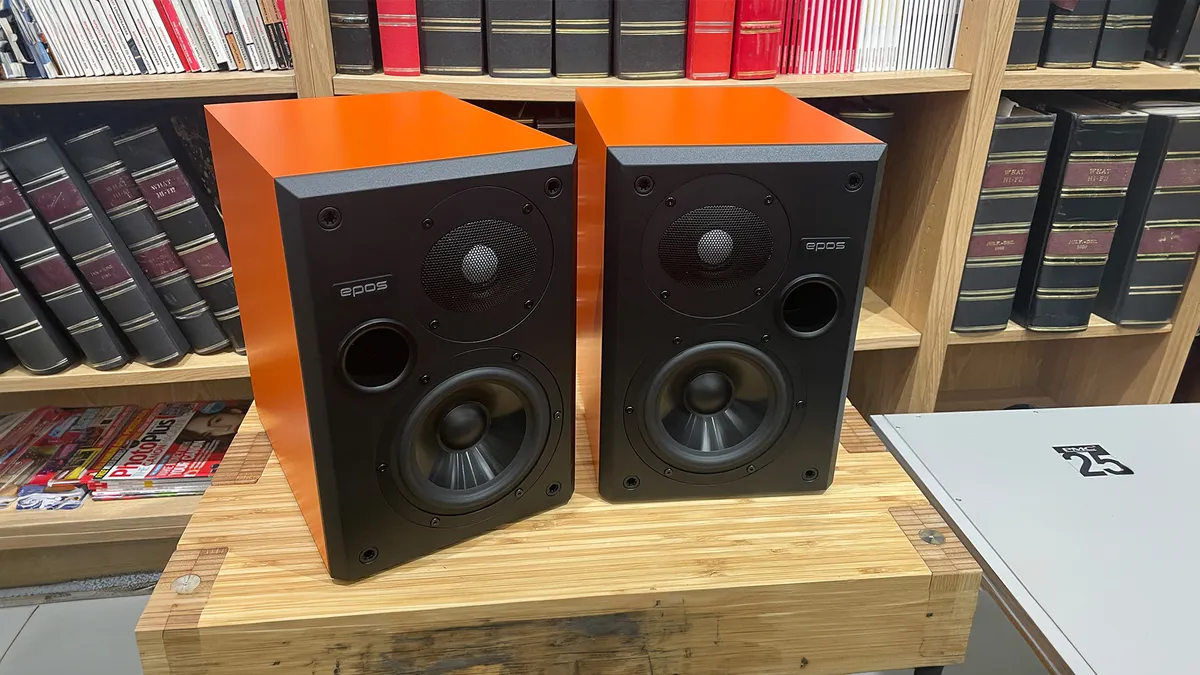
The second longest-running Award winner on this list is the Epos ES-7N ( £1890 / $2195 / AU$4995), which this year celebrates its third anniversary as our favourite standmount speaker between £1500-£2500.
For anyone looking for a pair of speakers that is truly flexible about placement, the ES-7N are a solid choice. This is due to a switch on the rear of the cabinet which allows you to choose between sound settings for either a semi free-standing arrangement or placing the speakers on (or in) a bookshelf or cabinet.
This arrangement is made possible, in part, by the speakers' front-ported design.
Jack of all trades, master of... not quite! The ES-7N have a clear, forthright and expressive sound, and they even cope quite well when we put them in a tightly packed bookshelf. Dynamically, these are a sensitive pair of speakers, too, and they also have plenty of rhythmic drive.
The fact that they can perform well in sub-optimal conditions just makes these Epos standmounters even easier to love.
Another win for PMC

It would be a shame to disappoint with a name like the Prophecy 1 (£2875 / $4299 / AU$5499). Thankfully, these speakers live up to their rather grandiose nomenclature, with a sound that more than justifies their position as our favourite speaker costing more than £2500.
This speaker's slim and stylish cabinets use PMC's tried and tested transmission line configuration, with a rear firing output acting as the mouth of a carefully damped path inside the cabinet. The low-frequency sound that emerges from this port fills in below the point where the mid/bass driver's output tails off, providing an extra portion of bass.
The Prophecy 1 have an expansive, layered and precise soundstage that is resilient against changes in volume and recording quality. These speakers are pleasingly tonally balanced and put in a class leading performance in terms of clarity and precision.
Small but mighty Ruarks

The Ruark MR1 MK3 (£399 / $579 / AU$899) continue to fly the flag for the 'best desktop speakers' thanks to their terrific performance from such a compact form. These speakers feature 50W of Class D amplification built in, thus setting themselves apart from the passive speakers in the first half of this category.
With an excellent built-in moving magnet phono stage, audio inputs including USB-C, optical and aux, plus Bluetooth with aptX HD, these speakers' connectivity options make them flexible to use with laptops, smartphones, TVs and record players. Their build quality, too, exudes subtle luxury in a way that will look good in any home.
In terms of sound, the MR1 MK3 have a powerful, punchy and dynamic sonic signature with a strong sense of rhythmic drive and solid stereo imaging. Even while using the internal phono stage, these speakers keep up a strong performance that belies their humble stature. For anyone short of space, these desktop powered speakers are a strong option.
Two new active speakers enter the fold

We now have our two new active speaker winners.
These speakers have built-in amplification, while also including multiple input options and Bluetooth for convenience. For those who don't want to deal with multiple separate boxes (or don't have the budget to), these active speakers are an ideal flexible option.
For under £700, it can be hard to find a pair of active speakers that meet the brief in terms of flexibility whilst maintaining superb sound quality. Fortunately, Fyne Audio's first-ever active speakers, the Cubitt 5 (£549 / $749 / AU$1495), do just that.
With inputs including HDMI ARC, optical, stereo RCA line level, a moving magnet phono stage and Bluetooth 5.0, these speakers can be used with any setup, whether that's a separates hi-fi system with a turntable, a TV or simply a smartphone with Bluetooth.
What's more, they sound great across their inputs. The Fyne boast a whopping great 120W of power per channel, and sound impressively balanced and insightful, with nicely controlled bass.

For active speakers above £700, the new KEF Coda W are another success for the brand, offering a seriously upmarket sonic performance at £799 / $1000 / AU$1450.
Again, versatility is a strong consideration here, with HDMI ARC, USB-C, optical, stereo RCA line level and moving magnet phono inputs availble. When it comes to wireless streaming, too, these speakers are well equipped with support for aptX Lossless and aptX Adaptive Bluetooth.
However you choose to listen to music, you can expect a clear, detailed presentation, with deep, controlled bass and expertly handled dynamics.
The Coda W feature KEF's iconic Uni-Q driver array, with 100W of amplification powering each channel. They're well made too, and show off KEF's proven success in the wireless speaker systems category on a more modest and simplified pair.
All of these speakers are Award winners in their own right, but one of them will take home the overall Product of the Year trophy in the standmount speakers category. We'll be announcing those winners – a few additional special awards – at our What Hi-Fi? Awards 2026 ceremony on the night of 12th November, so stay tuned!
MORE:
See all the What Hi-Fi? Awards 2026 winners
What Hi-Fi? Awards 2026: Dali and Wharfedale shake things up in this year's floorstanders face-off
Best bookshelf speakers 2026: top standmounts for every budget tested

