
How much should I spend on each part of my stereo system?
It's an obvious question to ask for anyone putting a system together. It is easy to assume that the answer is simple and follows some predetermined formula. But, as with so many things in hi-fi, things are not as straightforward as they might at first seem.
What Hi-Fi?’s stock answer to the question of system balance has been consistent through the years. It goes along the lines of spending broadly equal amounts on each major component, say record player, amplifier and speakers, and then another 10-15% of the total system budget on cables. (If you think cables don’t matter, let’s agree to disagree and leave it at that.)
Spending the same amount on each major component, as a rule of thumb, seems to make intuitive sense. Most of our recommended systems stick to this idea, so it clearly can work.
However, hear how well Acoustic Energy’s AE1 40th Anniversary standmount speakers (£1499 / $1999) perform when driven by Yamaha's C-5000/M-500 pre/power amplifier (£17,198 / $21,998), or how capable a Rega Planar 3 RS Edition turntable (£999 / $1795) sounds when feeding a system made up of Vertere's Phono-1 MkII L phono stage (£1495 / $1895), PMC’s Cor integrated amp (£6995 / $9999) and a pair of Epos ES14N speakers (£3750 / $4500), and you will realise the allocation of budget can’t simply be a fixed equation.
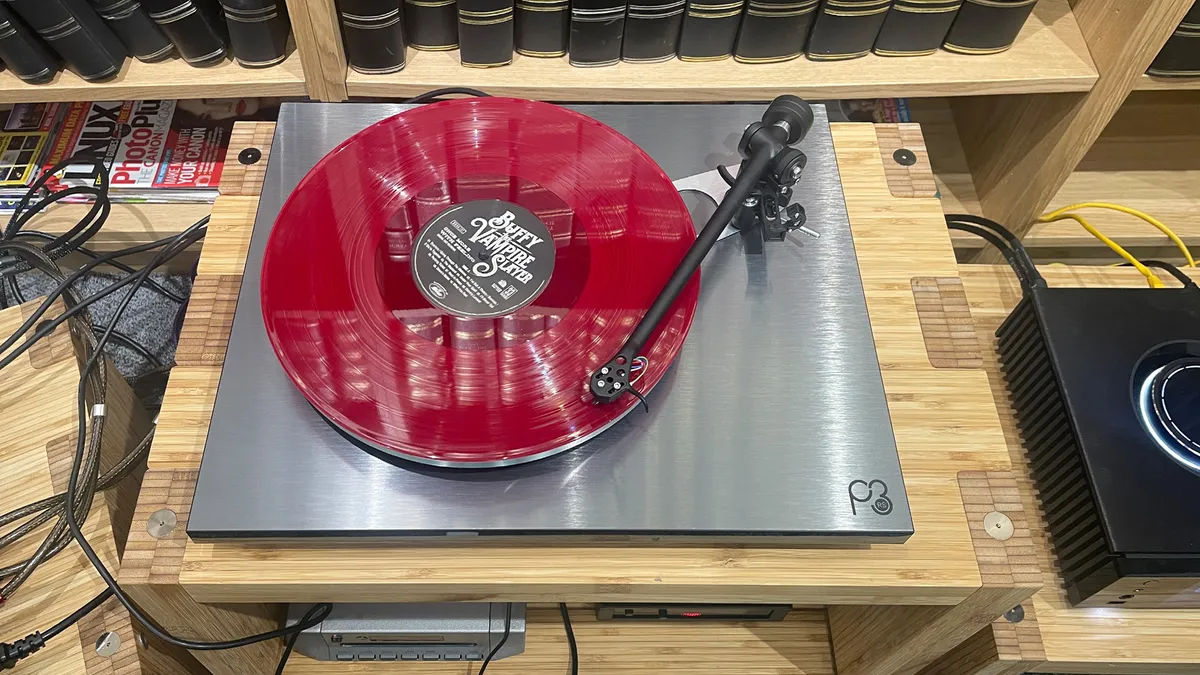
Every product has certain sonic and electronic characteristics. These things are not price-related.
It is entirely possible to partner products of vastly different retail prices that still gel seamlessly and produce excellent sonic results. That’s certainly the case with the examples mentioned above.
In addition, the idea that different types of components selling for the same money are somehow sonically equivalent doesn’t hold water. Each product type, be it a streamer, amplifier, record player or speakers, uses very different internal components, manufacturing technologies and production methods.
There is no direct price/performance correlation between a DAC chip and a drive unit, or an aluminium casework to a luxuriously finished floorstander cabinet. So, to even suggest that a £500 streamer provides the same performance level as a similarly priced floorstander doesn’t add up.

That said, is there a better answer to our original question? Maybe there is. I would start off with a good idea of my overall budget and then be open-minded with the cost of each component within that limit. The aim is to achieve the level of performance I want, rather than balance costs.
While buying online may get you a better price on the individual products, only an experienced dealer can really guide you through this process and let you try out the various options.
Ultimately, it doesn’t matter if your amplifier costs twice as much as your record player or steamer if you are getting a sound that you love.
MORE:
3 hi-fi products I can't wait to see in person at the upcoming Bristol Hi-Fi Show 2026
We've put together an affordable, old-school hi-fi system with a modern sonic twist
We dial up the nostalgia with our favourite songs from 1986 that are turning 40 this year

