
Speaker stands seem like pretty simple things, don’t they? Usually, they are just a few bits of metal bolted together that keep your speakers off the ground.
However, this most humble of hi-fi products – I hesitate to call them an accessory – contribute to your system’s sound far more than you might suspect.
I admit that, on the surface, this hardly appears to be the most scintillating of topics. However, the way speakers are supported has a huge impact on their performance – arguably more so than any other factor, barring possibly room positioning.
What exactly is the job of a speaker stand? At the most basic level, it needs to position the speaker’s tweeter at broadly ear level when the listener is seated.
Additionally, the support should hold the speaker cabinets rigidly at audio frequencies, so that every tiny movement of the drive unit’s diaphragm translates into sound rather than being cancelled by any motion of the enclosure.
On the practical side, it should be the right size, not only in terms of height, but also the top plate should be appropriate for the intended partnering speaker. There are numerous stand types, but they mainly tend to fall into two design types: high mass or low mass.

The thinking behind high mass is that it takes more mechanical energy to move the stand, so it potentially moves around less (on a microscopic level) when stressed by the forces generated by the speaker’s drive unit. Newton's Third Law explains this. This gives the speakers rock-solid support, which is good.
However, more mass means more stored mechanical energy, and this takes longer to dissipate as vibration. When a stand vibrates, it generates sound. In the case of a high mass stand, this low-level sound hangs around longer, which is not a good thing as it mixes with the sonic output of the speaker.
The larger the surface area of the stand, the more sound is generated. This is where lighter frame-type designs come in. They tend to be low mass but still rigid, and dissipate any unwanted energy more quickly. The smaller surface area of such a design means that re-radiated sound is reduced too.
Beyond that, there are all sorts of variations. I’ve come across designs that make use of wood, marble, glass or even stone, and each material has its benefits and drawbacks. Some stand designs even have a degree of added ‘give’ to control the flow of vibrational mechanical energy, or in the case of some extreme examples, to try to isolate the floor from the vibrations caused by the speakers, and vice versa.
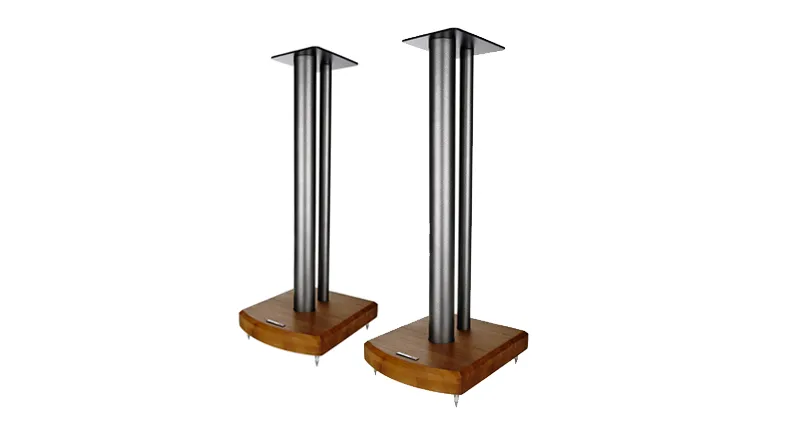
Why isolate the speaker from the floor? If you have a rigid stand, and the floor vibrates, then the stand, and by extension the speaker, moves too. It’s a vicious circle, though a solid concrete floor certainly copes better than the suspended wooden floors that are so common in the UK.
Which approach is best? Rather unhelpfully, the answer is ‘it depends’. A support can change the balance of the partnering speaker so dramatically that the safest option tends to be to use whatever the speaker manufacturer recommends.
This will give you the sound that the speaker’s designer intended, as there is a high chance that the speaker was tuned using that support. Even if you don’t buy the speaker manufacturer’s own design, there is a good chance that a third-party product that follows similar principles could work as well or, in some cases, even better.
But you’re reading What Hi-Fi?, so the chances are that the urge to experiment will surface, and there is no harm in that. Use a low-mass but rigid support with a speaker intended for a high-mass stand, and you will significantly change its balance. However, this may suit your system and taste better.
As with so many things in this lovely hobby of ours, there is no definitive answer that works across the board. All you can do is have a listen and trust your ears. And that’s the fun of it.
MORE:
Read our Atacama Moseco 6 review
Check out our guide to the best speaker stands
New issue of What Hi-Fi? out now: superb hi-fi and home cinema systems from Award-winning kit

