
We ask a lot of our stereo speakers. By our reckoning, a great home set-up should be, among many things, clear and expressive, powerful yet capable of nuanced dynamics, and characterful without imposing excessive tonal colouration.
A speaker designer’s core task is to balance these often juxtaposed requirements and strike just the right balance between them.
To see which models we think fit the bill, you can check out our list of the best hi-fi speakers that we've tested, covering all budgets and types.
That alone is no small task, but many hi-fi manufacturers also build monitors for use in recording studios, where the role of the speaker is somewhat more forensic; less about enjoyment, more about analysis and finding faults.
But studio speakers still require enough character to keep artists from feeling too self-conscious while listening back to their performances.
While pondering what was beginning to seem like the fairly herculean task of speaker design, we decided to talk to leading speaker manufacturers, to find out how their approaches differ when it comes to designing professional studio and home hi-fi speakers.
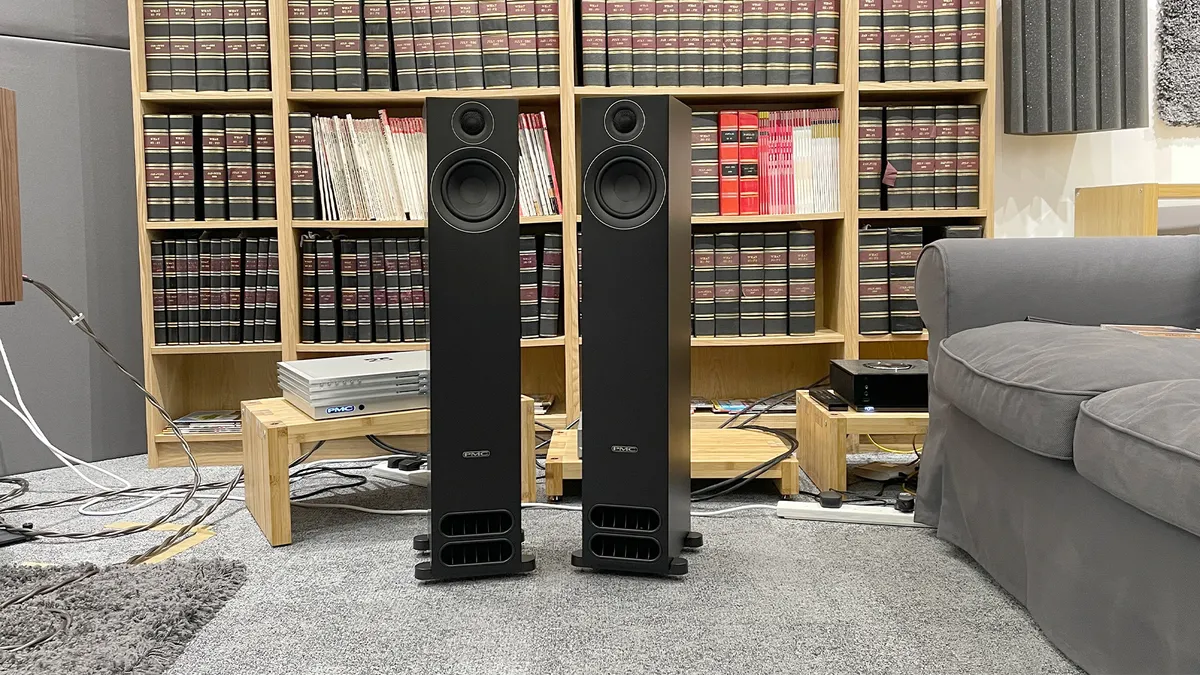

"PMC’s professional monitors and domestic hi-fi loudspeakers are built around the same core principles. Clarity, transparency, wide dispersion, tonal accuracy, dynamics and high resolution are fundamental to both. The aim is always simple: to hear the music, not the loudspeaker.
"Many of the same technologies are used across both ranges, including Advanced Transmission Line bass loading, Laminair airflow technology, steep-slope crossovers, and advanced driver designs. The exact implementation varies from model to model, but the goal remains the same: lower distortion, less colouration and a more natural, revealing presentation.
"The biggest technical differences come from how and where the speakers are used. PMC’s professional monitors are generally active or supplied as part of a carefully matched active system. The drivers, amplifiers, crossovers and, where fitted, DSP are designed to work together as one complete package. This gives PMC precise control over the performance of the whole system, helping to deliver consistent tonal balance, predictable output and plenty of headroom.
"Professional models may also include balanced analogue and digital inputs, room-boundary adjustment, EQ controls and network-based setup. These features make it easier to integrate the monitors accurately into composing, recording, mixing, mastering and broadcast environments.
"Studio monitors also have to cope with demanding workloads. They may be used for long sessions and need to reproduce powerful transients and high sound-pressure levels without compression, clipping or obvious distortion. For that reason, continuous and peak SPL performance is often specified in more detail than it is for domestic speakers."
"PMC’s hi-fi loudspeakers are generally passive, which reflects the more traditional approach of the home-audio market. This gives customers the freedom to choose their own amplification, source equipment and cables, and to build a system that suits their room, budget and personal preferences. PMC also offers active domestic models, bringing the benefits of closely matched amplification to home listeners.
"Appearance is another practical difference. Hi-fi models are designed to sit comfortably in the home and are available in elegant, furniture-quality finishes. Studio monitors tend to be more functional and durable, often with matte-black cabinets suited to professional installation.
"Despite these differences, neither range is designed to sound clinical or matter of fact. PMC loudspeakers combine exceptional accuracy with a natural sense of ease, a wide and immersive sound field, and ultra-low distortion. That makes long sessions enjoyable, whether someone is creating a hit record or film score, or listening to the finished result at home.
"This consistency from studio to living room is a key part of PMC’s reputation: the music can be enjoyed by the listener with the same energy, emotion, and intent as those heard by the people who created it."


"ATC has got one foot in each of those two markets and we make products that span both. The SCM50 is the first that comes to mind as a well regarded hi-fi speaker and studio monitor.
"In terms of the engineering, there really is no difference between the hi-fi and pro versions. Both use the same drive units and the same amplifier. They are set up in the same way, so when it comes to calibrating the amplifiers, we calibrate with the same balance. We are always striving for an optimally flat balance from the speaker.
"We feel that a high quality loudspeaker is a high quality loudspeaker, whether it’s going to be used in professional or domestic settings. We don’t believe a speaker’s balance should be tailored to make the speaker sound a certain way, we think it should sound as accurate as possible."
"Our objectives are always the same: to make the best performing, flattest frequency response, lowest distortion speaker that we can, whether we are doing it for hi-fi or professional use.
"Of course, there are certain situations, such as a large format studio monitor, where you wouldn’t want to put the port on the side or the back of the speaker, in case the studio wanted to mount it in a wall.
"The addition or omission of a grille also varies between our professional and domestic ranges. Generally, people don’t want grilles in professional contexts, while, on the domestic side of things, they’ll demand it. It can be quite tricky to design a grill that protects the drive units, has minimal impact on the acoustic performance of the speaker and looks good, too.
"The other difference is finishes. Our pro customers are generally more accepting of a functional, painted finish. All our consumer models, on the other hand, are available in a range of different veneers. We are open to discussing specific requirements with all of our customers."


"At Genelec, the distinction between studio monitors and domestic hi-fi speakers is much smaller than many people might expect. We believe that the most faithful listening experience comes from reproducing recordings exactly as their creators intended. That's why the same core technologies trusted by recording, mixing and mastering professionals are also available to listeners at home. Some of our flagship studio monitors, models such as the 8381A and 8380A, are increasingly used in high-end residential listening environments as well as for professional studios.
"In all our active loudspeakers, the amplifiers, drivers, crossover filters and signal processing are designed as a complete system, ensuring precise alignment between all components. This approach delivers consistent performance, low distortion and simplified installation without the need for amplifier matching. Studio monitors are built this way because engineers need consistent, predictable behaviour across many listening sessions and different rooms.
"A second difference is directivity control. Studio monitors are generally designed to keep their off-axis frequency response as close as possible to the on-axis response, so that reflected sound (from walls, ceiling, mixing desk) doesn't colour the direct sound much differently than the direct sound itself. Genelec loudspeakers are engineered to minimise room interaction through advanced cabinet design, controlled directivity and sophisticated driver technologies. Models such as The Ones employ coaxial technology to provide accurate imaging and consistent performance both on- and off-axis."
"For any kind of speakers, whether a home listening hi-fi system or in a studio, room acoustics play a major role in sound quality. Genelec loudspeakers feature room response controls via rear-panel DIP switches, allowing users to compensate for the effects of placement and room acoustics.
"For those seeking an even higher level of adaptation, our SAM models add a measurement microphone and DSP-based room correction (via GLM software) that measures the in-room response at the listening position and applies correction filters offering highly precise adjustment to the listening environment.
"One thing worth flagging: the line between 'studio monitor' and 'domestic hi-fi speaker' is genuinely blurry at this point. Our flagship models like the 8381A, 8380A or The Ones are marketed for both use cases, since the underlying technology doesn't change between them.
"Whether in a control room or a living room, the goal stays the same: a listening experience that remains faithful to the original recording, with reliable performance for decades."


"We generally don’t differentiate between studio monitors and domestic speakers in terms of technical construction. We use the same tweeter and woofer materials, and designs, and aim for a neutral response from both types of speakers. From a sound tuning perspective, we principally treat both equally.
"Where studio monitors and domestic speakers differ is more in practical terms: studio monitors are typically active, with either built-in or separate power amplifiers and active crossovers.
"In the domestic market active speakers are becoming increasingly popular, and for these products we generally use very similar technical constructions, but with more elaborate front end to accommodate for the domestic requirements. However passive models are still the predominant domestic form factor in typical homes."
"Aside from that, there are some specific design requirements for each use case that result in different practical designs. For instance, a near-field studio monitor needs all drivers to be close together, so a tall design with drivers spread out, as is common in domestic products, would not work.
"Part of this consideration also lies in the expected SPL output. A near-field studio monitor typically does not need as loud an output as a domestic speaker or a far-field studio monitor designed for larger rooms. Again, these are design considerations based on the use case, more than inherent technical differences between studios and living rooms.
"Another perhaps more obvious difference is that generally studio monitors are treated as workhorses, so the look and feel of the finish matters less – as long as it is sturdy. For this reason generally more care has been put into the look and feel of domestic cabinets, as home users tend to value this aspect more, and are often not satisfied with a simple black box."
MORE:
What are studio headphones and should you buy a pair?
Our pick of the best speakers 2026

