
If you are hunting to find an affordable TV model, it can feel mighty difficult to spot the best of the bunch. There are countless cheap TVs on the market, but how do you know which ones are any good?
That's where we come in. Our expert team at What Hi-Fi? have been testing budget TVs for decades, and we know which models are the best of the bunch.
Even if your budget cannot stretch to over £500, there are plenty of TVs worthy of your living room. We have been reviewing budget TVs all year round, with models ranging from hidden gem status to rotten eggs that ultimately earn a two-star rating.
All of the top performers are celebrated here, where our reviewers list the best cheap TVs they have reviewed and recommend. You can read more about how we test bargain TVs at the bottom of this page.
If your budget can stretch a little further, we have also gathered the best TVs under £1000 into another handy guide. We also have a page dedicated to the best OLED TVs on the market.
Without further ado, let's take a look at the best cheap TVs right now.

During my time at What Hi-Fi?, I have tested a huge range of TVs at a variety of different prices. And, more often than not, they have surprised me with their ability to balance affordability, picture performance, and beefy specification offerings. In this guide I and the wider reviews team check each set in dedicated viewing rooms to ensure it delivers an enjoyable home cinema experience and the best performance possible at its price – so you can trust our buying advice.
The best cheap TVs of 2026
Why you can trust What Hi-Fi? Our expert team reviews products in dedicated test rooms, to help you make the best choice for your budget. Find out more about how we test.
Best overall


The 50-inch TCL C6KS is the cheap TV we recommend to most people right now. Despite its modest price tag, the set comes with some surprisingly accomplished hardware, including a brighter than average Mini LED panel.
Mini LED is a rare sight this low down in the market and means the set has much more finesse than many of the basic LED rivals you’ll find in this list when it comes to light control. This is thanks to its use of smaller LEDs which are arranged in a grid format and charged by zones.
As well as more granular control over the panel, the technology also lets the TV go much brighter while retaining contrast. During our testing it performed admirably, burning much brighter than the rival sets we tested it against, while also offering surprisingly good, black levels.
This led our reviewers to report:
“We’re pleasantly surprised by how much refinement and subtle toning the TV retains in areas that are notoriously tricky for affordable TVs, such as skin tones, blue skies, leafy trees and grassy meadows. Nothing feels clumpy or cartoonish. This has a knock-on effect on the C6KS’s sharpness, joining forces with the strong shadow detail performance to really convince you that you’re looking at 4K images despite this TV sporting a relatively small screen size by today’s standards.”
In fact, we have only two words of caution about the C6KS. First, its motion handling is middling, with there being some softness to characters’ movements, particularly when playing films. Second, while it has ALLM and VRR it doesn’t have an HDMI 2.1 input, so gamers won’t be able to enjoy frame rates beyond 60fps.
But, these are both common issues on nearly all the cheap TVs we test and more than forgivable given its otherwise fantastic performance.
Read our full: TCL C6KS (50C6KS-UK) review
Best 70-inch


Getting a 70-inch TV for under £500 / $500 is a tricky task to begin with. Getting one that’s good is nigh on impossible – at least, that’s what we thought until we got the Sharp GK4245K (70GK4245K) in for testing.
For very little cash you will be treated to a giant TV built around the Tivo platform with a surprisingly developed set of features and specifications.
For starters, the 4K screen can understand Dolby Vision HDR and Dolby Atmos signals. So if you’re streaming content mastered to either, or both standards, it will actually try and match the source.
For gamers, while 4K/120Hz is understandably off the cards, it can run games in 1080p at 120Hz – which is pretty good for a TV this size and means people with a current generation console can get higher frame rates if they’re willing to sacrifice resolution.
VRR and ALLM are two other rare inclusions at this price, which help intelligently match the frame rate to the source and reduce latency.
App support is solid and there’s even Freely for UK-based buyers, which grants access to most broadcasters’ content including the BBC, ITV, Channel 4 and Channel 5.
But, most importantly, while there are black level and contrast issues, the picture is impressive for such a cheap, giant set, to the point our reviewers reported:
“The GK4245K’s pictures turn out to be a really pleasant surprise in most ways. For starters, they’re substantially brighter than we’d anticipated based on our experience of other similarly ultra-affordable TVs. This expresses itself in both enjoyably crisp and punchy highlights within HDR pictures, and respectable sustained brightness with full-screen HDR bright shots.”
But be warned, there are compromises. First you will need a giant stand to accommodate it as the feet only have one configuration – on the base’s furthest edge. Second, audio is poor, even for a set this price with the speakers being bass-light and thin.
However, even with these caveats, if you insist on getting a 70-inch TV and aren’t willing to spend more than £500, this is the one to get.
Read our full Sharp GK4245K (70GK4245K) review
Best 43-inch


The 43-inch TCL P7K is here to prove that you don't even need to pay £500 to get a decent TV. In fact, you can get one for less than half that.
It launched at £269 / AU$799 (around $360), making it quite the bargain. We have seen it drop even lower which is even more tempting.
Although there is no Freeview Play or Freely app support, its Dolby Vision and Dolby Atmos support (as well as HDR10+ and HLG) make it stand out in the cheap TV market.
In terms of picture quality, the TCL P7K is far better than we would have expected from such a cheap TV. We say in our review that "the brightest HDR highlights enjoy some genuine intensity, too, and there’s a surprisingly high level of general brightness with HDR content that floods the whole screen with light."
It also manages to deliver some seriously impressive sharpness and detail with native 4K sources, thanks to the way TCL’s screen avoids the lost resolution over moving objects that is such a common feature of budget TVs.
It's not perfect, of course. Viewing angles are quite limited before colour and contrast start to be affected as well and while most aspects of the AiPQ processor work quite well, the set isn’t the best upscaler. Still, for the money, this is a good picture performance.
On the sound front, the two 10W stereo speakers offer a surprisingly immersive sound that spreads the audio around the space relatively well. Voices do get pushed to the background a little, however, and action-packed scenes tend to sound a bit thin. For that reason we recommend budgeting for a soundbar or dedicated sound system to push your home cinema experience to the next level.
For the price, the 43-inch P7K provides a better overall package than really anyone has any right to expect at this sort of price.
Read our TCL P7K review
Best 24-inch

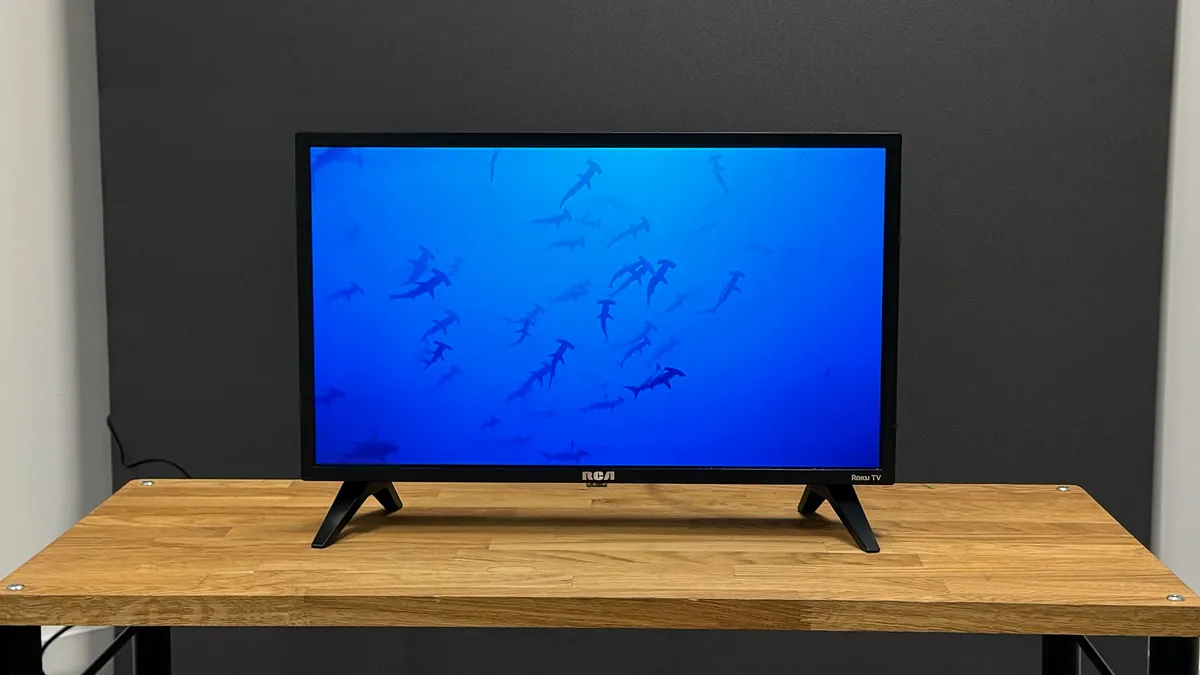

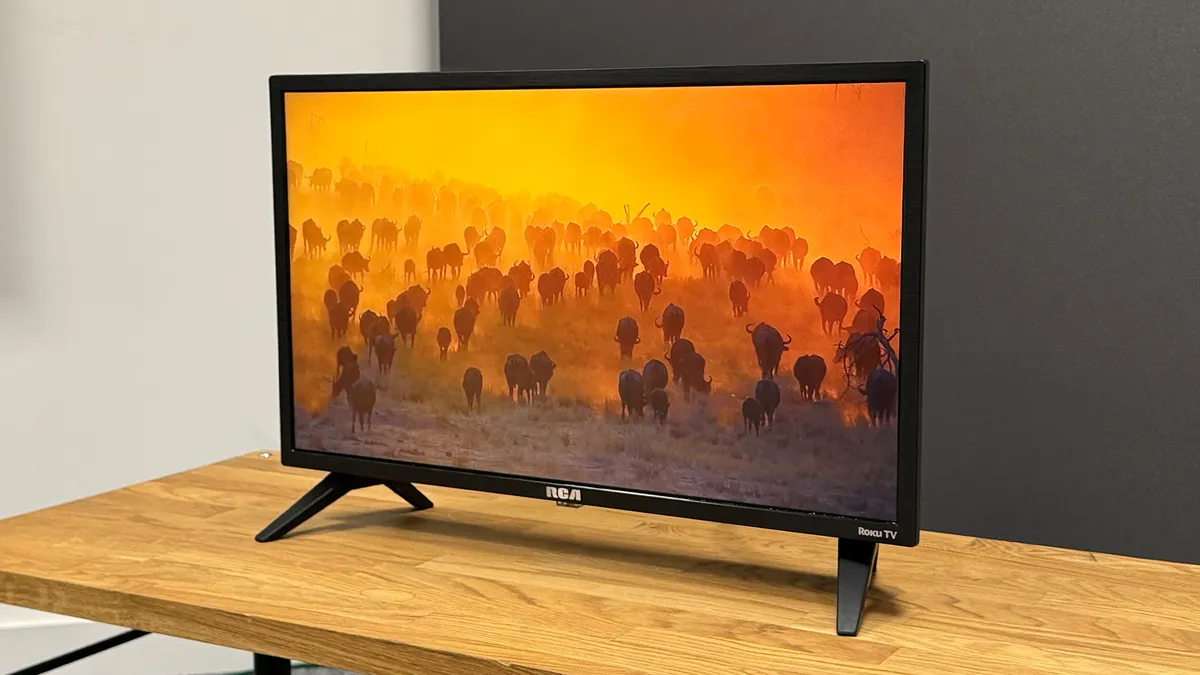


If you want an absolutely tiny TV for your kitchen or a smaller bedroom, where even 32-inches is a little too big, then we’d strongly recommend considering the 24-inch RCA Roku TV.
The tiny TV is fairly bare bones, featuring no HDR support and giant bezels. Its tiny speakers also undeniably struggle with even moderately challenging scenes, let alone our standard Blade Runner 2049 scene two, low-end stress test. But at this size, having tested as many 24-inch TVs as we could get our hands on we can safely confirm it’s the best you’ll get.
The Roku software means its got all the apps and smart features you’ll need for casual TV viewing while cooking or waiting to fall asleep. And despite its dinky dimensions and modest screen hardware the RC Roku TV is surprisingly bright and sharp, making casual Netflix viewing or catching up on the latest Bake Off episode a suitably pleasant experience. Hence our four star rating and conclusion:
“While its picture and sound are a touch too rough and ready to earn the RCA RK24HF1 Roku TV an unqualified recommendation, it picks its budget battles intelligently enough, with enough awareness of what most of its likely buyers will most want a 24-inch TV to do well. And this makes it, in the end, a much better bet than we’d expected it to be.”
Read our RCA Roku TV review
Best subscription TV


The Sky Glass Air offers a tempting proposition: a 65-inch TV costing less than a takeaway pizza per month. At the moment, you can buy the 65-inch model in monthly instalments with a Sky subscription plan, costing you just £13.
Note, though, that you can only get these prices if you also take on a Sky TV streaming subscription, which starts at £15 p/m for new customers. Plus, there’s also a one-off £20 up-front fee with all of the monthly payment options.
There is the option to purchase it outright, but the instalments will certainly appeal more to those on a budget.
Despite how affordable it is, the Sky Glass Air has a native 4K resolution and supports high dynamic range video. The HDR support extends beyond the HDR10 and HLG basics to Dolby Vision, too.
But what about its picture quality? Considering its low price tag, we find after having it in our test room that the Glass Air delivers a surprisingly balanced and natural picture performance. We say in our review: "The Glass Air’s sharpness and detail are also better than we’d expect to see from such a cheap TV, leaving you in no doubt that you’re watching a native 4K screen."
It's a pleasant surprise when it comes to sound, too, as the 65-inch model delivers a fairly convincing Dolby Atmos soundstage. If you're looking for a pleasant 65-inch TV without a hefty price tag, then this is a great choice.
Read our full Sky Glass Air review
Also consider
- Bush UT24SB (50UT24SB): If the Amazon Fire Omni TV is too much and you want a 55-inch set, the Bush UT24SB is the best alternative we’ve tested if picture quality is your primary concern.
- LG B4: OLED TVs by their nature aren’t cheap – which is why there isn’t one on this list. But if you are determined to get one, the LG B4 has been known to drop down to just below £500 on occasion. Still, it's the cheapest OLED model we have tested and can wholeheartedly recommend at this price.
How we choose
Value for money is a key element we consider in our cheap TV buying advice. It holds more weight in this list than others on the site, given its focus on the affordable end of the TV market. We gauge this by comparing the TV with other sets in the same price bracket and creating a median gauge of what we expect it to deliver as a baseline in key areas.
Picture quality is the other main factor we consider, even when talking about cheap TVs. Though cheaper sets often come with performance compromises, including slightly grey black levels, less accurate colours and occasionally issues with backlight uniformity, we still expect them to offer a competitive, entertaining viewing experience.
Sound quality is another key area we check. TVs in general struggle to deliver audio on a par with a decent soundbar, let alone speaker system. If you see our best cheap soundbars guide you will see a selection of cost-effective options that can radically improve your movie watching experience, even when buying a cheap TV. But we still check every cheap TV’s speakers during our testing process, and expect them to deliver a listenable experience.
Features and gaming performance are the final big areas we check before recommending a cheap TV. First we check its app support to make sure it offers all the mainstream services most TV owners want – these include big name services such as Netflix as well as local streaming platforms, such as BBC iPlayer in our native UK. Then we look at connectivity, and gaming support. Most current-generation games consoles need an HDMI 2.1 connection to run all their features, so this is an important factor if you own a PS5 or Xbox Series X/S.
How we test
We test cheap TVs using a constantly evolving methodology we have spent over half a century developing.
As in all our reviews, we always do comparative testing. This means we always review TVs directly against rivals and similarly priced sets we think readers would also be considering, in controlled conditions. This lets us make direct performance comparisons based on our real-world experience running the sets against one another. We never rely on our testers’ memories when making performance comparisons between cheap TVs.
To further ensure accuracy, every TV we review is looked at and tested by multiple members of staff. We never publish a cheap TV review without at least two members of the team having looked at it and compared notes.
Using this methodology we test picture quality by setting the TVs up side-by-side and splitting the signal using our reference AVR. We then test the picture at various qualities and HDR standards using an ever-evolving library of test 4K Blu-rays and shows/movies on streaming services. We update the specific titles used to ensure we reference the latest movies and TV shows people are watching at the time.
We also tailor the movie choices to test specific aspects of the TV's picture quality. We may use a scene mastered at an atypically high nit count to check maximum brightness and contrast, for example. Similarly, we would then use a very dark scene to test shadow detail and black level.
We do the same when testing audio. For example, we would use a very bass-heavy scene with rhythmically complex audio to test a TV speaker’s low-end performance and to see if it is prone to common problems such as distortion – a problem we often encounter on cheap TVs that makes them sound horrible at even moderately high volumes.
We check app support by checking the TV’s store and running through a list of services we expect it to offer. We then install all the supported services and check that they run all the HDR standards, resolutions and audio formats they should.
To test gaming performance we test the TV with a current generation Xbox Series X plugged in. As well as checking support for things such as VRR, ALLM and HDR performance we also measure input lag. The latter is a key issue that impacts how reactive the TV is to incoming commands from a controller.
Latest updates
- 5 March 2026: Added Sky Glass Air as best subscription TV.
- 3 February 2026: Removed TCL P755K as best 65-inch due to lack of availability.
- 18 November 2025: TCL P7K added as best 43-inch TV.
- 24 July 2025: Sharp GK4245K (70GK4245K) added as our recommended 70-inch affordable TV.
- 11 June 2025: Hisense replaced with Sharp GM6245K for 43-inch category.
- 3 March 2025: Added updates to OLED section in FAQs.
FAQ
Are you testing any new cheap TVs?
We tend to review cheap TVs in batches and base the ones we pick on a variety of factors. But to be considered the set needs to retail for around, but ideal less than £500 / $500 and be easily available to buy from mainstream retailers. We’re planning on getting a fresh batch in for review in the coming months to make sure our advice is as up to date and accurate as possible ahead of key shopping events, the nearest of which is Amazon Prime Day. If there’s a set you particularly want us to check out and add to our review pile, get in touch on social media, or using our shared whathifi@futurenet.com email address.
Are there any cheap OLED TVs?
OLED TVs are gradually coming down in price, especially if you’re willing to buy an older model. During sales events, including Prime Day and Black Friday we have seen top OLEDs drop in price by multiple hundreds. We even recently saw a big price drop on the LG B4 where it dipped to just below £500, but that was short-lived and quite the rarity. While we have not reviewed this specific model, we gave its predecessor the B3 a five star review.
Still, truly "cheap" OLEDs are few and far between. That’s why, despite their performance benefits, there isn’t any OLED currently available we can recommend in this best cheap TV guide.
Which brand makes the best cheap TVs?
The cheap TV market is currently incredibly competitive with multiple big-name and emergent brands vying for supremacy. Based on our testing, we recommend avoiding being too committed to one specific brand, as there are massive performance variations on a set-by-set and year-on-year basis. That means you can’t even trust one TV from the same brand’s line to perform comparably across all size points. This was most recently demonstrated by Amazon’s Fire TV Omni QLED line, where the smaller 43-inch model performed noticeably worse than its larger 50-inch sibling when we ran the two head to head. It’s better to do your research on the specific model you’re interested in than put all your faith in a brand.
Which cheap TV is best for gaming?
We currently recommend the larger sizes of the Amazon Fire TV Omni QLED for gamers on a strict budget. For the money, it has the most complete offering when it comes to connectivity, features and general picture quality. The 50-inch model retails for surprisingly little, is regularly on sale and comes with VRR and ALLM support across all four of its HDMI ports. The fact one of these is also eARC enabled means it is the only cheap TV on this list you can also send uncompressed Dolby Atmos audio through, making it a great choice for people with a compatible soundbar. The only downside is that, like all the cheap TVs we have tested, its panel goes up only to 60Hz. Many mid-range and flagship TVs now have faster 120Hz panels, that take full advantage of the PS5 and Xbox Series X/S increased graphical grunt.
Are cheap TVs good?
There are always fairly big performance disparities between cheap TVs. This is due to the lower specifications, less stringent quality assurance at a factory level and the like. This has always been the case since we started reviewing TVs. In recent years we have noticed the number of cheap TVs we consider “good” has been diminishing, which is why the majority of the sets in this guide are four, not five, star products.

