
2026 has been one of the most interesting and, if we're being brutally honest, exhausting years for TVs on record.
From the mainstream adoption of RGB Mini LED to cheaper OLED SE panels hitting the market, and the news of TCL essentially buying a majority stake in Sony's Bravia TV division, it's been a whirlwind.
And yet, there's been one manufacturer which has remained concerningly quiet up until now: Panasonic.
Rewind all the way to February (which feels like both a lifetime ago and strangely recent), when I flew to Munich to attend the Panasonic Experience 2026. At the event, the renowned Japanese consumer technology brand was showing off everything from air fryers, cameras and toothbrushes to Technics turntables, rice cookers and hair dryers.
TVs were also on show, and Panasonic made a huge announcement; just not the one I was expecting.
Now, it's an open secret that Panasonic's TV division has been struggling. At the lower end, it has struggled to keep up in a market now dominated by affordable 4K sets produced by the likes of Hisense and TCL. At the top, its prestigious OLED sets have seen tough competition from the likes of Sony, Samsung and LG: look at our recent lists of TV Award-winners, and it doesn't paint a pretty picture for the brand.
To rectify this, Panasonic announced that it was entering a strategic partnership with Shenzhen Skyworth, under its parent company Chuángwéi RGB, which would secure the future of its OLED, Mini LED and QLED sets in Europe.
The partnership was set to take effect on the 1st of April, and since the date came and went, Panasonic has been unnervingly quiet. Broadly speaking, its TVs have been out of stock at most retailers, and the one OLED TV it did announce, the Z86C, hasn't materialised.
Fast forward to IFA 2026, which took place earlier this month, and I was invited to the Panasonic TV booth to meet with Toshihiro Takagi (Product Planning, TV Business Division), Haruka Kono (TV Business Division) and Paul Williams (Press Relations) from Panasonic Corporation, as well as Paul Darch (CEO and Managing Director) and Sebastian Wegielski (General Manager Europe and Managing Director) from the newly formed SWMEU GmbH.
Reassurance, reorganising, and rebuilding

My discussion with representatives from Panasonic's new TV business centred mostly on what's happened over the past six months, and the short answer is that Panasonic has been incredibly busy behind the scenes.
It acknowledged that the April date originally planned was well behind us, but it wanted to get this partnership right, hence why it's been working hard to lay a strong foundation and hasn't rushed any TVs out to market.
The overall goal is to restore the brand's position within the European marketplace, with Panasonic eyeing up the number five spot within the pan-European market; hence why it needs to hit the ground running.
Development of the business has centred around four main pillars (which it originally shared during the Munich event): "The reference stays the reference", "Continuity you can trust", "Scaling Up" and "Innovation Pipeline". These are "the cornerstones of our strategy as we move forward", according to CEO Paul Darch.
They all seem fairly self-explanatory, but they are also key indicators as to what we can expect from Panasonic in the coming years.
The notion that Panasonic is eager to retain its position as a reference TV manufacturer is the first promising sign, and it recognises that OLED is the way to secure this legacy. It hasn't been shy in proudly proclaiming that its high-end OLED sets have been used by Hollywood editors and colourists, and it wants to keep that keep that status.
"What we mean by that is that what was once a Panasonic TV is still a Panasonic TV. The same guiding principles that govern picture, sound, design and OS continue", Darch said, which was reassuring to hear.
Doubling down on that, Darch also affirmed that "one of the key pieces of feedback that we receive is: will these Panasonic TVs really be Panasonic TVs? The answer is yes". Ultimately, based on what I've been told, the notion that future TVs will be any old set with a Panasonic badge slapped onto it can be dispelled.
Continuity is another major focus for this new partnership, hence why SWMEU GmbH has opened its head office in Wiesbaden, Germany, which is the city where Panasonic's European headquarters is located.
The innovation pipeline and scaling-up initiatives are where Panasonic really hopes to make up some ground, though. Broadening the product portfolio and bringing its TVs to market more quickly are two major priorities for the brand moving forward.
This already seems to be paying off, as Darch notes that "feedback, overwhelmingly, has been extremely positive; the market is requesting Panasonic to come back stronger as an evangelist of premium picture quality".
"OLED remains our leadership flagship"
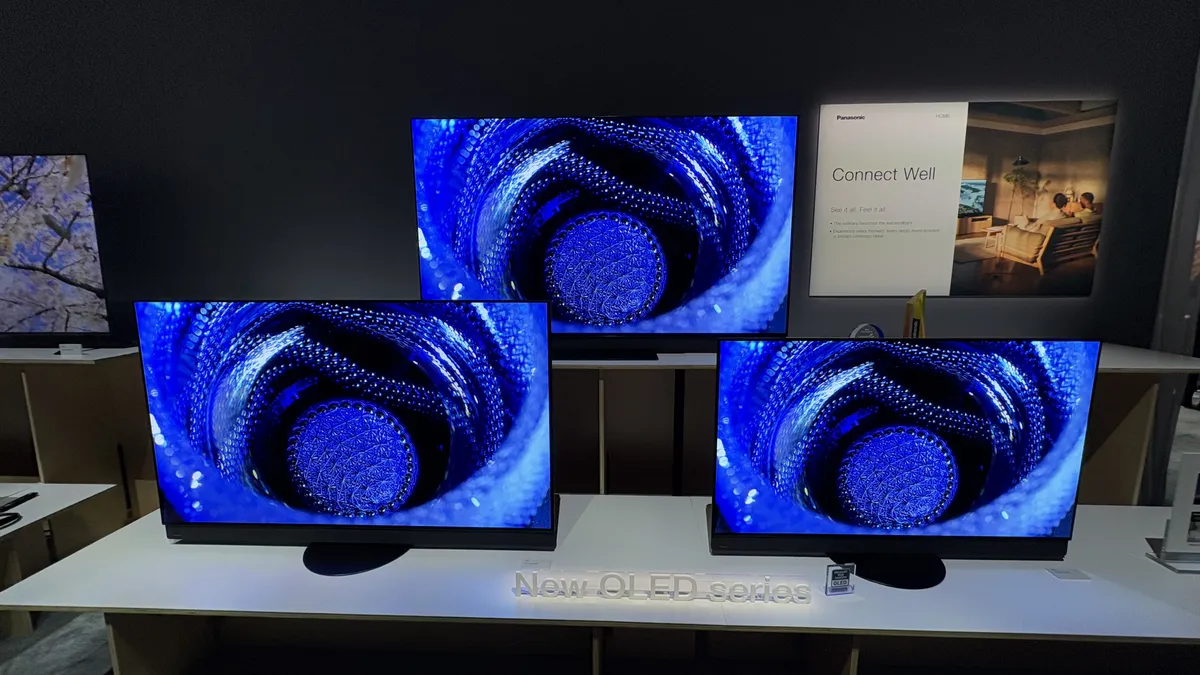
Retaining that title means keeping the technology that Panasonic is renowned for alive. Panasonic recognises this, and that's why it's keeping OLED as a "key focus" in its lineup.
Panasonic consciously didn't replace its Z95B and Z90B OLED TVs this year, and these five-star models will continue until Panasonic launches its 2027 lineup. That said, it also recognises the importance of QD Mini LED within the current TV market, but Darch affirms that Panasonic won't be "bringing it for the sake of bringing it".
Panasonic is relying on its glare-free technology and picture processing to differentiate it from the likes of Hisense and TCL in this market, but whether it will be enough to win back market share from rival powerhouse TV manufacturers is another matter.
I quizzed Panasonic on what to expect from its 2027 TV range, but it remained tight-lipped for now, telling me it will "probably around CES time is when you'll really see the strength and the power of this new organisation".
"The objective is to ensure that both the Japanese and the overseas lineup reflect a consistent Panasonic TV identity"

What was most apparent is that Panasonic wants to remind us that this isn't a buyout, but rather a collaboration that will ensure a future for Panasonic TVs in the UK and Europe.
"This is no short-term gimmick, no short-term collaboration. We are working strongly with the partnership for 2027 and onwards," Darch affirmed, continuing "I want you to leave the room having confidence in this collaboration".
He then handed over to Mr Toshihiro Takagi to discuss how this partnership works from Panasonic Japan's perspective.
"The objective is to ensure that both the Japanese and the overseas lineup reflect a consistent Panasonic TV identity", Takagi affirmed, and he continued to explain how each component of the business will work in tandem going forward.
Particularly with the brand's premium TVs, Panasonic's established engineers will continue to take responsibility for picture tuning and the integration work required for certification programmes (Panasonic has an established partnership with the picture calibration company Calman, for example).
"As a result, Panasonic's distinctive picture quality and modes continue to be incorporated into our TVs", Takagi confirmed.
This sentiment continues with sound, as I was assured that Panasonic's microphone-assisted audio calibration system will remain, and Takagi confirmed that the team is working on a new DSP algorithm for the 2027 models, which he mentioned in relation to a new speaker configuration.
Behind the scenes, Panasonic Japan has audited the manufacturing operations against the brand's approved criteria, which essentially means that Panasonic has ensured that the scaled-up manufacturing process meets its quality standards and expectations.
Panasonic Japan is still very much involved, by the looks of things, although it seems like Panasonic's engineers will have a much more direct involvement with the brand's future premium TVs, such as the theoretical follow-ups to the Z95B and Z90B.
A few questions remain...

While I did my best to eke out some information about next year's lineup, Takagi explicitly told me that "we cannot discuss future lineups or specifications today; we look forward to sharing more when the time is right".
Therefore, my questions relating to whether we can expect to keep seeing Technics-tuned sound systems in future flagship OLED sets, or if we can expect an RGB Mini LED from the brand in the future, were shelved for now.
That said, Darch rounded out our conversation with a simple yet powerful sentiment: "Panasonic TV is back. What does back mean? Back means a stronger product offering, stronger commercial and robust distribution strategy, a stronger team and backed with real resources for what really comes next".
Ultimately, the proof is in the pudding, and we'll need to see Panasonic's 2027 TV lineup in action to see if this partnership has achieved what it set out to create; but in the short term, I get the sense that Panasonic is alive and kicking.
MORE:
Read our full Panasonic Z95B review
As well as our Panasonic Z90B 48-inch review
And check out our picks for the best OLED TVs
