
You can’t have a conversation about the best TVs without mentioning Sony. In fact, if you’re reading these words, it’s likely because you want to know all about Sony’s new 2026 TV range. If so, hello – you’re in the right place.
This year, Sony’s lineup isn't built around brighter OLED panels or another incremental Mini LED upgrade. Instead, Sony is introducing its first True RGB televisions – a new type of Mini LED TV that replaces traditional white backlighting with individually controlled red, green and blue LEDs.
The company believes that this allows it to reproduce colours more accurately, while also delivering dramatically higher brightness than today's OLED TVs can achieve.
The exciting new display tech headlines the new Bravia 9 II and Bravia 7 II, but they're far from the only new TVs in Sony's range. More affordable Bravia 3 II and Bravia 2 II models also join the lineup (with some country-specific caveats), while several existing OLED and LED models continue alongside them.
The Sony tech headlines for 2026
Before we dive into the 2026 Sony TV models proper, here are the headlines across the range:
Embracing the RGB Mini LED revolution

For years, OLED has been regarded as the pinnacle of TV picture quality, but 2026 is shaping up to be the year RGB Mini LED goes mainstream.
Sony joins rivals including Samsung, Hisense, LG, Philips, and TCL in adopting the tech, though the company refers to its implementation as True RGB.
Instead of using conventional white or blue Mini LEDs behind a coloured panel, Sony's new system uses independently controlled red, green and blue LEDs.
The result, in theory at least, is a TV capable of producing richer colours at much higher brightness levels, while also improving colour accuracy and reducing some of the compromises traditionally associated with LCD panels.
Sony is chasing studio monitor picture quality

Sony has long claimed its TVs are designed to reproduce films and TV shows as their creators intended, and that philosophy remains central to its latest 2026 TV range.
The Bravia 9 II, for example, has been developed with Sony's professional BVM-HX3110 mastering monitor firmly in mind, with the company claiming its new True RGB technology delivers colours and brightness that more closely match the displays used by filmmakers during production.
During our early hands-on testing, our TV and AV Editor Tom Parsons found the Bravia 9 II tracked the mastering monitor remarkably closely in many scenes, particularly when it came to colour accuracy and HDR highlights. It’s worth noting that he also stated that OLED still retained certain advantages in perceived depth and overall image solidity.
Super-sized screens

Sony has also expanded its range of truly enormous TVs, with the flagship Bravia 9 II now stretching all the way up to a massive 115 inches, while the Bravia 7 II introduces a new 98-inch option.
Even the more affordable Bravia 3 II gains a 100-inch version for the first time, giving buyers who want a cinema-sized screen more options than ever before without necessarily stepping up to Sony's flagship models.
Sony has finally added four HDMI 2.1 sockets – but only on one TV
After years of criticism, Sony has finally introduced a TV with four full-bandwidth HDMI 2.1 ports. The rather bonkers catch? It's the Bravia 3 II, rather than one of the premium True RGB models.
That's right; both the flagship Bravia 9 II and step-down Bravia 7 II continue to offer just two HDMI 2.1 sockets, one of which doubles as the eARC connection for a soundbar or AV receiver.
Frankly, this seems an odd decision. Buyers investing in premium home cinema systems might not all be gamers, but certainly a sizeable chunk of them are. And even if they aren’t, it seems odd to have a superior connectivity feature on a model lower in the lineup. Right?
Welcome additions

While True RGB understandably grabs most of the attention, Sony has refreshed much of the wider user experience, too.
Across the new range, you'll find a redesigned remote control with automatic backlighting, USB-C charging and a construction that uses 80 per cent recycled plastic.
Sony has also introduced a new My Cinema interface that makes picture and sound settings easier to personalise, while Direct Connect allows compatible Sony rear speakers and subwoofers to connect wirelessly to supported TVs without the need for a soundbar.
Elsewhere, Dolby Vision, Dolby Atmos, DTS:X, Sony Pictures Core, Google TV and Wi-Fi 6 all remain key parts of the experience across much of the lineup.
Sony 2026 TV range breakdown
So, we've covered the key highlights, but what about the individual models themselves?
Fear not, for it's all broken down below – leading with the newest models, before covering all of Sony's existing TVs that are sticking around for 2026.
Sony Bravia 9 II

The Bravia 9 II replaces the original Bravia 9 as Sony's flagship TV, and also marks the company's first commercial RGB Mini LED (or 'True RGB') TV.
Available in 65-, 75-, 85- and colossal 115-inch sizes, it's designed to bring professional mastering-monitor levels of brightness and colour accuracy into the home.
Unlike conventional Mini LED TVs, which use blue or white LEDs behind an LCD layer, the Bravia 9 II uses independently controlled red, green and blue LEDs.
Sony claims that this setup delivers twice the colour volume of the original Bravia 9 and four times that of the Bravia 8 II OLED.
Elsewhere, gamers may be less enthusiastic. Despite being Sony's flagship TV for 2026, the Bravia 9 II still includes only two HDMI 2.1 sockets supporting 4K/120Hz, VRR and ALLM. It's an increasingly frustrating limitation when many rivals (including Sony’s own Bravia 3 II) now offer four full-bandwidth HDMI 2.1 ports.
Audio is another focus area, with Sony's 2.2.2-channel Acoustic Multi-Audio+ system including upward-firing speakers for Dolby Atmos and DTS:X.
That all sounds very exciting indeed, but we have now reviewed the Bravia 9 II, and while it's exceptionally accomplished for a backlit TV, it struggles somewhat to justify itself against the very best OLEDs, most notably Sony's own Bravia 8 II.
Read our Sony Bravia 9 II review
Sony Bravia 9 II specs:
- Sizes: 65, 75, 85 and 115 inches
- Display type: True RGB Mini LED
- Resolution: 4K
- Processor: XR Processor
- Sound: 2.2.2-channel (80W Acoustic Multi-Audio+)
- HDMI 2.1: Yes (x2)
- Gaming features: 4K/120Hz, VRR, ALLM
Sony Bravia 9 II launch pricing:
- Sony Bravia 9 II 65-inch: £3499 / $3600 / AU$5999
- Sony Bravia 9 II 75-inch: £4299 / $4600 / AU$7499
- Sony Bravia 9 II 85-inch: £5499 / $6500 / AU$9999
- Sony Bravia 9 II 115-inch: £22,999 / $31,000 / AU$44,999
Sony Bravia 7 II

The Bravia 9 II may grab most of the headlines, but the Bravia 7 II could end up being the more important TV for most people.
Like its flagship sibling, it adopts Sony's new True RGB backlighting technology, bringing the same fundamental advantages of wider colour reproduction and higher brightness to a considerably lower price point. It also comes in a much broader range of sizes, stretching from 50 inches all the way up to a huge 98-inch version.
Naturally, there are compromises.
Sony positions the Bravia 7 II below the Bravia 9 II by reducing the number of local dimming zones, lowering peak brightness and fitting a simpler 2.2-channel Acoustic Multi-Audio speaker system that omits the flagship's upward-firing Atmos drivers.
The gaming front is also unchanged. Like the 9 II, the Bravia 7 II still relies on Sony's Pentonic 1000 platform, meaning buyers again have just two HDMI 2.1 ports despite support for features such as 4K/120Hz gaming, VRR and ALLM.
On paper, the Bravia 7 II looks like a very tempting performance-per-pound proposition, but like the Bravia 9 II, we feel most buyers will be better served by a similarly priced OLED.
Read our Sony Bravia 7 II review
Sony Bravia 7 II specs:
- Sizes: 50, 55, 65, 75, 85 and 98 inches
- Display type: True RGB Mini LED
- Resolution: 4K
- Processor: XR Processor
- Sound: 2.2-channel (40W Acoustic Multi-Audio)
- HDMI 2.1: Yes (x2)
- Gaming features: 4K/120Hz, VRR, ALLM
Sony Bravia 7 II launch pricing:
- Sony Bravia 7 II 50-inch: £1899 / $1600 / AU$2299
- Sony Bravia 7 II 55-inch: £1999 / $2100 / AU$2499
- Sony Bravia 7 II 65-inch: £2299 / $2600 / AU$3299
- Sony Bravia 7 II 75-inch: £2999 / $3100 / AU$4499
- Sony Bravia 7 II 85-inch: £3999 / $4000 / AU$5999
- Sony Bravia 7 II 98-inch: £6999 / $9000 / AU$12999
Sony Bravia 3 II

Not everyone needs a flagship TV, and Sony clearly hasn't forgotten that.
The Bravia 3 II sits much further down the company's 2026 range, swapping the cutting-edge True RGB backlight found in the Bravia 9 II and Bravia 7 II for a more conventional LED panel.
That naturally means it won't deliver the same dazzling brightness, colour volume or local dimming performance as its premium siblings, but it still benefits from many of Sony's broader software and smart TV improvements.
Google TV remains at the heart of the experience, providing access to all of the major streaming services alongside built-in Google Cast support, voice control and Sony's familiar smart TV interface.
One particularly notable addition for 2026 is the availability of a huge 100-inch version – the first time Sony has offered the Bravia 3 range in such a large screen size. That could make it an appealing option for buyers wanting an enormous display without paying flagship prices.
As mentioned a few times already (you’ve probably guessed by now that there are a few gamers in the What Hi-Fi? office), the Bravia 3 II actually outdoes its more expensive siblings in one important area – it offers four HDMI 2.1 ports. For users with multiple current-generation consoles, gaming PCs and soundbars, that could prove more than a little useful.
Of course, you shouldn't interpret that as meaning the Bravia 3 II is somehow a better gaming TV than the flagship models overall. Picture quality remains the priority higher up the range, and the lack of Mini LED or True RGB technology means HDR performance won't be in the same league.
But if connectivity is high on your wishlist, it's an unusual advantage that shouldn't be overlooked.
Rather bizarrely, though, the Bravia 3 II is not currently scheduled for launch in the UK.
Sony Bravia 3 II specs:
- Sizes: 43, 50, 55, 65, 75, 85 and 100 inches
- Display type: Direct LED LCD
- Resolution: 4K
- Processor: XR Processor
- Sound: 2.0-channel (X-Balanced Speaker)
- HDMI 2.1: Yes (x4)
- Gaming features: 4K/120Hz, VRR, ALLM
Sony Bravia 3 II launch pricing:
- Sony Bravia 3 II 43-inch: £n/a / $600 / AU$1299
- Sony Bravia 3 II 50-inch: £n/a / $700 / AU$1399
- Sony Bravia 3 II 55-inch: £n/a / $800 / AU$1499
- Sony Bravia 3 II 65-inch: £n/a / $900 / AU$1899
- Sony Bravia 3 II 75-inch: £n/a / $1200 / AU$2399
- Sony Bravia 3 II 85-inch: £n/a / $1600 / AU$3499
- Sony Bravia 3 II 100-inch: £n/a / $3100 / AU$5499
Sony Bravia 2 II

The Bravia 2 II completes Sony's 2026 range as its most affordable new television.
Like the Bravia 3 II, it uses a conventional LED backlight rather than Mini LED, making it the entry point into Sony's latest lineup. Buyers still get Google TV, built-in Google Cast, access to all the major streaming platforms and Sony's familiar smart TV experience, but the focus here is very much on value rather than cutting-edge picture technology.
Available in a wide range of sizes from compact 43-inch models up to larger living room-friendly options, the Bravia 2 II is aimed at people who simply want a dependable Sony TV without paying for premium display hardware they'll rarely use. It's likely to prove particularly attractive for bedrooms, guest rooms and more budget-conscious buyers who still appreciate Sony's picture processing and straightforward interface.
While it will naturally lack the spectacular brightness and colour performance of the True RGB models, Sony hasn't stripped away the essentials. Google TV, voice control and support for today's most popular streaming services remain intact, making it an accessible entry point into the Bravia family.
Sony Bravia 2 II specs:
- Sizes: 43, 50, 55, 65 and 75 inches
- Display type: Direct LED LCD
- Resolution: 4K
- Processor: X1 Processor
- Sound: 2.0-channel
- HDMI 2.1: No (HDMI 2.0b x3)
- Gaming features: ALLM
Sony Bravia 2 II launch pricing:
- Sony Bravia 2 II 43-inch: £629 / $400 / AU$1099
- Sony Bravia 2 II 50-inch: £749 / $500 / AU$1199
- Sony Bravia 2 II 55-inch: £899 / $600 / AU$1299
- Sony Bravia 2 II 65-inch: £1199 / $700 / AU$1699
- Sony Bravia 2 II 75-inch: £1399 / $900 / AU$2199
Older Sony TVs continuing in the lineup
Sony's 2026 range isn't made up entirely of new models. Alongside the latest Bravia launches, Sony is continuing to sell several existing OLED and Mini LED models.
Sony Bravia 8 II

While the Bravia 9 II is Sony's flagship LCD TV, the Bravia 8 II sits at the top of the company's OLED range. Despite its name, it isn't a replacement for the Bravia 8. Instead, it succeeds the A95L, with the Bravia 8 continuing lower down the lineup.
It uses Sony's latest QD-OLED panel, paired with the XR Processor and Acoustic Surface Audio+ sound system. Like the Bravia 9 II, gaming support includes 4K/120Hz, VRR and ALLM, though there are still only two HDMI 2.1 sockets.
If you're deciding between Sony's two flagship TV technologies, the choice is fairly straightforward. The Bravia 9 II prioritises brightness and very large screen sizes, while the Bravia 8 II focuses on OLED's pixel-level contrast, and perfect blacks.
Read our Sony Bravia 8 II review
Sony Bravia 8 II specs:
- Sizes: 55 and 65 inches
- Display type: QD-OLED
- Resolution: 4K
- Processor: XR Processor
- Sound: Acoustic Surface Audio+
- HDMI 2.1: Yes (x2)
- Gaming features: 4K/120Hz, VRR, ALLM
Sony Bravia 8 II prices:
- Sony Bravia 8 II 55-inch: £1799 / $3300 / AU$3999
- Sony Bravia 8 II 65-inch: £2299 / $2600 / AU$3299
Sony Bravia 8
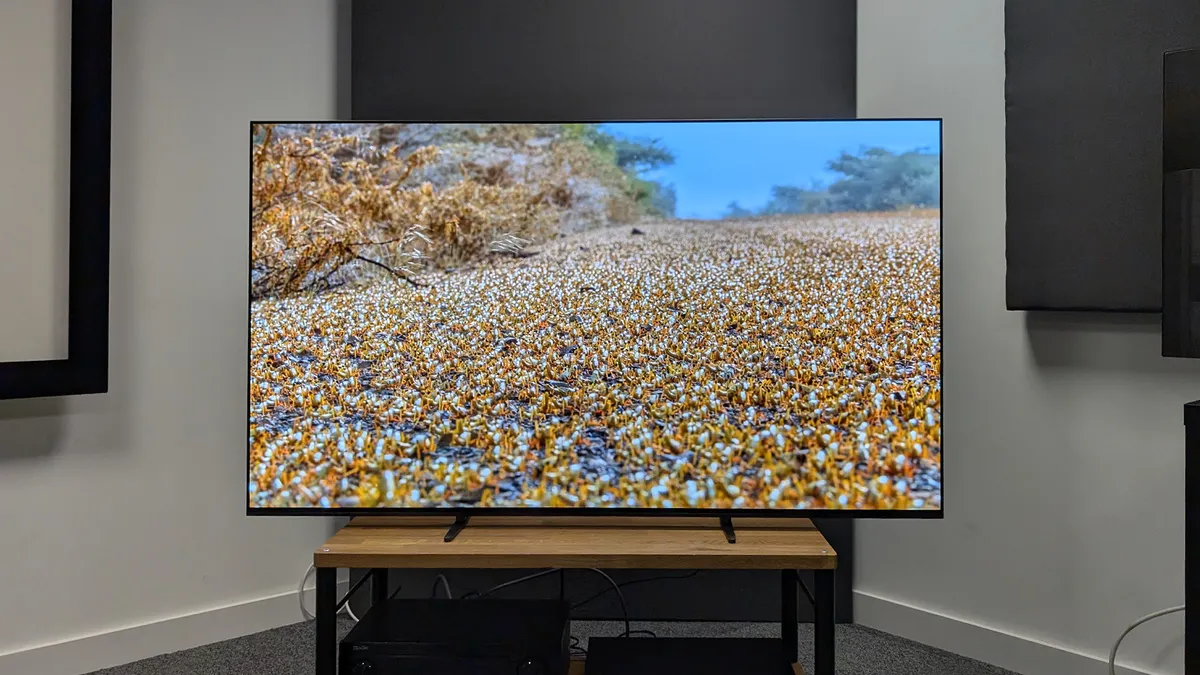
The Bravia 8 remains one of Sony's core OLED TVs and continues in the lineup alongside the newer Bravia 8 II. Originally launched as the successor to the award-winning A80L, it combines a 4K WOLED panel with Sony's XR Processor and Acoustic Surface Audio+ technology.
Like the Bravia 8 II, it supports Dolby Vision, Dolby Atmos, 4K/120Hz gaming, VRR and ALLM, though only two HDMI inputs are HDMI 2.1.
Available in 55-inch, 65-inch and 77-inch sizes, it continues to offer a premium OLED option for buyers who don't need Sony's flagship QD-OLED model.
Read our Sony Bravia 8 review
Sony Bravia 8 specs:
- Sizes: 55, 65 and 77 inches
- Display type: OLED
- Resolution: 4K
- Processor: XR Processor
- Sound: Acoustic Surface Audio+
- HDMI 2.1: Yes (x2)
- Gaming features: 4K/120Hz, VRR, ALLM
Sony Bravia 8 prices:
- Sony Bravia 8 55-inch: £1399 / $1600 / AU$2499
- Sony Bravia 8 65-inch: £1799 / $2000 / AU$2999
- Sony Bravia 8 77-inch: £2699 / $3000 / AU$4499
Sony Bravia 8A

The Bravia 8A is a variant of the Bravia 8, rather than an all-new TV. Sony says that it delivers identical picture and sound performance, with the only differences being a non-backlit remote control and fewer Sony Pictures Core streaming credits.
Available in the same three sizes as the Bravia 8, the Bravia 8A gives buyers another option if pricing differs between the two models. If it's noticeably cheaper, it could prove the better buy, given that Sony says performance is otherwise unchanged.
Sony Bravia 8A specs:
- Sizes: 55, 65 and 77 inches
- Display type: OLED
- Resolution: 4K
- Processor: XR Processor
- Sound: Acoustic Surface Audio+
- HDMI 2.1: Yes (x2)
- Gaming features: 4K/120Hz, VRR, ALLM
Sony Bravia 8A prices:
- Sony Bravia 8A 55-inch: £1199 / $N/A / AU$N/A
- Sony Bravia 8A 65-inch: £1499 / $N/A / AU$N/A
- Sony Bravia 8A 77-inch: £2399 / $N/A / AU$N/A
Sony Bravia 5

The Bravia 5 continues as Sony's most affordable Mini LED TV, offering a step up from conventional LED sets without the price of the company's flagship models.
Combining Mini LED backlighting with Sony's XR Processor, it brings many of the company's premium picture-processing features to a wider audience.
Available in sizes from 55 inches up to a huge 98 inches, the Bravia 5 also supports Dolby Vision, Dolby Atmos, 4K/120Hz gaming, VRR and ALLM. As with many Sony TVs, only two HDMI inputs support the full HDMI 2.1 specification.
If you're looking for a Sony Mini LED TV without stretching to one of the company's flagship models, the Bravia 5 remains a compelling option.
Read our Sony Bravia 5 review
Sony Bravia 5 specs:
- Sizes: 55, 65, 75, 85 and 98 inches
- Display type: Mini LED LCD
- Resolution: 4K
- Processor: XR Processor
- Sound: Acoustic Multi-Audio (40W)
- HDMI 2.1: Yes (x2)
- Gaming features: 4K/120Hz, VRR, ALLM
Sony Bravia 5 prices:
- Sony Bravia 5 55-inch: £1099 / $1400 / AU$1699
- Sony Bravia 5 65-inch: £1299 / $1500 / AU$1999
- Sony Bravia 5 75-inch: £1599 / $2000 / AU$2499
- Sony Bravia 5 85-inch: £1999 / $2400 / AU$2999
- Sony Bravia 5 98-inch: £4499 / $5000 / AU$5999
Sony A90K

The A90K remains Sony's premium small-screen OLED, offering buyers a high-end option in 42-inch and 48-inch sizes. Powered by the Cognitive Processor XR, it combines a 4K OLED panel with Sony's Acoustic Surface Audio+ sound system and Google TV.
Gaming features include 4K/120Hz, VRR and ALLM, with two HDMI 2.1 inputs available. While Sony's newer OLEDs deliver improvements in brightness and overall performance, the A90K remains a premium OLED choice for anyone who wants a more compact TV.
Sony Bravia A90K specs:
- Sizes: 42 and 48 inches
- Display type: OLED
- Resolution: 4K
- Processor: Cognitive Processor XR
- Sound: Acoustic Surface Audio+
- HDMI 2.1: Yes (x2)
- Gaming features: 4K/120Hz, VRR, ALLM
Sony Bravia A90K prices:
- Sony A90K 42-inch: £1399 / $1300 / AU$n/a
- Sony A90K 48-inch: £1499 / $1400 / AU$n/a
MORE:
Check out our Hands on: Sony Bravia 9 II review
Decisions, decisions... Sony Bravia 3 vs Sony Bravia 5: which is the best value Sony TV?
Here are the best TVs you can buy right now

