
KEF touted its LS Luxe wireless active speaker system as its “most ambitious creation to date”, and it has certainly been a success in our test rooms.
Costing £3500 / $4000 / AU$6375, the LS Luxe is a more premium proposition than the established £2199 / $2999 / AU$4295 price of the LS50 Wireless II, but the clear step up in performance means that, to our ears, the LS Luxe justifies that considerable extra outlay.
Boasting a distinctively curved aesthetic designed in collaboration with artist Ross Lovegrove, the LS Luxe has ticked all of the right boxes, and gained five stars from us across the board for its excellent standard of construction, vast feature suite and refined, authoritative sound.
To explore the process that brought KEF’s latest creation into the world, delve deep into the technologies behind it, and discover what marks the Luxe out as distinct from its stablemates, we spoke to KEF’s Senior Vice President and Chief Technology Officer, Dr Jack Oclee-Brown, to shine a light on the five-star LS Luxe.
KEF’s journey to active speaker systems
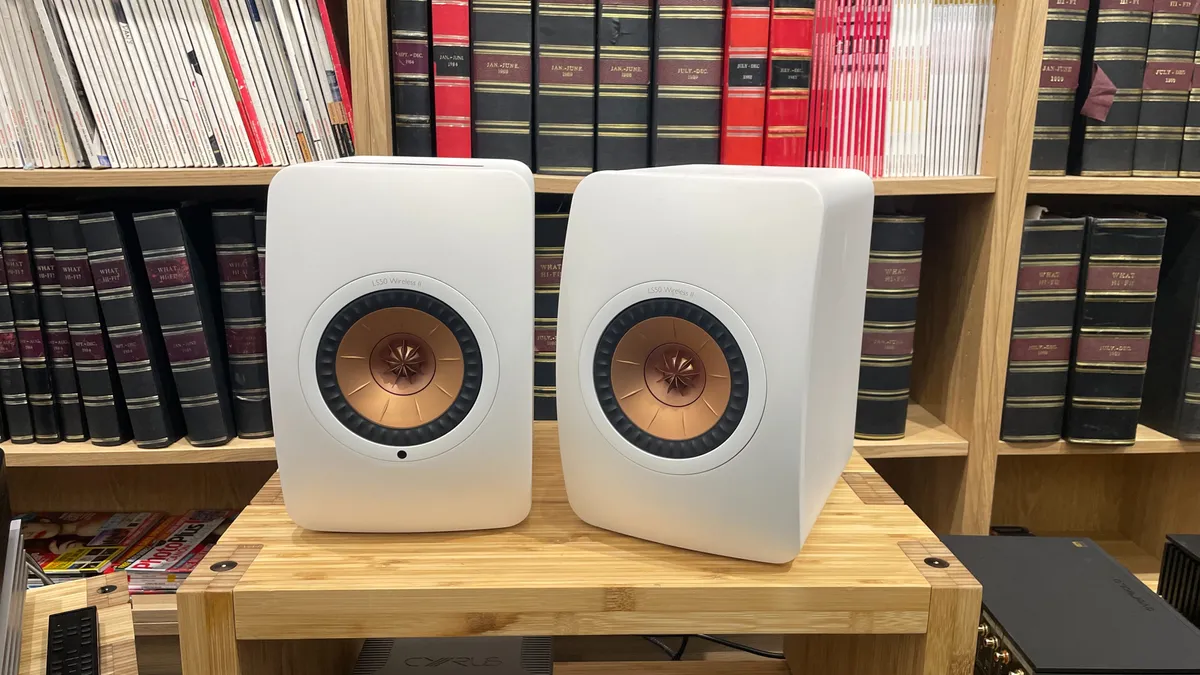
To understand how we arrived at this point, a brief history lesson is in order. After its founding in 1961, KEF’s first speaker was the K1, a three-way monitor with a polyester ‘Melinex’ dome, followed soon after by the original Celeste bookshelf unit and, in the 1970s, the legendary BBC LS3/5A studio monitors.
In the late 1980s, KEF released the C35 standmounter, the first of its speakers to use the now-iconic Uni-Q array, the same array (subsequently refined and amended over the years) that you will find at the heart of the LS Luxe.
More immediate heritage naturally stems from KEF’s recent success in producing full-blooded wireless stereo systems, starting in 2018 with the LS50 Wireless and refined a few years later with the Award-winning LS50 Wireless II.
Housing amplification, streaming and an extensive connectivity suite into a pair of speakers clearly came rather naturally to KEF since the launch of the LS50 Wireless, with later models, such as the LSX II and LSX II LT, garnering further plaudits.
KEF’s success at blending performance with streaming features and built-in amplification is established, and it’s the lessons taken from the successes of the brand’s active streaming speakers which have been instrumental in the development of the LS Luxe.
According to Dr Jack Oclee-Brown, “We’ve always had a strong belief in the technical advantages of active speakers. A key tenet of this is that active and passive loudspeakers shouldn’t necessarily have the same configurations of drivers or technologies.
As he explains, the development of KEF’s active and streaming-capable speakers requires bespoke technologies and design concepts: “We have an aggressive research plan that’s targeting technologies for active speakers. The algorithms are continually improved and are several generations more advanced than in our early active speakers. Our aim is to widen the performance difference between active and passive.”
So, why active wireless systems? It might seem like an odd question, but it’s a big part of KEF’s present and, most likely, its future.
Oclee-Brown explains that part of the reason is ease of use for the consumer. “Active systems are simpler; they don’t require the customer to have any prior experience of hi-fi and no other partnering equipment. The customer makes one purchase, and that’s all they need.
“I believe KEF appeals to hi-fi fans who are looking for cutting-edge performance and the very latest acoustic technology. There are many people who enjoy music and, at KEF, we are also trying to make products that will allow this audience to enjoy their music more deeply. This has been one of the driving factors behind KEF’s active streaming loudspeaker push over the past decade.”
There are advantages on the side of the manufacturer, too.
“From a technical perspective, active speakers have huge advantages, which allow us to make active speaker systems that can outperform a traditional hi-fi system of the same total price.
“It’s even more true today because we have spent the past ten years developing new acoustic technology specifically for active loudspeakers, such as ‘Uni-Core’ and ‘Velocity Control Technology’.” We’ll get to those in a moment.
A smooth operator

It’s hard to talk about the LS Luxe and not mention the design. Before you have listened to a single note from KEF’s new system, you’re probably going to have strong feelings about its curved, almost egg-like speaker cabinets.
We keep our egg-based comparisons to ourselves when asking KEF about its choice to once again collaborate with Ross Lovegrove, the Welsh designer with whom KEF previously joined forces when developing its big-money Muon floorstanders.
According to KEF, the LS Luxe’s design is a blend of the functional, the luxurious and the natural. Says Oclee-Brown: “Ross’s style is very organic, and he uses a lot of shapes inspired by nature. For the LS Luxe, his was an excellent match and resulted in a form that works extremely well from a performance perspective.”
That last part is crucial, as the speakers’ design goes beyond mere looks. Those curved edges seek to improve performance by reducing build-up of standing waves within the cabinet, while durable ‘Bulk Moulded Compound’ (BMC) composite material reduces the need for excessive internal bracing, allowing for greater internal volume within the speakers to aid their low-frequency response.
Oclee-Brown gives us a more detailed explanation as to just how much difference the speakers’ rounded form makes. The smooth shape “reduces diffraction, where sound tends to scatter from sharp edges, and this gives much smoother on- and off-axis performance, leading to the impressive and three-dimensional soundstage.”
For KEF, those rounded exteriors are key to both the LS Luxe’s look and sound.
A Luxe for life

While the LS Luxe has been a success in our test rooms, we are keen to hear how the team behind it perceive their latest creation.
In terms of prospective buyers, KEF believes “there is demand for a higher-performance stand-mount active wireless speaker that is a step up from LS50 Wireless II,” allowing for the introduction of technologies such as VECO and the implementation of that more distinctive design.
The LS Luxe is clearly billed as a step up from the LS50 Wireless II, but what’s interesting to hear is how KEF’s perception of the LS Luxe during its development marries closely to the resultant sound we experience in our listening rooms. We press Oclee-Brown to see if there is such a thing as ‘KEF’ sound, something which he describes as “wide-bandwidth, low colouration and evenly balanced”.
Admittedly, that matches up with what we have heard during our test time. We describe the LS Luxe as being “gratifyingly unfussy about placement” thanks to its “supremely well-integrated sound”. It’s a quality that tallies with KEF’s aim during development “to produce loudspeakers that work well in a wide range of rooms and with a wide range of music”.
Oclee-Brown expands upon that tuning philosophy further, explaining that a KEF speaker “can be listened to for long sessions without being fatiguing. All KEF products follow the same tuning philosophy, and as we develop new technologies or improve our facilities, the KEF sound evolves, but we still have the same overall target.”
We wonder if the tuning of this latest project in any way diverged from that established KEF philosophy, sensing a desire for evolution rather than revolution.
As KEF’s CTO further explains: “The specifics of each product, such as the size, shape, drivers, and technology package, do have an impact on the final tuning. However, we do try to remain faithful to our KEF tuning philosophy, and the outcome is that the sound signature is broadly consistent across the whole KEF speaker range.”
Again, that comes as little surprise. The LS Luxe may outshine the likes of the LSX II and the LS50 Wireless II, but the sound still exhibits the even, balanced, and refined signature of its more affordable antecedents.
The technical innovations behind the sound

A lot has gone in to creating the LS Luxe, and we get a sense that after six years of research and development, there was a desire to push beyond the boundaries of what came before.
KEF has either integrated new technologies or refined its established designs to do so. The integration of its 12th-generation Uni-Q driver array is at the heart of each speaker; it is backed by KEF’s heralded Metamaterial Absorption Technology (MAT), which absorbs rearward sound from the back of the tweeter dome.
If you’ve already read our review, you might have noticed that each speaker draws on two distinct types of amplification. With our nerdy engineer’s hat on, we probe for an answer as to why:
“One of the huge advantages of an active speaker is that there is one dedicated amplifier for each driver. We use a Class D amplifier for the low-frequency driver, which means we can have high power and high efficiency.
“For the high-frequency driver, we are using a class-A/B amplifier, which avoids switching artefacts and gives a very wide bandwidth. In both cases, the amplifiers are highly customised to the driver they are connected to.”
Notably, this is also the first speaker or speaker system to feature KEF’s ‘Velocity Control Technology’, as seen in the brand’s five-star XIO soundbar. ‘VECO’ measures the speed of the cone movement, compensating for any differences between that and the expected value in real time to reduce distortion levels.
The implementation makes sense. With KEF touting its new system as a simple, easy-to-use solution that can handle the demands of a separates hi-fi system while filling up a listening room, the Luxe needs to be able to handle the sonic demands placed upon its rounded shoulders.
As Dr Oclee-Brown explains, Veco technology has “the dual target of increasing bass output from small speakers, or reducing distortion in conventionally sized speakers such as the LS Luxe.
“In addition, it allows us to use current-output amplifiers, which also give a significant midrange distortion reduction and eliminate power compression.”
We get a feel for that ability in our test rooms. As we say in our review, “the scale and authority showcased belie the Luxe’s compact form, serving up a rendition of Hans Zimmer's Why Do We Fall? that soars… with power, scope and grandeur.”
Integrated systems, be they active, wireless stereo systems or all-in-one units, are becoming ever more popular at a time when modern music fans are increasingly seeking a blend of performance, convenience and ease of use.
The LS Luxe feels like the culmination of KEF’s desire to “appeal to hi-fi fans who are looking for cutting-edge performance and the very latest acoustic technology” in a more user-friendly design.
And we think it might have a hit on its hands. The LS Luxe is undoubtedly pricey, but from what we have heard, it’s an impressively strong alternative to an equivalent separates hi-fi system that could quite easily cost a good deal more.
MORE:
Read our review of the more affordable KEF LS50 Wireless II
Hi-fi in 2076? How engineers envisage the next 50 years of music listening
Best active speakers: our experts pick the top pairs with integrated amplifiers

