As celebrating milestone anniversaries typically involves reflecting on the early years, it’s only natural that, as part of our 50th anniversary celebrations this year, we have backpedalled to the ’70s with the dedication of a Led Zeppelin documentary.
We have looked back at the first issue of What Hi-Fi?, picked the 50 best hi-fi and AV products since 1976, and asked hi-fi brands for their perspectives on the biggest shifts in music and hi-fi during our 50-year lifetime. But as nice, warm and fuzzy as it is basking in nostalgia, it’s arguably more exciting to peer into the unknown and take an educated guess at what could lie ahead.
It’s difficult to imagine the music and hi-fi landscapes going through as many changes in the next 50 years as they have done in the past 50, where tactile, analogue and vinyl-led listening has largely transitioned into phone-controlled, digital and networked streaming.
But with those industries currently standing at The Crossroads of Innovation, with AI and spatial audio seeming to be the most brightly lit paths, you’d be brave to bet against that. So, what will hi-fi and music playback look like in 2076? We asked a handful of the most forward-thinking figures in hi-fi to rub their crystal balls…
Highly intelligent systems

Today, with varying degrees of success, spatial audio is challenging the stereo format. Music production and playback are no longer strictly ‘channel’-based, whereby sounds are allocated to and played through specific speakers.
Now, through audio-processing techniques, sounds can be ‘placed’ anywhere in an all-encompassing ‘3D’ soundfield, replicating how the human ear hears everyday sounds.
At the same time, artificial intelligence (AI) is brewing up a storm in the music industry by giving anyone the means to use AI music creation software to create full, unique songs with little effort, guidance and, in the traditional sense of music-making, talent.
Such machine-driven algorithms are also driving how we discover and play songs on streaming services, as well as playing an increasing part in how audio systems can adapt playback to their environments and listeners’ EQ preferences.
Both disruptive technologies feel very much in their infancy and will undoubtedly play a significant part in the future, as WiiM’s CEO, Dr Lifeng Zhao, discusses.
“Over the next 50 years, hi-fi will evolve from a collection of fixed components into an intelligent, adaptive acoustic system,” says Zhao. “Speakers will understand the room, the listener's position and even individual hearing characteristics, continuously optimising sound while preserving the artist's intent.
“The most exciting future is not technology that colours the music, but technology that disappears – removing the room, set-up complexity and compatibility barriers between the listener and the performance.”

Touraj Moghaddam, Vertere Acoustics’ CEO, agrees that everyday music playback will be defined by computational intelligence, even envisioning a future audio landscape that wouldn’t look out of place in a new Black Mirror episode.
“I doubt we will ‘put something on’ any more,” he says. “Music will be woven into the environment itself – ambient systems reading mood, activity, even biometrics, and shaping the sonic atmosphere accordingly. Home, car, glasses – even some unnoticeable ‘earwear’ – will simply handle it.”
While AI already curates playlists based on your listening history and voice prompts, Moghaddam believes streamed music will in future be generated in real time to suit specific moments, such as times of day.
“Choosing an album to play while cooking may feel as quaint to future listeners as tuning an analogue radio dial feels to us now,” says Moghaddam. “And I suspect streaming as we currently know it – scrolling through apps and pressing play – will disappear.
“In hindsight, it will likely look like a clunky transitional phase, much as the CD era now appears: functional, slightly soulless and ultimately superseded.”
Interestingly, however, despite envisioning a future shaped by AI and streaming, he believes that human artistry and album concepts will survive – just not as we know it today. “If anything, it will make it more precious,” he says.
“A body of work that builds and develops speaks to something different in us than a shuffled queue. An ‘album’ in 2075 might be an hour-long spatial composition you move through, or a piece that adapts slightly depending on who’s listening and when. But the underlying instinct – an artist making a considered statement – should remain, because artists will always want to make one.”
Moghaddam also predicts a dominance and progression of immersive audio beyond what Dolby Atmos and binaural audio technologies currently offer; an experience that is more personalised to the room and listener, possibly also expanding to other senses.
“Something closer to bone-conduction blended with room-filling soundfields, perhaps with haptic elements,” he foresees.
“An orchestra wouldn’t simply play for you; you’d sit inside it, instruments arranged around and behind you, or even move yourself around for a different perspective. Habitats could even have these built into their architecture.”
Sound quality secondary?
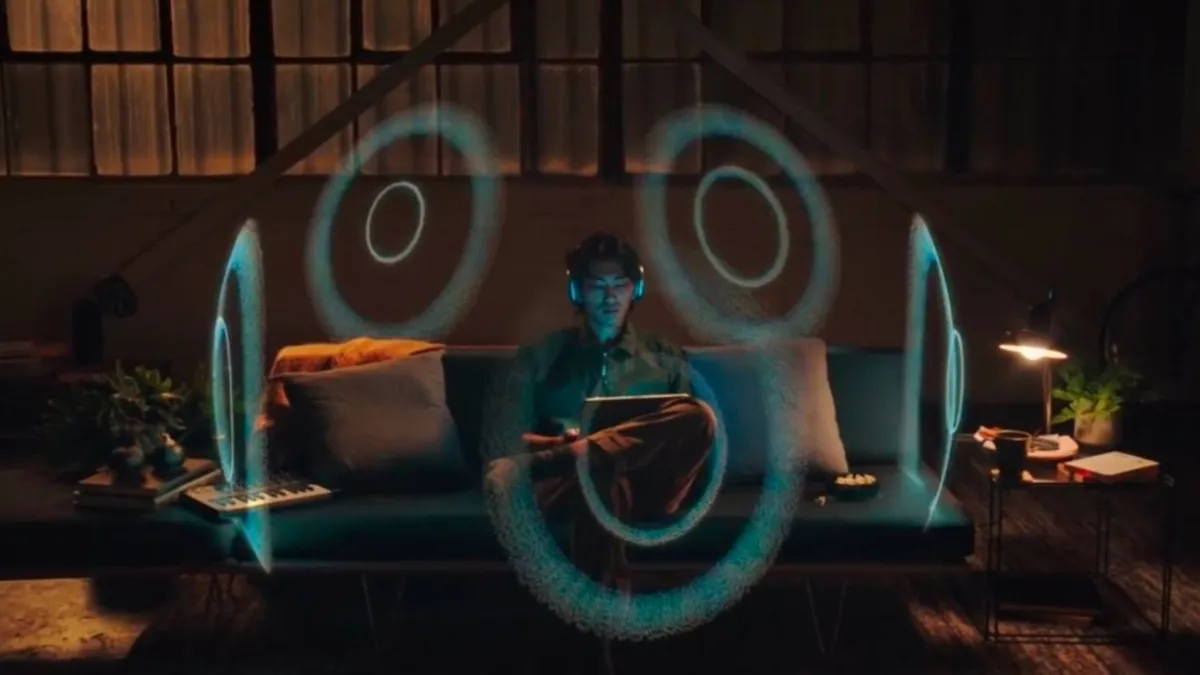
A futuristic picture? Yes, but far from an unrealistic one. Machine intelligence, spatial audio, haptic interaction… but where does that leave sound quality?
Matt Bartlett, managing director of Chord Electronics, recognises the history of the hi-fi cycle “moving from the best-quality listening to simpler systems, but at the detriment of sound reproduction, and then back again once consumers realise what they are missing,” and he doesn’t see that changing in the next 50 years.
“Clearly audio – especially wireless transmission systems – has the capability to improve dramatically,” he says. “Luckily, a large proportion of listeners still strive for different listening set-ups and look for the next best thing, and engineering will have to lead this and provide new solutions and a constant evolution of existing audio components to meet this need.
“Ultimately, the goal of any audio engineering team is to produce a product that can reproduce the original sonic performance in the most accurate way possible. So with advances in technologies, I hope that in 50 years we have the designs to do this perfectly so that the listener cannot tell the difference between the live performance or a recording, and playback.”
Like Bartlett, Paul Neville, senior director of Harman Luxury Audio’s Global Engineering team, also believes higher-quality sound, driven by environmentally sustainable product designs and energy-efficient technologies, will play a major part in the future of hi-fi as melomaniacs and audiophiles look for “time off from the ‘connected’ digital world”.
He envisions more pointed focus “on quality, both in terms of product design and user experience, which is really closing the loop and taking us back to where hi-fi began to try and replicate that live music experience.” A desire to “buy less but buy higher quality”.
A shrinking niche

Hi-fi components haven’t dominated the music-listening hardware market in decades; not since it shifted towards personal listening devices, which has, of course, culminated in the phones and headphones of today.
Karl-Heinz Fink, owner of Fink Audio-Consulting and Epos Loudspeakers, believes mainstream hi-fi is heading in only one direction. “Hi-fi will simply be a commodity, bought in much the same way people buy a toaster today,” he says. “And, much like a toaster, it will increasingly be bought online. The traditional dealer, where customers came to listen and compare before buying, will play a smaller and smaller role.
“Many traditional companies will disappear, and Chinese vendors will come to dominate the market – in the same way Japanese companies did in the 1980s. It is not only the lower cost of Chinese products, but also the technology they have, for example in streaming.
“Their domestic market is so large that they have the volumes needed to bring prices down and to justify developing new technology.”
But while Fink also predicts that an increasingly casual attitude to hi-fi will have a knock-on effect for a shrinking high-end market, he doesn’t predict the extinction of the passionate audiophile anytime soon.
“There will always be a group of enthusiasts who listen to high-end equipment and spend a lot of money on their systems,” he says. “As before, these will mostly be older people with the necessary means, which was already the case when I started almost 50 years ago.
“There will still be fans of turntables, of course, but much like mechanical watches today: we like the way they work, but nobody buys them to get the most accurate time.”

Neville and Moghaddam agree that vinyl will persist. Neville, due to an overwhelming amount of choice in a ruling digital world and a consequential wish to focus on more mindful activities, while Moghaddam doesn’t see it as being as entwined into popular culture or as socially relevant as it is today, but instead as a specialist hobby alongside “the ambient, AI-generated, fully immersive listening” that will dominate everyday life.
“I expect vinyl will sit where letterpress printing sits today: a small, devoted niche with a genuine community and its own folklore – some of it accurate, some exaggerated,” he says.
“There will still be people who insist on vinyl, much like some today insist on shooting film – partly for real technical reasons, and partly because the ritual has simply become part of how the music feels to them.”
He believes that the supply chain will survive to power this niche market, although he makes a point that it could still exist without active cutting and pressing industries due to the permanence of records themselves.
“As PVC doesn’t decompose in any meaningful timeframe, the hundreds of millions of records already out there would still be perfectly playable in 2076 and well beyond. Digital formats depend entirely on platforms, codecs, and infrastructure staying alive and compatible – vinyl just sits on a shelf, indifferent to whether anyone is maintaining it.”
Adapting to a smarter world

The consensus seems to be that an increasing need for ‘disconnected’ experiences in a dictatorial digital age could well keep the tactile hi-fi system as we know it today alive, albeit perhaps in a more niche context.
Even more likely is that the smart digital world will get only smarter, and that the audio industry will have to do what it does now – try to keep up.
Digital hi-fi will have to adapt and find new ways to pander to demands for convenience, while striving for sound quality that gets even closer to the live experience, and becoming intelligent enough to create tailored room- and listener-specific experiences. Spatial audio may even seize the 22nd century.
It’s a tall order, but an exciting prospect.
MORE:
Read more What Hi-Fi? 50th-anniversary features