
Isn’t it fascinating how such seemingly similar recipes can produce such wildly different results?
The exciting world of cooking keenly highlights this phenomenon. Add just a touch too much flour to your Yorkshire puddings and they’ll let down your entire Sunday roast. Too much salt in your Bolognese will have your Italian grandmother weeping similarly saline tears, while dialling up your mustard intake by a fraction can take a perfectly palatable sausage from tasty treat to eye-watering episode.
All very similar things, but change things just a touch and you’ve got something new entirely – a pancake and a Yorkshire pudding are the same recipe cooked in a different way, lest we forget, but you don’t eat Yorkshire puddings for breakfast. Anyway, enough of this culinary detour.
Standmount speakers are the same, believe it or not. This year, we’ve had the pleasure of testing (or else revisiting) a raft of contenders drawn from the same tranche of the market, and while our assessments have tended to be positive across the spectrum of models sampled, the underlying reasons for our enthusiasm have varied significantly from case to case.
2025: the year of the standmount speaker

Perhaps the most notable set to pass through our doors were the Acoustic Energy AE300 Mk2, a pair of mid-price (£649 / $1099 / AU$1580) standmounts featuring a two-way design and a rear port. In case you missed it, they went on to become 2025 What Hi-Fi? Award winners (and received a coveted Product of the Year trophy) thanks to their natural, nuanced sound.
We also enjoyed the talents of KEF Q3 Meta (originally £649 / $900 / AU$1300), another pair of bookshelf belters which, while a little shorter and squatter than their Acoustic Energy rivals, again featured a rear port and a two-way design.
Then there’s the Monitor Audio Bronze 50 7G (£500 / $849 / AU$1099), which go in a different sonic direction to their rivals. Not that you’d know it to look at them – once again, two drivers housed in a handsome cabinet with a port at the back.
The only pair to break that pretty rigid formula have been the recently reviewed Triangle Borea BR04 (£529 / $649 / AU$1100), yet another pair of standmounters which hover around the same sort of price point and employ a two-way design, but with the key difference of having a port at the front rather than hidden away around the back.
What’s remarkable about this ever-growing roster of budget-to-mid-range speakers is just how different they are in terms of audio performance. Each showcases a unique character and general temperament which is distinct from its rivals, to the extent that our recommendations can often fluctuate depending on what any would-be buyer desires in their chosen speaker candidate.
Similar designs, different results

Push us, and the Acoustic Energy would be our pick as the speakers that we’d want were it our money being spent. They’re subtle and nuanced performers as opposed to showy dynamos, but that character only grows more engaging and enthralling when, after a time, you realise just how revealing these Award-winners can be. That all said, they’re still the most expensive pair here as they push well into what we would term ‘mid-range’ territory.
Were we to choose a safe alternative at a lower price, however, it’s hard to look past the KEF Q3 Meta, especially now that their price has dropped considerably since release. With their balanced, controlled presentation, flexible, accommodating temperament and impressive levels of resolution, they’re speakers that we’re confident would please most people most of the time. These aren’t specialists boasting one standout feature – instead, they’re truly accomplished all-rounders.
KEF’s Q3 Meta standmounts use the 12th generation of the company’s signature Uni-Q driver, in which the driver array acts as a single point source to disperse audio more evenly, something which lends to that immersive, cohesive soundstage we’ve experienced across other models in the KEF range, such as the LS50 Meta and KEF LSX II LT.
If you are after a more characterful presentation, the Monitor Audio Bronze 50 7G might be more to your tastes. The Monitors take a completely different direction entirely, prioritising punch and snap over trying to be even-handed and conciliatory. They’re not ones to sit back and relax with, but if sheer entertainment is what you want in speakers, these are born to have a good time.
Oh, and let’s not forget that the Bowers & Wilkins 607 S3 and 606 S3 are still around at this price range (albeit lower than their launch a few years ago) and they too have their own signature sounds. Clear, crisp and detailed, with a slightly forward treble and a looser, freer bass, they’re not the most forgiving standmounts you’ll hear, but these are still former What Hi-Fi? Award-winners, lest we forget. And yes, both are two-way configurations with a port at the back.
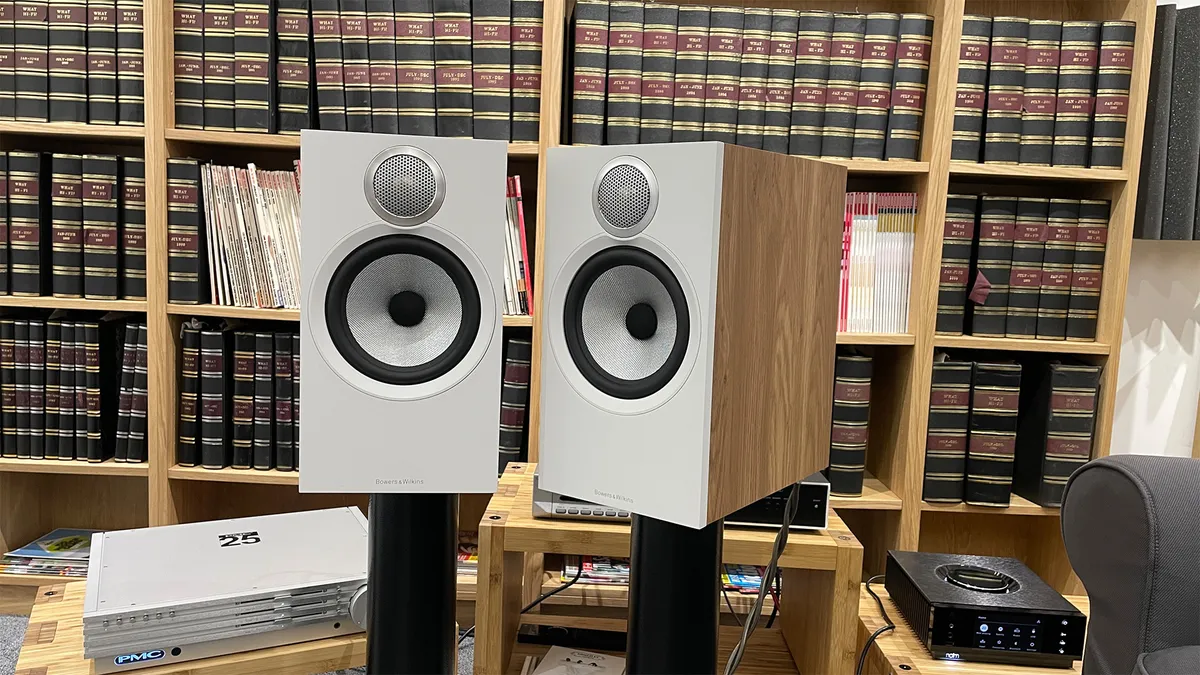
So, all seemingly similar designs at similar price points and with so many common elements, all producing wildly different sounds. The lesson here, naturally, is how those subtle differences in design philosophy, construction and tuning preference add up to create a diverse array of standmounted wildlife.
Put the smaller 607 S3 side-by-side with the larger Triangle Borea BR04, and it won’t surprise you to learn, it’s the latter pair that pump out more bass than the leaner, treble-forward Bowers boxes. That extra cabinet size clearly makes a serious difference, as does the fact that the BR04 are working with a 16cm mid/bass driver, whereas the 607 S3 have a comparatively compact 13cm alternative.
Then you’ve got to factor in driver materials. The 607 S3 employ a titanium dome and favour a clear, slightly bright treble reproduction, whereas the Bronze 50 7Gs’ light, thin 25mm C-CAM gold dome tweeter with an updated waveguide makes good on its promise of a wide, precise sound with excellent time alignment.
There are other factors at play, of course, from cabinet construction to how the crossovers are designed, but those materials are unquestionably having an effect, adding or complementing the other to give each speaker its own unique flavour.
Choice is king

The take home point is that all this is great news for the end consumer. That there are currently so many good, if not excellent, standmount speakers available in this mid-price range, with different styles, sizes and sonic characters – meaning there should be a pair to suit almost any set of personal sonic tastes for those looking for a new set of speakers.
Yes, we believe in certain qualities that make hi-fi objectively ‘good’, ‘bad’ or somewhere in the middle, but that doesn’t mean there aren’t lots of ways of achieving a positive outcome, as all the speakers we've tested here prove.
In the world of midrange standmount speakers, you’ve rarely been so spoiled for choice. Now it’s time to go out and find exactly which pair is right for you – once you do, it’ll be a match made in heaven.
MORE:
Down with Spotify! These 6 independent music streaming services want a better experience for musicians and listeners alike
Goodbye, 2025! Check out 7 of our favourite test tracks of the year
Best bookshelf speakers: top standmounts for every budget tested

