
Over the past couple of years, one question has been nagging at home cinema nerds, myself included: are giant TVs going to kill off projectors?
There are good reasons to think they might: the average TV is currently capable of producing brighter highlights, deeper blacks and more vibrant colours than a typical projector; they tend to have more robust smart platforms and better gaming specifications; they don’t require the purchase and installation of a separate screen; and prices are coming down at a ridiculous rate.
But there’s a romanticism and cinematic authenticity to projection that a television can’t match, at least in the minds of many. And, while TVs are getting much larger, once you go over 100 inches, projection tends to be much more affordable.
It’s a thorny subject – one that my colleague Lewis Empson and I recently discussed on video.
You can watch that video below, but how does the projector industry itself feel about it? Are manufacturers worried that they are about to be rendered obsolete by their TV-producing brethren? We decided to ask them to find out.
If Sony, Optoma, Anker and Xgimi are worried, they certainly don’t seem it (we also reached out to BenQ, JVC and Epson, but didn’t hear back).
In fact, they all pointed to the unique qualities that projectors offer and TVs can’t match – and those qualities are thankfully much more quantifiable than “projectors make it feel like being in the cinema”.
Projectors don’t take over your room

Projection continues to offer something televisions cannot easily replicate: a truly cinematic experience without requiring a permanently dominant screen in the room
James Fitzgerald, Optoma
A recurring theme in the responses was that projectors offer greater flexibility when it comes to how a room looks and functions:
“Projection continues to offer something televisions cannot easily replicate: a truly cinematic experience at 100, 120, 150 inches and beyond, without requiring a permanently dominant screen in the room,” says Optoma’s UK sales manager, James Fitzgerald.
“As homes become more multi-purpose and design-conscious, many consumers still value the ability to enjoy a large-screen experience when they want it while keeping their living spaces flexible and uncluttered,” he continues.
That’s a sentiment shared by Anker’s managing director for the UK, Ireland, Italy, Spain, and Portugal, Faraz Mehdi: “Projectors are compact in size, take up no wall space, and become ‘invisible’ once turned off.”
And Apollo Zhong, Xgimi’s Founder and CEO, concurs: “A 100-inch TV is still a large piece of furniture that takes up space all day, every day,” he says. “A projector gives you the same scale when you want it, but doesn’t permanently occupy your room when you don't.”
Unlike the other manufacturers we spoke to for this piece, Sony produces TVs as well as projectors, so it has a foot in both camps. Still, Adrian Bond, Sony Europe’s product marketing manager for home projector and Bravia, agrees with his contemporaries:
“A projector in hidden housing with a retractable projector screen is vastly more discreet and flexible in aesthetics than a monolithic super-large screen TV.”
Projectors offer more flexibility over where you watch
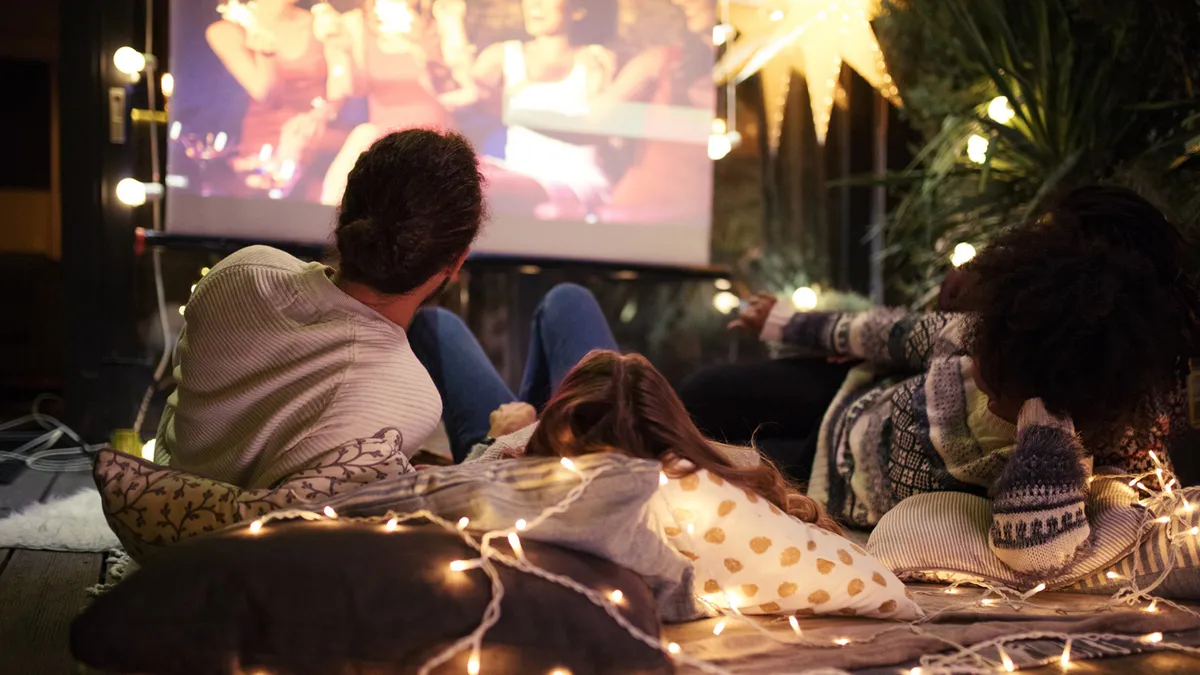
Unsurprisingly, given the lifestyle and portable models they produce, a couple of the manufacturers were keen to point out the flexibility that a projector can offer over a very large TV.
“Many of today’s projectors also offer a level of flexibility that televisions simply cannot match,” says Optoma’s James Fitzgerald, “with compact designs that can be moved easily from room to room, taken to different locations, or set up indoors and outdoors depending on the occasion.”
Projectors allow portability, being easily moved and used in various settings such as bedrooms, living rooms, and campsites
Faraz Mehdi, Anker
Anker’s Faraz Mehdi agrees: “They allow portability, being easily moved and used in various settings such as bedrooms, living rooms, and campsites, which TVs cannot offer.”
But it’s not just about portability, argues Sony’s Adrian Bond; there can be benefits for those building dedicated home cinema spaces, too.
“Transporting, manoeuvring and installing a 115-inch TV is far more challenging than hanging a projector and screen, especially for any premium install in a high-rise apartment building,” he says.
Projectors are simply more cinematic than TVs

While a lot of the answers to our questions had a clear practicality argument at their core, Sony’s Adrian Bond wanted to make the point that, in some ways at least, projectors are simply better than TVs.
According to him, “our projectors still offer a different, elevated and more precise experience for the discerning cinephile.”
Our projectors still offer a different, elevated and more precise experience for the discerning cinephile
Adrian Bond, Sony
“A 100-inch+ TV is an epic viewing experience for sure”, he continues, “Our new FWD-115XR95M2 will deliver exactly this. But for the fully immersive experience that engulfs the peripheral vision and has a wider angle, then dedicated home cinema projectors are superior.”
Of course, a suitably large TV screen at the appropriate distance will also fill your vision in the same way, but Bond says there are also changing aspect ratios to consider:
“A TV at 100+ inches will still be fixed in 16:9 aspect ratio due to its form factor,” he says. “To watch in CinemaScope, you will still incur the black bars at the top and bottom of your screen, whereas with a home cinema projector and screen, you can enjoy CinemaScope as intended, on purpose-built screens.”
He makes an excellent point about sound, too: “With premium micro-perforated or woven projector screens, super high-end centre speakers can be placed directly behind the screen, perfectly matching audio with the action/dialogue on screen.”
This is, of course, the sort of sound-from-picture experience that we’re all used to from the local cinema, but it’s very hard for TVs to replicate, thanks to their typically frame- and/or rear-mounted speakers.
As Bond points out, this is the philosophy behind the Acoustic Surface Audio technology of Sony’s OLED TVs, which feature actuators that vibrate the actual screen to make sound. As clever and effective as this solution is in some regards, though, and as good as Sony’s OLEDs tend to sound by prevailing TV standards, it’s not in the same league as having a large, properly calibrated, hi-fi-quality speaker handling centre-channel duties by firing directly through a quality perforated screen.
The final word (for now)

So, are projector manufacturers concerned about the rise of giant TVs? It certainly doesn’t sound like it.
We don’t really see larger TVs as a threat – if anything, they confirm that people want bigger and more immersive screens
Apollo Zhong, Xgimi
As Xgimi’s Apollo Zhong says, “We don't really see larger TVs as a threat. If anything, they confirm that people want bigger and more immersive screens. We also don’t think it’s a zero-sum competition. TVs and projectors solve different problems.”
I’m not entirely convinced the industry can afford to be quite so relaxed, though.
As TVs get bigger and more affordable, the advantages of projection will inevitably become harder to sell. Modularity, as pioneered by solutions such as Samsung’s The Wall, could also help to overcome some of the practical challenges of installing a truly enormous TV.
For now, though, I am inclined to agree with Optoma’s James Fitzgerald when he says that “projection remains uniquely positioned to deliver scale, flexibility, portability and cinematic impact in ways other display technologies cannot.”
A retractable screen, a portable projector or a dedicated home cinema setup can offer flexibility that a giant TV simply can’t, while a properly designed projection system can deliver the sort of scale and immersion that remain, for now, prohibitively expensive to achieve with a conventional TV.
And then there’s that elusive sense of cinema.
Perhaps it’s the sheer size of the image, the way it fills your field of view, the beam of light travelling through the room before the picture is reflected back from the screen, or simply the ritual of settling down in a darkened room to watch a film. Whatever it is, projection has a particular magic that even the best TVs struggle to replicate.
But I keep coming back to one question: what happens if cinemas themselves move away from projection?
Samsung Onyx LED screens already offer a TV-like alternative in some cinemas. If that approach becomes more widespread, will we still associate projection with that special sense of cinema? Or will we eventually come to regard a wall-sized TV as just as cinematic?
I don’t know the answer. But while TVs continue to close the gap, I suspect the future of projection will depend on more than just how big an image it can produce.
MORE:
Here are the best projectors and the best TVs you can buy right now
Check out this dream penthouse custom install home cinema

