
When it comes to multi-room music systems, Sonos has ruled the roost for years now. The Era 300 is perhaps the jewel in its crown – but there could be a new pretender to the throne in the shape of Denon’s Home 400.
Launched as part of a new range of Home 2 wireless speakers, the Denon Home 400 has a lot in common with the Sonos Era 300. Both offer spatial audio, have similar sonic architecture, and can form part of much larger audio ecosystems, so it only felt right to take a closer look at what sets them apart.
While we’re yet to give the Denon Home 400 the full What Hi-Fi? review treatment, we can still compare the two and see where it might hope to outdo the Era 300. Here’s the tale of the tape.
Denon Home 400 vs Sonos Era 300: price
The Denon Home 400 hit the shops recently with a pretty substantial price of £449 / $599 / AU$999.
In the UK that’s exactly how much the five-star Sonos Era 300 would have set you back when it launched just over three years ago, but it’s now available for a much more wallet-friendly £359 / $379 / AU$695 (and we’ve even seen it drop very slightly lower).
That’s a fair chunk of extra cash you’ll need to find for the Denon, so we’ll be expecting big things when it comes to testing it.
Denon Home 400 vs Sonos Era 300: design

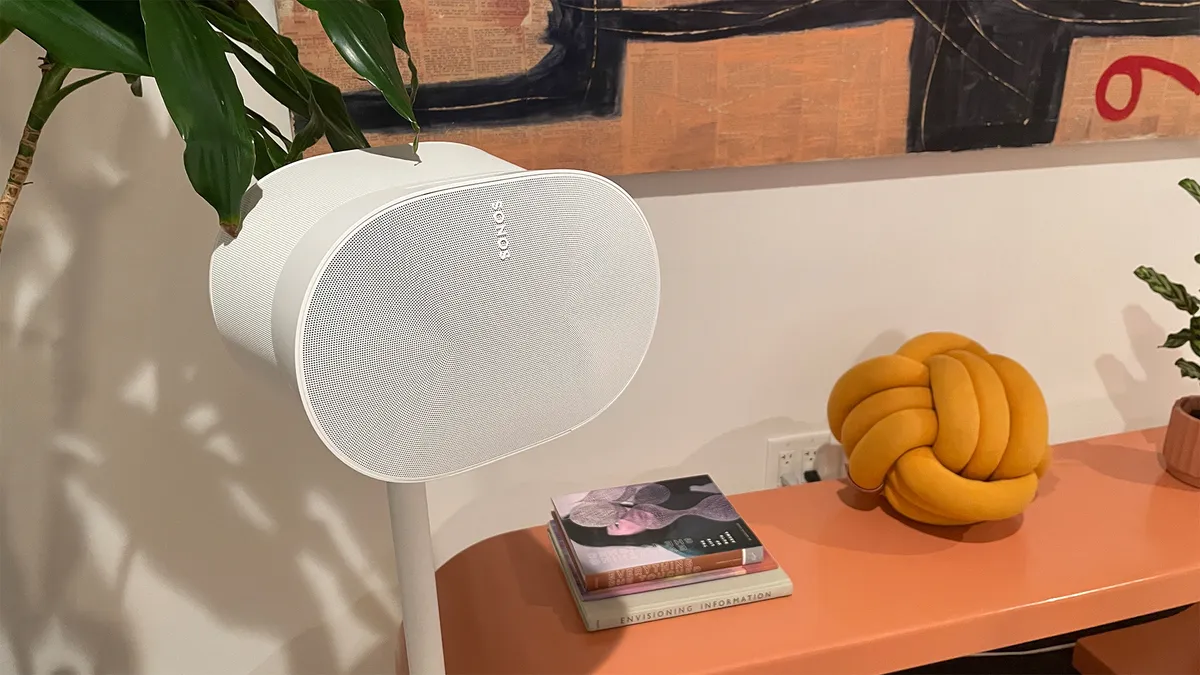
There’s no denying Sonos took a bit of a risk with the design of its Era 300, but there’s sonic logic behind its unusual shape.
In order to facilitate its spatial audio skills, Sonos fitted the Era 300 with four tweeters (one forward-firing, two side-firing, one upward-firing) and two horizontally angled woofers – so while it might be divisive, its design is born out of the physical positioning of the drivers.
In every other way the Sonos Era 300 is pretty minimalist. It comes in either black or white and there’s no display, but you do get a set of touch-sensitive controls on top that blend in nicely. The build quality is typically high, too.
Denon’s Home 400 also feels suitably premium as befits its price. It’s a touch bigger but weighs slightly less and has a more familiar shape, while the fabric covering gives it a softer appearance. A set of rubberised buttons down the side offer control over volume and playback, plus a trio of shortcuts for your favourite sources or sound modes.
The Home 400 comes in either charcoal or stone colours (basically black or silvery grey) but overall feels like the nicer of the two on a purely aesthetic basis, with the Sonos perhaps a little too stark for some tastes. At the end of the day, though, it’s purely personal preference.
Denon Home 400 vs Sonos Era 300: features

Both these speakers can form discrete parts of wider multi-room music systems but they’re also equally happy operating on their own, with spatial audio support the main way to differentiate them from a lot of their wireless speaker siblings.
Both speakers have six drivers inside, but the Denon Home 400 has two that point upwards compared to just one inside the Sonos Era 300.
Both also support Dolby Atmos, but the Denon is a little more flexible over where you source your Atmos-powered spatial tunes from. On the Era 300, you’ll need to use Amazon Music or Apple Music, while the Home 400 is happy playing them from Tidal’s catalogue as well.
In terms of wireless connectivity, there’s no separating them. Wi-fi, Bluetooth and AirPlay 2 are all on the menu for streaming from Spotify, Tidal et al, but the Denon is a little more welcoming to wired sources.
There are USB-C and 3.5mm connections on the back of the Home 400, whereas the Sonos only has the former, with a separate adapter required if you want to connect something using an aux cable.

As well as full multi-room use, you can also create stereo pairs with both of these speakers, plus they’re compatible with soundbars from their respective manufacturers and can be used as rear channels in a surround set-up.
If you like telling your speakers what to do, you’ll probably be better served by the Sonos Era 300, which has native support for both Amazon Alexa and Sonos’s own voice assistant.
There’s a microphone onboard the Denon Home 400 (and a mute button on the back) but it doesn’t support voice control out of the box. In fact, the only way to talk to it (at least if you want to get a response) is to use Siri, but that's only if you have an Apple HomePod or HomePod Mini connected on the same network. You can then link them together within the HEOS app and summon Siri via the Home 400. It's a rather bizarre workaround, we admit, and we'll explore more when we have our review sample in for testing.
Denon Home 400 vs Sonos Era 300: sound

We’re yet to get the Denon Home 400 into our testing rooms for a full review, so a definitive verdict on its abilities will have to wait, but after hearing it at the launch of Denon’s full Home 2 range back in March, plus some further dedicated ears-on time for this piece, some initial assessments are possible.
The impact of those two upward-firing drivers is immediately apparent, with a real sense of space between the instruments. The soundstage has a really nice three-dimensional quality to it that makes music sound more lifelike, although, as is often the case with spatial audio, the mixes can sometimes be a little off depending on the particular song being played.
In general, though, first impressions are good. The Home 400 puts on an engaging performance that seems to strike a nice balance between all aspects of the frequency range.

When it comes to the Sonos Era 300, however, there’s no such uncertainty surrounding its performance. In our five-star review first published in March 2023, the Era 300 was described as an “immensely immersive experience”.
Particularly impressive is the sheer scale of the sound it’s capable of producing, which projects more effectively than any similarly sized wireless speaker we’ve tested so far, particularly when you feed it Dolby Atmos tracks (although quite how effective it is varies by song).
On the whole it sounds detailed, dynamic and cohesive, with deep, impactful bass and plenty of rhythmic flair.
Fundamentally the Era 300 has set a high standard for the Denon Home 400 to reach, but there are reasons to believe it could give Sonos a real run for its money.
Denon Home 400 vs Sonos Era 300: early verdict
With smart looks, an extensive list of features and promising early signs of its sonic performance, the Denon’s Home 400 looks like it could be a serious contender. The lack of voice control is slightly surprising, but with Alexa and co. popping up in so many other devices around the average home it doesn’t feel like a huge absence.
Can it beat the Era 300 though? Sonos’s unusually shaped speaker was the first one to convince us that spatial audio was more than just a gimmick, and its standard stereo performance is hugely enjoyable too, so it’s not going to be easy for the Denon to take the crown.
Once we’ve had the opportunity to fully scrutinise the Denon Home 400 and compare it with the Era 300, we’ll be able to pass judgement on which of these wireless speakers is the best – and it could well be a close battle. Stay tuned for the full review.
MORE:
Which Sonos speaker should you buy? Find out here
The best multi-room systems around
Check out the best Sonos alternatives

