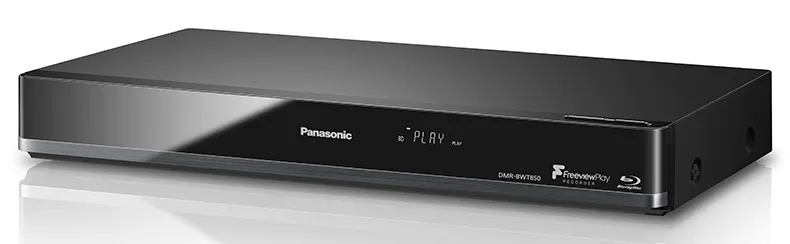
The first of the new models is the Panasonic DMR-BWT850 (above). It’s a networked 3D Blu-ray player and recorder with a twin HD tuner. It comes with Freeview Play which allows you to scroll back through an electronic programme guide (EPG) by up to seven days, and view catch-up content from selected broadcasters: BBC, ITV, Channel 4 and Channel 5.
It supports 4K video and jpeg playback, so you can play content recorded on 4K cameras for example. It also features 4K upscaling, bringing Blu-ray images to near-4K quality. 4K content can also be recorded onto the hard-drive in a bit rate up to 100mbps and a resolution of up to 3840 x 2160. A 4K Ultra HD TV is required to view any 4K content.
FLAC and WAV file formats are supported for high-res audio playback, and the DMR-BWT850 also comes with Panasonic’s Pure Sound Mode, which is said to improve sound quality when listening to music.
As for TV, two channels can be recorded at the same time thanks to its twin HD tuner, and the DMR-BWT850 has a 1TB built-in hard drive.
Other features include TV Anywhere, which allows you to view recorded programmes and live TV broadcasts on a smartphone or tablet over the internet. The service will work even if you’re abroad, but relies on a stable broadband internet connection. The Panasonic Media Centre app is required to use the service too.
A range of apps are available on the Panasonic DMR-BWT850, including Amazon Instant Video, Netflix and BBC iPlayer, and further content can be accessed from USB devices and SDXC cards.
The Panasonic DMR-BWT850 will be available from October, priced £599.

The Panasonic DMR-PWT655 (above) comes with many of the same features as the DMR-BWT850, but can only play Blu-ray discs, rather than record them. It can record on to DVD though and has a 1TB built-in hard drive. It too comes with a twin HD tuner and Freeview Play for seven day catch-up.
4K video can be played and recorded onto the hard-drive and Blu-ray discs can be upscaled to near 4K quality. It also supports the TV Anywhere service. Video streaming and on-demand apps come installed and content can be accessed from USB devices and SDXC cards.
The DMR-PWT550 has all the same features as the DMR-PWT655 but instead comes with a 500GB hard-drive as opposed to 1TB, and can’t support playback from SDXC cards.
Both models will be available from October. The Panasonic DMR-PWT655 will cost £399 while the DMR-PWT550 will cost £350.

Moving down the range and we get to the Panasonic DMR-HWT250. This is a networked HDD recorder with twin HD tuner and Freeview Play seven day catch-up. Programmes can be recorded to the 1TB hard drive and viewed on a smartphone or tablet via TV Anywhere. 4K content can’t be recorded to the hard drive and can only be viewed from a connected USB device.
It also comes with the same video streaming and on-demand apps as the other models.
The Panasonic DMR-HWT150 has the same features and functionality as the HWT250, but instead comes with a smaller 500GB hard-drive.
Both models will be available from October, with the DMR-HWT250 costing £319 while the DMR-HWT150 will cost £269.
Finally, the Panasonic DMR-EX97 is a DVD recorder with twin HD tuner. It doesn’t come with Freeview Play, TV Anywhere or 4K networking. It’s a Freeview+ device, so can pause and rewind live TV programmes, and record them to its 500GB hard drive. It doesn’t have built-in wi-fi (all other models do) and doesn’t have smart functions such as video streaming and on-demand apps.
The Panasonic DMR-EX97 will be available from October for £350.

