

Lucky, that’s what I call it. The chances of having three of the most significant small speakers of the past 60 years all in one place at the same time, and in proper working order, are small. But here I am, listening to mini-monitor royalty and loving every minute.
Two of the speakers in this group, the BBC-designed LS3/5A and the Acoustic Energy AE1, can rightly claim to be legendary. I think the third, KEF’s LS50, has done enough in the past decade or so to lay claim to that status in the future.
The LS3/5A arguably originated the high-quality mini-monitor speaker category. This is a properly small speaker (about the size of a shoebox ) with an internal volume of around five litres.
It was originally developed for use in outside-broadcast vans and cramped studios, primarily to monitor speech, but was quickly hijacked by hi-fi enthusiasts who loved its gorgeous midrange performance and exceptional stereo-imaging skills.
The LS3/5A was one of the fruits of an extensive BBC research project into speaker design and was first introduced in 1975. The BBC isn’t a speaker manufacturer, of course, so the speaker’s design was made available under license to third-party manufacturers to make.

KEF was the supplier for both of the drive units, but didn’t make the complete speaker until the mid-’90s. Its version of the LS3/5A, the gloss black one we have in our test room, was made to celebrate the company’s 35th anniversary. Only 500 pairs were ever produced.
Given that the BBC had some of the best audio engineers in the business at the time, and resourced them well beyond the capabilities of any commercial speaker manufacturer, it's no surprise that the LS3/5A turned out to be a technical tour de force back then.
The use of a Bextrene cone in the 11-cm mid/bass was considered cutting-edge technology in a world where just about everyone else still used paper; and the thin multilayer birch-ply cabinet was intentionally designed with a bit of ‘give’ to move any resonances out of the midrange and down into the bass frequencies, where our hearing is less sensitive. The sealed (non-ported) enclosure was heavily damped to control those resonances.
The LS3/5A’s high frequencies are delivered by a 19mm Mylar dome tweeter with a perforated metal cover. The felt strips that surround it reduce reflections off the front panel and cabinet edges
KEF lists the LS3/5A sensitivity at a miserably low 82.5 dB/W/m and a modest power handling of just 30 watts. Essentially, high volume levels and wide-ranging dynamics are off the table if you want the speakers to survive.
This is where Acoustic Energy’s AE1 came in. It launched in 1987 and was a determined attempt to produce a small speaker that ticked all the boxes. The company succeeded, proving that a small box (about the same frontal area as the LS3/5A but a fair bit deeper) could really produce wide-ranging dynamics, high volume levels and a decent dose of bass. Its detail resolution was exceptional for the time.

This performance was made possible by a formidable-looking all-metal driver array that was cutting-edge back then, and an engineering ethos that focused on minimising dynamic compression. An ultra-rigid cabinet that was lined with plaster to reduce internal standing waves and an unusual straight-edged mid/bass cone profile also helped.
The new Acoustic Energy AE1 40th Anniversary model (£1499/$1999) we have isn’t identical to the 1987 original, though. Think of it as a resurrection that is faithful to the original’s character and engineering principles, but tweaked with the benefit of four decades' worth of progress.
The first-generation drive units are no longer available, so AE’s engineers had to remanufacture them. The new drivers adhere to the original’s design ethos, but are tweaked for improved performance where possible.
Both have ended up a few millimetres larger than before (the tweeter is 29mm in diameter and the mid/bass is 12.5cm). Modern manufacturing methods and advances in design mean that both are better behaved than before. The improved drive units have allowed the engineers to simplify the crossover network, so improving the speaker’s performance.
In addition, the cabinet, which is the same size as before, has also improved. It forgoes the mess and complexity of the earlier model’s concrete-lined interior, and is now made with composite sandwich panels tuned to retain the original’s sonic character while being easier to manufacture.
All these things have incrementally improved the AE1 without changing its distinctive sonic signature. I have to say that the build of this 40th Anniversary edition is light-years ahead of the first generation, and the speakers look lovely in their high-gloss finish.
The third of our speakers is KEF’s LS50 Meta (£1299/$1599). This has become something of a modern classic. The LS50 was first introduced in 2012 to celebrate KEF’s 50th anniversary – it seems that KEF likes its anniversary models – and was upgraded to include the company’s clever metamaterial technology eight years later.
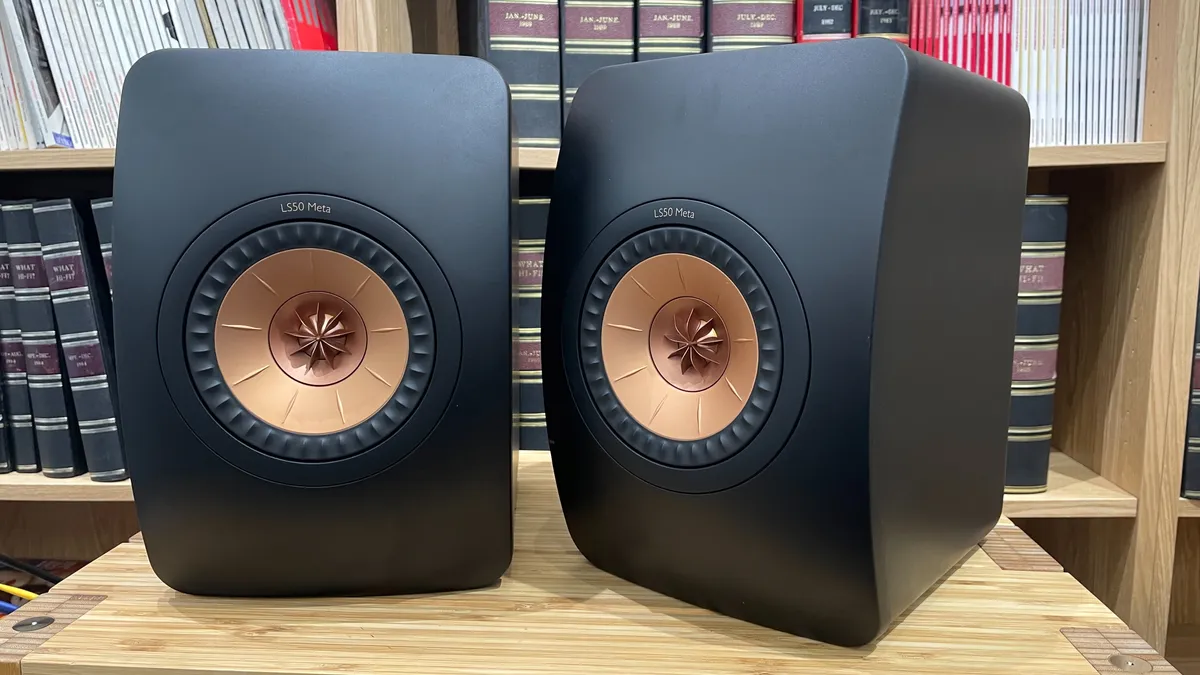
The heart of this speaker is the Uni-Q driver array that mirrors the AE1’s use of aluminium diaphragms, but places the 25mm dome tweeter in the throat of the 13-cm mid/bass rather than above it.
This coaxial configuration aligns the acoustic centres of the drivers, giving the LS50 even dispersion characteristics, which ensure an impressively wide listening sweetspot and enviable soundstage stability as we move around the room.
As touched on above, the ‘Meta’ in the KEF’s name refers to a technology that absorbs a claimed 99% of the rearward sound from the tweeter dome, reducing distortion and improving clarity in the process.
Elsewhere, the LS50’s curved front baffle is made of BMC (Bulk Moulding Compound), a material that provides a rigid and well-damped foundation for the Uni-Q array, and the speaker’s rear-firing reflex port is flexible to reduce resonances. Build, fit and finish are as good as we would want them to be.
I listened to all three speakers using the What Hi-Fi? reference system of Naim ND555/555 PS DR music streamer, Technic SL-1000R/Kiseki Purpleheart record player and Burmester 088/911 MkIII amplifier.

The LS3/5A is first, and its excellence with voices is obvious. It may not have the outright resolution of more recent designs, but there is a naturalness to its delivery that is hugely appealing. This is a fleshed-out performance that has a palpability that leaves many modern alternatives sounding thin, clinical and lacking in natural warmth.
If placed with care – a little away from a rear wall and on proper stands – these speakers also stereo image beautifully. That’s down to the well-damped enclosure, controlled dispersion and an impressive pair matching that is within 0.5dB of the BBC-specified reference target.
Given the age of the design, there are shortcomings, of course. Play any music that requires scale and dynamic reach (Stravinsky’s The Rite of Spring, say) or demands low-end muscle and punch (Massive Attack’s Heligoland or Billie Eilish’s Bad Guy), and these BBC speakers wave a white flag. They sound small, dynamically limited and rhythmically flat-footed with music such as this.

In comparison, the AE1 40th Anniversary speakers respond to such challenges with all the enthusiasm of a two-year-old bribed with a bucket of ice cream. These monitors sound bold and punchy, and are capable of sustaining high volume levels without issue.
Detail levels are clearly better than from the LS3/5A, though it has to be said that these all-action monitors don’t have the sweetness and body of the BBC design through the midrange and treble.
They are a more demanding listen, sounding harder edged without erring so far as to be unrefined or fatiguing. Tonally, they are more balanced, though the KEF LS50 Meta goes even further in this respect.
The AE1 are small boxes, so while they appear to bend the laws of physics when it comes to bass reach (given a muscular amplifier), listen carefully and you will find that properly deep bass is still missing.
Much the same can be said of the similarly sized KEF LS50 Meta. If anything, the Acoustic Energy sounds more muscular in the bass and is certainly more assertive generally, though the newer design’s progress in performance is obvious.

In comparison with the others, the LS50 Meta are clearer, cleaner and more spacious-sounding. They dig up a layer of fine detail that even the mighty AE1 don’t quite manage and deliver all that information in a wonderfully cohesive and balanced way. Their low frequencies may not be quite as burly as those the Acoustic Energy produces, but they are impressively agile and articulate.
In most ways, they are the most insightful and balanced speaker here, just as they should be given the age of the other designs. However, that doesn’t diminish the greatness of the others.
There is a reason that LS3/5A remains so beloved by many hi-fi fans. It has a sweet, easy-going manner that suits certain types of music beautifully, and if that’s what you listen to, these speakers remain as hard to beat today as they have always been.
The AE1 is my personal favourite. It is the small speaker that won’t wilt under pressure. It goes loud and delivers wide dynamic swings with enthusiasm. Sure, by current standards these speakers aren’t the last word in transparency and subtlety, but listen to a pair in full flow and the chances are that you won’t care. Feed them a quality signal, and the AE1 40th Anniversary will shine.
KEF’s LS50 Meta speakers have been What Hi-Fi?’s go-to premium standmounters for well over a decade. They are wonderful all-rounders that deliver a breadth of performance that few rivals get close to, let alone better. Of the three sets of speakers here, they get out of the way of the music most effortlessly. We can’t give them a higher compliment than that.
My conclusion? A great speaker remains a great product even as technology marches on. Sure, some limitations become more obvious over time, but the charm of classics such as the LS3/5A and AE1 doesn’t fade.
MORE:
In praise of small speakers: how their inherent design limitations can work to their benefit

