
What Hi-Fi? turns 50 in 2026 and we're looking back on some of the most important hi-fi and home cinema products in our lifetime – and beyond!
We're going back further than 1976 in this article as we look back on a series of debut speakers from hi-fi brands that went on to great things.
Our list details the first-ever models from some of the most renowned loudspeaker brands in history, including Bang & Olufsen, Bowers & Wilkins, KEF and Quad, some (but not all) of which started life long before What Hi-Fi?.
Wharfedale Bronze 2 (1932)

Wharfedale’s first speaker was built in the cellar of founder Gilbert Briggs' llkley home in 1932.
The Bronze was purely a drive unit (in those days, radio enthusiasts assembled their own cabinets). A year later, it was housed in a wooden cabinet for those who wanted an ‘extension’ speaker. Shortly after came the ‘Nubian’ cabinet speaker in 1934.
But it was a whole decade before Wharfedale marked the first of many milestones: the invention of the first two-way loudspeaker.
In 1945, the company combined a 30cm bass driver with a 25cm full-range ‘treble’ unit, using a crossover at 1kHz. And in the years after the company’s introduction of ceramic magnets to moving coil drive units led to the company’s much-celebrated Diamond series.
Bang & Olufsen Hyperbo (1934)

Not uniquely, Bang & Olufsen came to the speaker market through radio manufacturing. In 1925, Peter Bang & Svend Olufsen’s first commercial radio – the modest production of which began in Olufsen’s attic – was the Eliminator, a radio component that allowed the connection of a radio directly to the mains, eliminating the need for batteries.
Having moved to a factory in Struer just two years later (B&O remain at that same site today), the Hyperbo – a radio, gramophone and integrated loudspeaker – arrived in 1934.
Like every B&O product produced since, the Hyperbo was heavily influenced by the emerging Bauhaus style in the early 1900s: a design attitude that has consistently manifested itself in the artistic craft behind the company's many speakers and TVs.
Acoustic Research AR-1 (1954)

Acoustic Research was founded in 1952 by inventor Edgar Villchur and his student Henry Kloss. Based on the acoustic suspension principle patented by Villchur in 1956, its first model, the AR-1, sold for $185 (over £1000 in today’s money).
The AR-1's woofer trapped air in the speaker’s sealed enclosure to provide a spring for the diaphragm, enabling it to move back and forth – doing the same job as the more conventional mechanical spring.
This was followed quickly by the AR-2 but it was the AR-3, released in 1958, that became Acoustic Research's landmark speaker, borrowing the AR-1's acoustic suspension technology but bringing onboard newly designed drivers.
Quad ESL-57 (1957)

Quad founder Peter Walker was the first to implement electrostatic technology in loudspeakers, waving goodbye to traditional driver cones and cumbersome cabinets.
In their place he put a thinly-stretched, electrically-charged diaphragm between two metal grilles, which received the music signal from the amplifier.
The first in what has become a brand-defining range of electrostatic speakers, the ESL-57, was in production for nearly 30 years, while the ESL-63 continued Quad’s electrostatic legacy until 1999. Quad continues to manufacture electrostatic speakers to this day.
KEF K1 Slimline (1961)

KEF’s oldest speaker was born out of founder Raymond Cooke’s desire to achieve outstanding sound quality from a slim, living room-friendly enclosure.
At 12.5cm deep, the K1 Slimline incorporated the same driver innovations as the Monitor versions that arrived in the K1 series: the B1814 woofer with its flat rectangular diaphragm of aluminium skinned polystyrene, the M64 elliptical midrange unit with a similar diaphragm construction, and the T15 tweeter with its hemispherical Melinex diaphragm.
To minimise colouration, the wall panels of the braced cabinet were dampened with bituminous pads. And, lounge-friendly in their aesthetic as well as their size, the K1 Slimlines were finished in walnut with 'coffee' fleck grilles – a far cry from some of the designs it employs today.
B&W P1 (1966)

Beginnings don’t get much more humble than B&W’s. The year after founder John Bowers started hand-assembling speaker systems in the electrical store he ran with Roy Wilkins in Worthing, Bowers & Wilkins (then B&W Electronics Ltd) released its first loudspeaker: the P1.
The cabinet and filter were B&W's own, but the drivers came from EMI and Celestion – this was in the decade before the company started using the bright-yellow Kevlar woven composite.
The profits from the P1 allowed Bowers to purchase a Radiometer Oscillator and Pen Recorder, meaning that every speaker the company sold could have calibration certificates.
Spendor BC1 (late ’60s)

Bextrene was the material of choice for the speaker diaphragms in Spendor’s first pair of speakers, the BC1.
A product of BBC engineer Spencer Hughes (co-founder with Dorothy Hughes, hence the Spendor name) and co-designer Dudley Harwood, the BC1 speakers had a three-way design: the only commercial 8in Bextrene mid-bass driver, a Celestion HF 1300 tweeter and a Coles 4001 G supertweeter.
They were fed by a nine-element crossover comprised of film capacitors for frequency and temperature stability, and radio metal cored chokes that allowed for high transients and low resonances.
The BC1s hit the market in the late ‘60s and found their way into broadcast and recording studios before eventually being available to buy for consumers. Some 600 pairs were supposedly in operation at the BBC at one time.
Harbeth HL Monitor Mk1 (1977)

British speaker brand Harbeth came about due to the discovery, by founder H.D. Harwood, of a potential new film plastic for speaker cones.
Towards the end of his career in the BBC’s Research Department, and during investigation into bextrene plastic as a cone material for BBC monitors in the ‘60s, Harwood proposed that polypropylene would make a good cone material.
And so, upon his formal retirement, he set up Harbeth to make a speaker with his patented polypropylene-coned driver. The HL Monitor was released in 1977, and four versions subsequently followed over the next decade.
Dynaudio P-series (1977/78)

We have to pedal back almost 50 years to find Danish brand's first speakers – the five P-series models in 1977. However, they were short-lived, had limited distribution and, while using the company’s own crossovers, were the only Dynaudio speakers to rely on OEM drivers.
The P series (P for 'passive') comprised the P16 (pictured), P21, P31, P46 and P76. All models used specially coated soft dome tweeter with high power handling – something Dynaudio would later become renowned for.
The first range to use Dynaudio’s in-house MSP (Magnesium Silicate Polymer) woofers and tweeters, and receive international distribution, was the four-strong MSP series in 1984. Dynaudio has used its own drivers ever since.
ATC S50/S85 (1978)

After a few years making drive units, ATC produced its first speaker systems in 1978: the bass-reflex S50 (pictured) and infinite baffle S85, which established a naming tradition based on the internal volume of the speaker.
Inside the plywood-based 50- and 85-litre cabinets were 2.5cm soft dome tweeters, a 7.5cm soft dome midrange driver and a 22.5cm woofer (two in the S85).
Unusually, the crossover arrangement allowed for true active tri-amping, allowing you to choose between either the internal passive crossover or an external electronic crossover via a rotary switch.
ProAc Tablette (1979)

A few years after founding loudspeaker manufacturer Celef Audio Ltd in 1973, Stewart Tyler decided that producing more expensive designs in smaller quantities, rather than increasing production capacity and potentially sacrificing quality, was the way forward.
With that decision came a new company name: ProAc, short for Professional Acoustics.
The first speaker to bear the name was the Tablette; mini monitors – they really are dinky – which have spawned more than ten variations since their original production in 1979.
Wilson Audio WAMM (1982)
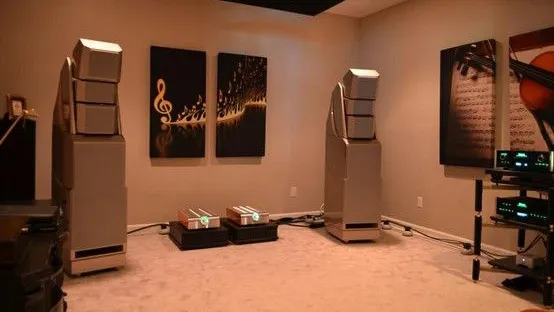
Following Wilson Audio’s Smart turntable, which was essentially a re-jigged Acoustic Research deck and became Wilson Audio’s first ever product, founder Dave Wilson introduced the company’s first pair of speakers, the Wilson Audio Modular Monitor (WAMM), in 1982.
Each channel comprised two towers: one sub-bass module, and one with twin mid-bass drivers and an electrostatic supertweeter flanked by twin midrange/tweeter modules. It sold for $28,000 and was the most expensive speaker you could buy at that time.
The WAMM evolved through six versions from 1982 to 1993, and has since been revived, with the Master Chronosonic and Master Subsonic speakers still current in the company's catalogue.
Focal DB13 (1982)

JMlab established Focal for speaker driver production in Saint-Étienne in 1979, and three years later the company's first pair of speakers appeared.
The DB13 bookshelf speakers were equipped with a double voice coil driver plus Polyglass and Polykevlar driver cones, and were capable of volumes more akin to larger speakers.
They propelled the company towards the high-end audio market and to international shores.
Martin Logan Monolith (1983)

Convinced they could make a class-leading electrostatic speaker capable of adequate bass and suitable for rock music, Gayle Martin Sanders and Ron Logan Sutherland (later ‘Martin Logan’) conceived a prototype in 1980. Unfortunately, its flat aluminium panel blew up when they turned up the volume...
Undeterred, their first production-ready speaker arrived three years later: the Monolith. A revised transducer saw a clear Mylar diaphragm sandwiched between two perforated-steel stators.
And to ensure good sound dispersion, a horizontally curved panel was implemented, and this curvilinear transducer has been central to the design of every Martin Logan electrostatic since.
Sonus Faber Parva (1983)

In 1983, three years after Sonus Faber founder Franco Serblin produced his first system (an all-wood, all-in-one model called the "Snail" that really needs to be seen), the brand was established in a small laboratory in Monteviale, northern Italy.
It was in that year Sonus Faber launched its first product: the Parva 2-way speaker, featuring a Kevlar midrange cone and solid walnut wood cabinet.
This paved the way for some legendary models (such as the Extrema and Guarneri ranges), and what is today, 35 years later, one of the world’s most distinguished and design-savvy high-end speaker brands.
Dali 2 (mid '80s)

The Dali 2 was released shortly after the renowned Danish speaker company Dali (Danish Audiophile Loudspeaker Industries) began in 1983.
The debut speaker had a two-way configuration, with a 6.5in laminate pulp/polyvinyl cone woofer, 1in tweeter with a soft polypropylene dome, and walnut veneered wooden cabinets.
The Dali 2 was followed by larger models in the range, the 3, 4, 6 and 8, which Dali explained shared the same design philosophy and signature sound: they don't "'thunder' or 'boom' bass – they just handle more power and provide better bass response".
Acoustic Energy AE1 (1987)

With the introduction of the AE1 Loudspeaker in 1987, Acoustic Energy Ltd was officially born. The concept was to create a compact studio monitor (it measured 30cm tall and 18cm wide) that could handle the high volumes and dynamics of larger speakers.
To achieve this, Acoustic Energy lined its cabinet with a concrete/plaster compound to eliminate as much resonance as possible, and developed a new mid/bass driver. It featured a 10cm cone of spun aluminium, thicker at the centre than the edges and anodised to create a ‘ceramic sandwich’, and used an oversized magnet assembly that allowed the AE1 to accept 200W of power.
The AE1 was refined in several revisions until 2016, when its SEAS tweeter went out of production. The design has since resurfaced in the amplified AE1 Active model.
Neat Petite (1991)

Neat Acoustics began life as a hi-fi shop in Darlington called North Eastern Audio Traders. After identifying a gap in the market for a small musical speaker, its owners developed the Neat Petite.
When we reviewed them in 1993, we heralded these speakers a musical success. We called their sound 'hugely stimulating', mostly due to the way they portrayed timing and dynamics – something that's continued to be a trademark in the brand’s more recent speakers.
PMC BB5-A (1991)

After a stint as the manager of BBC's Maida Vale studios, Peter Thomas and former BBC engineer Adrian Loader designed the first PMC speaker, the BB5-A.
It introduced the company’s hallmark Advanced Transmission Line technology, in which drivers were used to improve bass output.
In an interview with What Hi-Fi?, Thomas said: “The design was certainly not conventional. Whereas the majority of speaker designers used ported or sealed cabinets, we found that a transmission line system for bass loading, if refined, gave a performance that significantly exceeded conventional bass loading principles.”
Wilson Benesch A.C.T. One (1994)

Five years after launching its first product, the Wilson Benesch Turntable, the British company launched a second: the A.C.T. One loudspeaker.
Unveiled at the 1994 Frankfurt High End show, the A.C.T. One used carbon fibre – the world’s first curved carbon fibre composite panel in a speaker design. It sported the sloping top and solid metal baffle that remain part of the company’s distinctive designs today.
While many years before the implementation of crossover-free midrange driver designs, as seen in the company’s Eminence series, the A.C.T. One placed great importance on phase coherence and the reduction of crossover elements.
Eclipse TD 512 (2002)

Deviating from the traditional two-driver configuration and box design, Eclipse’s speakers are as distinct as they come. The company’s first, the 36cm-tall TD 512 speakers, were a "radical departure from the speaker norm" (as we stated in our 2002 review), with only one drive unit and an egg-shaped enclosure made of marble-loaded resin.
The former’s job to cover the whole frequency resulted in some shortcomings – namely, a rolled-off treble – but ultimately these beautifully imaged and detailed speakers did more than enough to enjoy a five-star debut. As we said at the time: "Little else at their price (£2350) will deliver such unrestricted access to the recording."
Q Acoustics 1000 series (2006)

Q Acoustics may not have the heritage of some other brands, but the British company’s debut, the six-strong 1000 series in 2006, has been one of the most notable of the 21st century.
The 1000 series comprised the 1010 and 1020 bookshelf speakers, 1010C centre channel, 1030 and 1050 floorstanders, and 1000S active subwoofer. Each model featured the same ferro-fluid cooled, micro-polyester weave tweeter and Linkwitz-Riley crossovers, and every drive unit was ‘torque mounted’ into its front baffle.
The 1010s were five-star performers in their own right, and later received another five-star review as part of a complete multi-channel surround package.
MORE: