
If you’re a regular reader of What Hi-Fi?, it’s likely you know more than a few things about records.
Vinyl is a format that continues to captivate, despite being well over 100 years old and experiencing some rather steep highs and lows.
So we have dug up some facts that even the most ardent record fan might not know.
Want to learn more about one of the longest-running consumer-audio formats of all time? Step right up…
Heavier records don’t always sound better

You will probably have noticed the 180g sticker (and higher price tag) on several records these days. Records mostly came in at the 120-140g mark in the 20th century, with the marketing trend for 180g records only coming in during the late ’90s.
Heavier records do come with some practical advantages, such as better resistance to warping. However, despite a consensus emerging that heavier vinyl is “audiophile-grade”, there is no inherent sonic benefit to 180g vinyl.
If a record was too light and unable to remain stable, then that would certainly impact sound quality – though you’re highly unlikely to find a record this light in the wild. Once a record is heavy enough to remain stable, adding extra weight will not actually make a difference to the process of the turntable reading a record.
In the opposite scenario, where the record is too light to remain stable, the stylus would fail to stay firmly in the groove, which would certainly impact sound quality. As long as the record is flat and the groove remains concentric with the centre, adding extra weight should not affect the sound.
We asked several hi-fi manufacturers if a record’s weight can impact sound quality. Interestingly, there was no consensus on the ideal vinyl weight and its impact on sound quality. Some argued that heavier records do make a difference, citing reasons such as reduced vibration transfer to the stylus, greater stability and less resonance during tracking. Others dispelled it as a myth, suggesting that a heavier disc simply gives customers a perception of higher quality. What was unanimous, however, was that the quality of the recording and the care taken during the mastering/pressing are far more important – a really well-recorded and produced 140g record is always going to sound better than a badly recorded and produced 180g record.
45rpm records sound better

This time, we do actually have a record type that sounds better and a clear reason behind it.
The 45rpm record was introduced in 1949, only a year after the 33⅓rpm record. The 33⅓rpmLP prevailed for albums, while the 45rpm record was the go to for the ‘singles’ format.
However, the 45rpm records actually sound better. Because the record spins faster (45 rotations per minute vs 33⅓), the needle travels over more vinyl surface area per second. Therefore, the wiggles in the record grooves are more spread out, making them easier for the stylus tip to track.
Think of it like a flipbook with 20 pages rather than 10. You’d have to flip the book faster for the characters to move at the same speed, but the animations would be far smoother as there is more detail to work with.
A phono stage doesn't simply amplify

Yes, a phono stage is necessary to amplify the extremely quiet signal from a turntable cartridge to a level that allows you to connect it to your sound system. But did you know that it also balances the sound frequency?
To counteract the physical limitations of the vinyl format, records are pressed with weakened bass and boosted treble according to the RIAA equalisation curve. The phono stage then applies the reverse of this curve during playback, restoring the original tonal balance and ensuring the sound is accurate and full-bodied.
UK record sales have increased by more than 3000% since 2007

It’s no understatement to say that records have had a bumpy ride in terms of popularity.
According to the Recording Industry Association of America (RIAA), vinyl sales in the US peaked in 1978 with sales of over 500 million units sold, eventually dropping to less than 1 million units in 2006 when the format was widely believed to be dying. It’s rather impressive, then, that the number of units sold in the US has since climbed back to 43.6 million in 2024.
Historic vinyl sales data is a bit harder to come across in the UK, though we reached a similar low in 2007 with 205,000 records sold according to the BPI. Luckily, we have also experienced a similar increase, with 6.7 million vinyl records sold in the UK in 2024 according to the ERA.
Record grooves are roughly the same width as a human hair
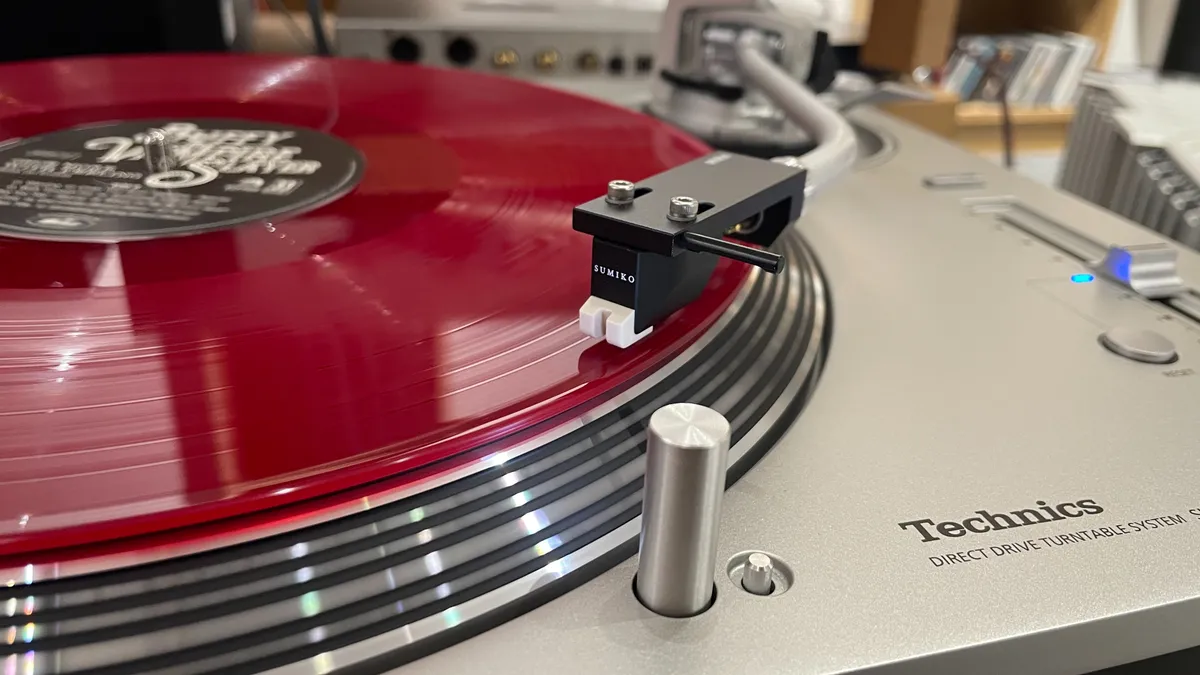
Despite reaching lengths of over 500 metres on a 12-inch LP, the grooves on a record are usually only 0.04-0.08mm wide, or 40 to 80 microns. It's remarkable that we can retrieve that data at all.
What’s even more fascinating is that this data retrieval is achieved with a tonearm, which is usually nine to 12 inches long – making the tonearm 3000 to 7500 times longer than the grooves it is navigating.
Monty Python broke a key record rule

How many grooves does a record have? Two, of course – one on each side. It’s the same continuous groove across the entire width of the record.
There are exceptions, though. Monty Python’s Matching Tie And Handkerchief has two separate spirals on one side. Depending on where you drop the needle, you will hear one of two different sets of tracks.
MORE:
Best turntables: top record players tested by our expert reviewers
Our comprehensive guide on how to set up a turntable
And our tips on what to consider when choosing a turntable for you

