
Drive units: 29mm soft-dome tweeter, 2 x 13cm pulp/wood-fibre mid/bass drivers
Ported: Yes (rear)
Bi-wire: No
Sensitivity (dB/w/m): 88dB
Impedance: 6 ohms
Dimensions (hwd): 82.6 × 16.2 × 27cm
Weight: 10.8kg
Finishes: x 4 (natural oak, white, walnut or black ash)
The Sonik 5’s compact size makes their crisp, punchy sound all the more surprising. While their bass doesn’t delve as deep as larger rivals, these speakers maintain a stable and expansive soundstage, boasting impressive textural detail to boot. As a space-conscious option in their price range, the Dali Sonik 5 take some beating.
Pros
- Expressive dynamic performance
- Unfussy nature
- Unobtrusive appearance
Cons
- The Fynes offer greater scale, authority and bass reach

Drive units: Isoflare array (25mm titanium compression dome/15cm multi-fibre mid/bass), 15cm multi-fibre bass
Ported: Yes (downward)
Bi-wire: Yes
Impedance: 8 ohms
Sensitivity: 90dB
Dimensions (hwd): 98.4 x 25 x 29.4cm
Weight: 18.9kg
Finishes: x 2 (black ash, walnut)
Somewhat bulkier than the Dalis, the Fyne F501E have no trouble justifying the space they take up. Talented sonic all-rounders, which we have found hard to dethrone within the price range, these speakers pair a taut, punchy low end with a crisp midrange and treble performance.
Pros
- Cohesive, expressive and entertaining presentation
- Taut and tuneful bass
- Even dispersion characteristics
- Solid build
Cons
- Too big for some spaces
- Lack the Dalis’ precision and insight
A good pair of floorstanding speakers come with virtues aplenty: extended bass, thanks to larger enclosures and extra woofers, no need for an additional subwoofer and a sense of scale and authority that most bookshelf speakers can’t rival.
Best of all, finding a quality option in the £700-£1000 price bracket has recently become easier, with numerous brands developing their entry-level offerings.
Last year, our favourite was the Fyne Audio F501E, which came out on top as 2025’s Product Of The Year at the What Hi-Fi? Awards. It would be sensible, then, to pick up a pair and go forth with unwavering confidence in your choice. Well… not so fast!
Fantastic speakers though the F501E are, they have recently come up against tough competition from Dali’s Sonik 5 speakers. Designed to replace the company’s Award-winning Oberon 5, the Sonik 5 have a sound that gives speakers north of their price a serious run for their money, as do the Fynes.
So, which should you go for? Let’s get stuck into it.
Dali Sonik 5 vs Fyne Audio F501E: price

The Sonik 5 cost £899 / $1800 / AUS$1749, while the F501E are available for £999 / $1299 / AU$1999. So, right off the bat, there’s a £100 disparity between the speakers. But considering the larger size of the F501E, you quite literally get more speaker for your money.
But, because the F501E have been on the market for longer than the Sonik 5, we think they are more likely to see a discount during big sales events. Indeed, we have seen discounts of as much as £100 this year, which, when they strike, bring the speakers down to the same price for UK customers, making this a draw.
**Winner: draw**
Dali Sonik 5 vs Fyne Audio F501E: build & design

The Sonik 5 are smaller than the F501E in all dimensions. Standing at just 83cm, compared with the Fynes’ 98cm, these speakers have a significantly smaller footprint and will fit into most listening spaces with ease.
Admittedly, due to their diminutive height, some thought is necessary when it comes to positioning the speakers, especially if you are planning on sitting close to them, which, from our test room’s sofa, leaves the tweeters well below ear height.
The Sonik 5 are available in four finishes: natural oak, white, walnut or black ash. Each of the finishes has a fairly unobtrusive look, which we think is particularly well exemplified by our walnut test pair.
The cabinets’ high-grade laminate looks convincingly wood-like, with a pleasant, natural feel. Overall, these speakers have a subtly refined air.
That impression of refinement is only enhanced by the build quality. Although they are not heavy speakers, they are appropriately solid and well-constructed, and the included magnetic grilles connect firmly and complement the speakers visually.
Inside the cabinets, the Dalis employ a two-way design, using a 29mm soft-dome tweeter and two 13cm mid/bass drivers made from the company’s trademark mix of fine-grain paper pulp reinforced with wood fibres. A flared reflex port at the back of the speakers optimises airflow to reinforce bass.
Due to their reflex port, the Sonik 5 sound best when placed slightly away from the wall, so we wouldn’t recommend tucking them in too tight.
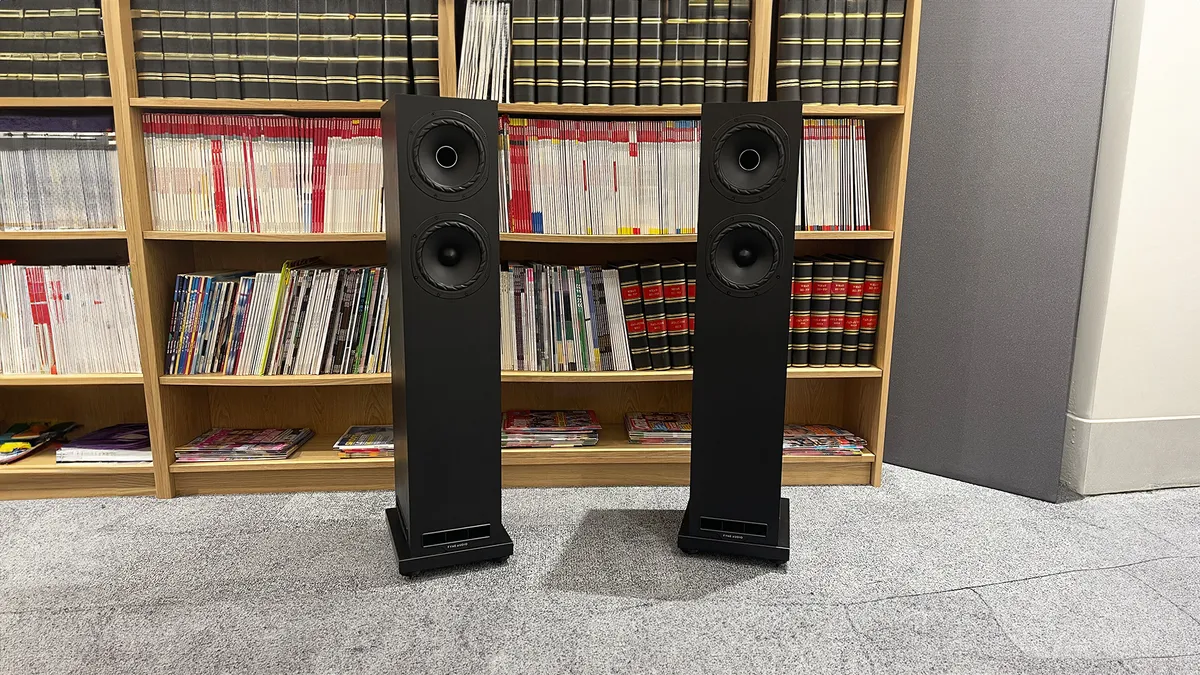
The Fynes, too, are sturdily built, and are now available in a walnut finish alongside the original black option. While their basic aesthetic does leave a somewhat monolithic impression, costs saved on aesthetic tweaks have afforded the inclusion of Fyne’s proprietary Isoflare driver technology within their entry range for the first time.
The IsoFlare design, which sees a 19mm titanium-dome tweeter mounted at the centre of a 12.5cm multi-fibre mid/bass woofer, is said to result in improved sound dispersion and integration between drivers.
Unlike the Dalis, the F501E use a two-and-a-half-way design, and the lower 15cm multi-fibre driver is tuned by a downward facing port in a configuration that the company calls Basstrax. Here, the port fires onto an upward facing cone to disperse low frequencies evenly across 360 degrees, making these speakers adaptable to different placements.
Fyne has also used a fluted surround to the mid/bass driver which it claims terminates the cone more effectively, for reduced distortion and improved clarity.
In terms of design, choosing between these speakers will depend heavily on buyers’ tastes and listening spaces. Both speakers have serious strengths: the Dalis take the lead for aesthetic charm, while Fyne’s Isoflare design works wonders in terms of stereo imaging.
As these speakers excel in different areas, at this stage, it’s neck and neck.
**Winner: Draw**
Dali Sonik 5 vs Fyne Audio F501E: compatibility

The petite Sonik 5 are unlikely to dominate most listening spaces, while the Fynes will need a bit more room to sit comfortably.
The Fyne’s Basstrax system does a lot to make the speakers less fussy about placement, though. In our 3 x 7 x 5m (hwd) test room, we find they sound best when positioned about 70cm away from the wall, but they don’t prove too particular about being placed closer.
The Dalis are somewhat more choosy about placement and need to come further into our test room – 80cm from the wall – to avoid bass dominance. Additionally, due to their compact height, we suggest tilting the Dalis slightly upwards when listening close, so that the tweeter axis lines up with your ears.

For stereo imaging, we think the Fynes sound best angled slightly in, while the Dalis perform better when facing straight out into the room. Thanks to their Isoflare design, the Fyne’s have a more precise stereo image than the Dalis, which remains stable as we move around the test room.
The Fynes have a slightly higher sensitivity of 90dB/w/m compared with the Dalis 88dB/w/m, and a claimed impedance of 8 ohms rather than 6 ohms. Both speakers work well with a range of amplifiers, from Arcam’s A5+ (50 watts per channel) and Naim Nait XS3 (70 watts per channel) to PMC’s Cor (95 watts per channel).
**Winner: Fyne Audio F501E**
Dali Sonik 5 vs Fyne Audio F501E: sound

The Sonik 5 are a highly talented pair of speakers. We are impressed by how much they do with their humble dimensions, with punchy bass, intricate dynamic tracking and a stable soundstage.
Across the frequency range, textures are presented with finesse. The Dalis’ midrange, in particular, wrings every last drop of emotion from vocal parts, with palpable humanity and warmth across genres.
Basslines are tight and well-textured, contributing to the Sonik 5s’ propulsive rhythmic drive. Thanks to the dynamic precision of these speakers, which brings out the fine details in decaying notes, percussive hits and basslines alike, their neat low frequency performance doesn’t diminish their rhythmic power.
In our review, we say that the Sonik 5 have a “layered soundstage, which retains focus and precision, even in dense arrangements”. Width is no issue for these speakers, either, and they can be positioned quite some distance apart before holes begin to appear in the stereo image.

The F501E won 2025’s Product Of The Year at the What Hi-Fi? Awards, so there isn’t much question about their sound quality.
The sophisticated and muscular sound of these speakers impresses us right away, with an ability to effectively convey a variety of sonic worlds, from “the majesty of a full blown orchestra” to A Tribe Called Quest’s The Low End Theory.
Speaking of low end, the Fynes have no trouble generating authority and punch on command. But they are also highly proficient in terms of treble, managing to handle “less than perfect recordings” with grace, “avoiding edge and undue harshness”, thanks to their balanced tonality.
Bass is taut and tuneful for price-standards, but while they might be capable of delivering more bass than the Dalis, we find that the Dalis reveal textures and dynamic subtleties in low frequencies that the Fynes sacrifice to their more powerful sound.
Nonetheless, the alignment of the drivers’ acoustic centres contributes to a well-integrated sound, with a stereo image that remains stable even as we move off axis. Improved driver integration also lends the Fynes’ midrange a crisp and forthright tonality that lets vocal lines shine through with emotional sincerity.
We find that the F501Es, a highly expressive pair of speakers, “track rhythms with determination while communicating changes in musical momentum in a natural and convincing manner.” They are rhythmically sure-footed and composed, but the Dalis take the lead here, with their snappy, more powerful sense of rhythmic drive.
While they may not be able to dive as deep as the Fynes in terms of bass, the Sonik 5 creep ahead in terms of textural detail, while also providing emotive dynamics with more than enough punch.
**Winner: Dali Sonik 5**
Dali Sonik 5 vs Fyne Audio F501E: verdict

Talk about a clash of titans. Both of these speakers boast performances that competitors will have difficulty matching. The Fyne F501E is the current What Hi-Fi? Award winner, so it’s something of a shock to see them beaten by the Sonik 5.
That’s not to say the Fynes aren’t excellent speakers in their own right. If you have the space to accommodate these towers, they are a rewarding listen with more extended bass than the Dalis and an exceptionally well-integrated sound.
But for a more precise performance, propulsive rhythmic drive and unobtrusive looks we recommend the Dali Sonik 5.
**Overall winner: Dali Sonik 5**
MORE
Read our Dali Sonik 5 review
And our Fyne Audio F501E review
How to choose the right speakers and get the best sound
Then, why not check out our guide to the best floorstanding speakers you can buy for every budget

