
It can’t be easy making a pair of wireless headphones in today’s market. Your main priority should be to get the audio sounding as good as it can possibly be, and that’s a tricky beast when customers are becoming increasingly aware of just how good a set of decent buds or over-ears can sound.
It’s even trickier when you’ve got a near-endless raft of competitors looking either to make a name for themselves or further cement their burgeoning reputations. Apple, Bose, Sony, Dali, B&W, Sennheiser, JBL – it’s hardly a one-horse race these days.
Overcome that particular hurdle and the job is barely even half done. Considerations regarding design and comfort must come high on the agenda, and then it’s time to think about supplying your latest contenders with the bulging feature-sets customers now so greedily expect. Noise cancelling, on-head wear sensors, custom equalisers, ‘find my’ facilities, spatial audio; the list goes on.
That last one remains relatively divisive, but I know plenty of people who are keen exponents of pure spatial tech. In short, it creates a wider, more immersive soundscape by making sounds seem as though they are anywhere within a three-dimensional space. (I also know many others who avoid it like the plague). I know not everyone is a fan, but I'm rather fond on Bose's patented 'Immersive Audio' spin on the technology – it's not perfect, but for some tracks, it works a treat.
What I have never found is a person who, when listening to music, actively and openly proclaims their love of spatial audio’s quirky cousin: spatial audio with head tracking. So am I missing something, or is head tracking one item that could be culled from an ever-growing menu of headphone features?
What is head tracking?

For those not familiar with the concept, head tracking is essentially a type of spatial audio which sticks your sound source to a single point in the soundscape rather than having it follow you around naturally as your head moves.
The idea is that by anchoring the sound to a single location – move your head right and it moves to your left ear, move it to the left and it moves it to your right – you’ll receive the experience of standing in front of a stage or speaker at a live performance. That's the core concept.
Except, you never do. Aside from all of the other ingredients missing from this apparent simulation of a live gig – overpriced refreshments, heaving crowds, low standards of personal hygiene – it’s almost impossible to convince yourself that head tracking is actually having the desired effect of making the audio sound as though it's emanating from anywhere other than inside your cans.
The problem is, listening to music with earbuds or headphones is such a specific sonic experience that it’s almost impossible to convince yourself of head tracking's desired effect.
Standard spatial audio can be effective in pulling the soundstage further away from your head to mimic the openness of a fully fledged surround system, especially if it works well and you’ve got a really decent pair of high-end cans such as the Apple AirPods Max. But I have yet to find any form of head tracking which has created the intended illusion of a source of live fixed audio.
That’s partly because the sound is so localised in your own head, and partly because head tracking with headphones essentially uses a sort of binary system whereby the audio has to switch from one earcup to the other.
That flitting from left to right isn’t something you naturally experience in the real world; but with headphones, that slight delay as the sound shifts from one side to the other – something we experienced with the otherwise commendable Bose QuietComfort Ultra Headphones (2nd Gen) – shatters the illusion.
I’m not the only one to have picked up on this particular problem. To quote our ever-perceptive contributor Joe Svetlik: “When I'm pottering around my kitchen, hearing the audio adjust every time I move my head just reminds me I'm wearing headphones, which is the antithesis of an immersive experience. I want to get lost in the music, not have the left headphone cut out because I put my phone in my right pocket.”
Too right, Joe.
Android, on its spatial audio explainer page, freely admits that while head tracking “helps the user understand the nature of the spatialized sound stage being simulated around their head”, the experience “is effective only when the latency is low”. If a delay is present, as it often is, the illusion very quickly shatters.
Also, I don’t know about you, but my head tends to stay on a pretty set axis whenever I’m firing out my favourite tunes. Yes, occasionally I will turn one way or the other to look out of a window or notice that the dog is currently chewing her way through another pair of trainers that need rescuing. For the most part, though, I spend most of my time staring dead ahead.
If I do have to move my skull from side to side, I have never once felt that the immersion was shattered by having the sound move with me as I do so. It’s music from headphones – it goes where you go. Isn't that sort of the point?
Move over, music
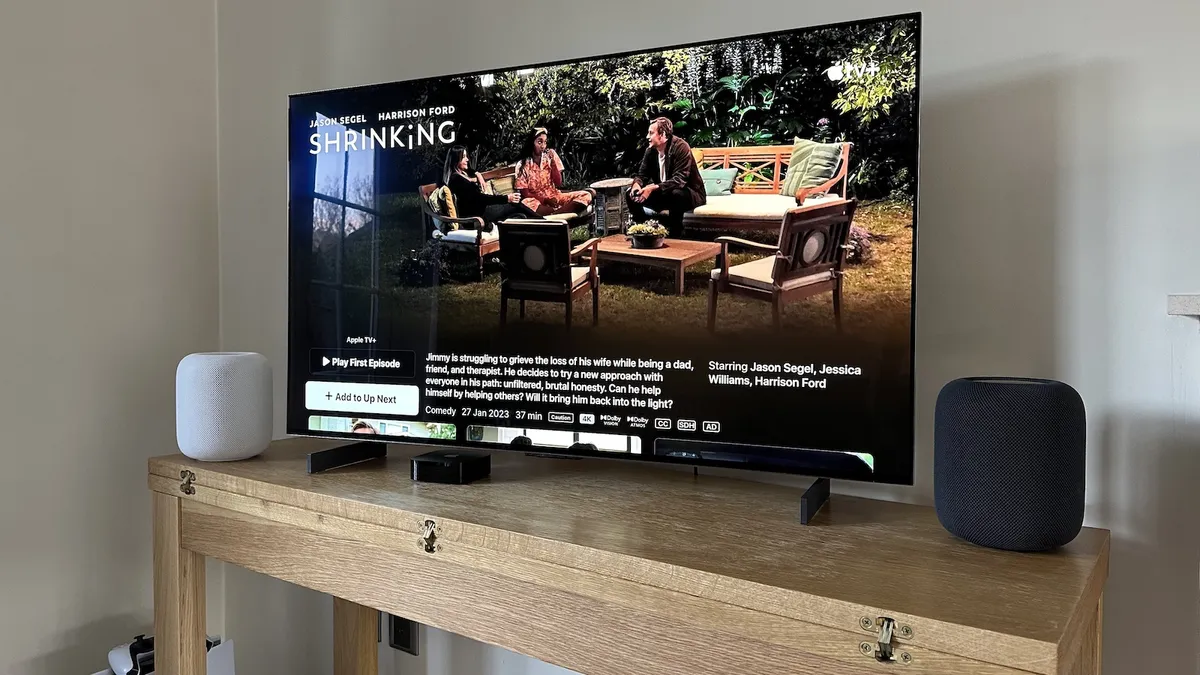
Let’s not be all doom and gloom. Head tracking might have its place in your headphones' arsenal of weapons; just possibly not when it comes to music. If the technology isn't quite capable of effectively replicating the experience of having music emanating from a fixed source, it may make more sense when it comes to enjoying your favourite movies and TV series.
Here's our TV and AV editor, Tom Parsons, to explain why:
“I share Harry’s fairly negative view of headphones head tracking for music; but I’m actually a big fan of it for movies. When my family hits the hay, I often switch from my ‘real’ Dolby Atmos system to listening via my AirPods Max, which are connected to an Apple TV 4K.
“The way the Spatial Audio head-tracking anchors the audio to the on-screen movie makes for a really natural aural experience that’s much closer to the listening-out-loud experience than you usually get from headphones. I genuinely think this is a great way to enjoy Dolby Atmos movies if you don’t have the space or budget for a home cinema speaker system.”
That makes a lot more sense. If you're not able always to enjoy your movies ‘out loud’, a technology which can replicate the feeling of having audio emanating from the screen, all while keeping it from spilling out all over the place when you’re trying not to wake up the wife and kids, feels far more appropriate.
Provided you have a pair of headphones that are good enough in the first place, of course…
The right tech in the wrong place?
Head tracking, it seems, has its place – just not when it comes to listening to your favourite music.
I can still see an argument for the virtues of pure spatial audio, yet it's hard to think of an instance when adding head tracking into the mix elevates, say, Nirvana's MTV Unplugged in New York set to the heights of the original recording. I don't think the tech is going to get to the point where I'm convinced I'm sitting in the same room as Kurt Cobain and his tatty green cardigan.
For movies, however, I'm far more sold. As many of my colleagues have pointed out, it feels far more appropriate for immersing you in your cinematic experience, especially when circumstances demand that you are restricted to head-bound listening.
Perhaps the lesson here is that there’s a time and a place for every emergent audio technology: you sometimes just have to figure out what works best for you.
MORE:
Don't Look Back in Anger at these classic 1996 tracks turning 30 this year
What is Apple Spatial Audio? What devices support it, and is it like Dolby Atmos?
I spent the day listening to Oasis in Spatial Audio, and heard the tech at its best and worst

