
Sonos makes speakers of all different kinds, from soundbars to portable models. But as different as they are, they all have one thing in common: they all fit neatly into the brand's ecosystem of wireless speakers.
That means your portable Bluetooth speaker can play the same song at the same time as your home surround sound setup, whether it's in the same room or not. Which is pretty cool.
They also support most popular streaming services, are built well and are simple to use. Plus – with only a couple of exceptions – they sound pretty great.
If you're unsure which Sonos speaker is for you, we're here to help. We'll help you navigate the range by breaking down what each speaker does, how it compares to what else is available and whether you should buy it.
We're focussing on Sonos music speakers here, but if you're after one of the firm's soundbars, check out our guide to which Sonos soundbar you should buy.
Sonos Era 300
Should you buy the Sonos Era 300?
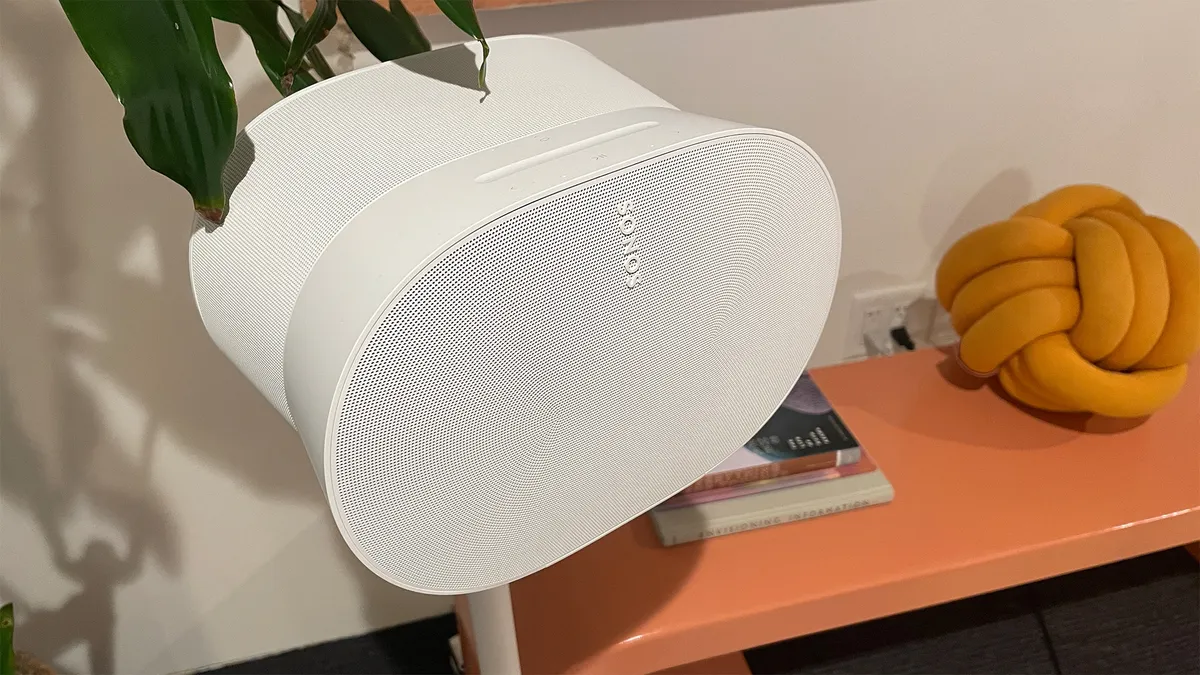
It might be over three years old now, but the Era 300 is still one of Sonos' most ambitious and impressive speakers – it earned five stars and a What Hi-Fi? Award in a previous year. It's the company's most versatile offering yet, with both Bluetooth and wired line-in onboard (Sonos offered these features before, but never previously in the same speaker).
The usual Sonos features are there too, including wi-fi 6, AirPlay 2, Sonos voice control and Alexa support (but no Google Assistant).
This speaker shares all these traits with its cheaper brethren, the Era 100 (see below). But the two are quite different propositions.
The Era 300 is built to show off spatial audio with Dolby Atmos tracks. Its unique cinched hourglass design houses six drivers (four tweeters, two woofers) with custom waveguides that fire sound out forwards, upwards, left and right to surround you with music. Each of these drivers is powered by its own class D amplifier.
The Era 300 can also be used as Dolby Atmos rears in a surround system with one of Sonos' soundbars – like the Arc Ultra or Beam Ultra – and a Sub.
Of course it wouldn't be much use if the Era 300 didn't support spatial audio via streaming services, but thankfully it does. It supports Dolby Atmos-powered spatial audio from Amazon Music, as well as spatial audio via Apple Music (it was the first speaker to do so outside of Apple's own devices).
There's no support for spatial audio via Tidal yet though. Hopefully it's coming soon.
Should you buy the Sonos Era 300?
If you can afford it, yes. It's Sonos's most impressive speaker yet, with an immersive sound, fantastic versatility thanks to its Bluetooth and feature-packed app, and a unique design. It offers the best example of spatial audio playback we've heard in a speaker yet, with a large-scale, open sound that's detailed and dynamic.
It is quite pricey, though. And it's a shame you have to pay extra for an adapter in order to plug in wired sources – it costs £19 / $19 / AU$35.
Is it the best smart speaker at its price?
Quite possibly. It outdoes even the Apple HomePod 2 (£299 / $299 / AU$479) in terms of sonics – Apple's smart speaker sounds positively small next to the Era 300.
Though as we say, it is mighty pricey, even more so now – a recent price rise saw it reach £499 / $499 / AU$799, compared to the launch price of £449 / $449 / AU$749. But if you can stretch to it, you won't be disappointed.
- Read our full Sonos Era 300 review
- Full comparison: Sonos Era 300 vs Apple HomePod 2
- Here's why one writer believes the Era 300’s spatial audio isn't a gimmick
Sonos Era 100
Should you buy the Sonos Era 100?

The five-star Era 100 replaced the old five-star Sonos One, and shares many of the same abilities as the Era 300 (above). It too has Bluetooth 5.0, wi-fi 6, AirPlay 2, Sonos voice control and Alexa support, as well as a USB-C line-in.
Also like the Era 300, it can handle audio files up to 24-bit/48kHz, and has the same new top panel interface with touch capacitive controls.
But the design is a lot more conservative. That's because it's designed to deliver stereo sound, but can't handle spatial audio. This is still an upgrade over the Sonos One though, which was only mono.
Inside are three class D amplifiers powering two angled tweeters with custom waveguides and a 25 per cent bigger woofer for a fuller low end. You can pair two Era 100s together, and they can also be used as rear speakers with certain Sonos soundbars.
Should you buy the Sonos Era 100?
This one is rather straightforward: if you want an entry point into the Sonos ecosystem, the new Era 100 is a terrific way in. It's better than the outgoing Sonos One in nearly every way – it sounds bigger, is more detailed and more open, digs deeper into the bass and simply blows the One away sonically.
Is it the best smart speaker at its price?
Also again, competition here is fierce. While the Era 300's price went up, the 100's price has dropped in recent years – it now sells for £199 / $219 / AU$319, or cheaper on a deal. That's more than the HomePod Mini 2 (£149 / $149 / AU$229) and Amazon Echo (4th generation) (£90 / $100 / AU$149). It trounces the latter for sound quality, but we haven't reviewed the HomePod Mini 2 yet.
The excellent Apple HomePod 2 is quite a bit pricier, but it does offer a more nuanced, textured delivery. But the Era 100 hold its own with a wider range of features; it offers plenty for a lot less money.
- Read our Sonos Era 100 review for the full verdict
- Full comparison: Sonos Era 100 vs Sonos One
Sonos Play
Should you buy the Sonos Play?

The Play is a versatile, do-it-all Sonos speaker. It's portable, with Bluetooth for playing music from a mobile device, but has a dock for more permanent placement within the home (while also keeping it charged). It's named after an old Sonos speaker range, but with enough features to satisfy most use cases, this is no exercise in pointless nostalgia.
Rather, it's like the lovechild of the bulky Move 2 and more svelte Roam 2. You can stream files up to 24-bit/48kHz over wi-fi, and using the USB-C port you can hook it up to a turntable (though you'll need an additional line-in adapter as well).
It's rated IP67 – which is plenty hardy – for outdoor adventures, and it sounds very good indeed.
Should you buy the Sonos Play?
If you want a portable speaker to soundtrack your barbecue while sitting pretty on the kitchen counter in the winter months, then yes, this four-star speaker would be a good choice.
Is it the best portable wireless speaker for its price?
That's harder to answer. At £299 / $299 / AU$499 it faces some pretty stiff competition – it's approaching HomePod 2 territory. You can also get five-star models for less, like the JBL Xtreme 5 or Charge 6 – though none of these models mentioned have the same home-and-away versatility as the Play.
- Read our Sonos Play review
- Sonos Play vs Apple HomePod 2: which is better?
Sonos Roam 2
Should you buy the Sonos Roam 2?

The Roam 2 arrived in the summer of 2024, offering redesigned controls, simpler Bluetooth pairing, a more subtle design... and that's it.
If we sound a little underwhelmed, it's because we are. Don't get us wrong, these changes are all welcome. The original Roam required setting up on your home wi-fi network before it could pair with a mobile device – hardly in keeping with the portable vibe – and pairing itself required holding down the power button for a set amount of time.
Not with the Roam 2 – this can pair straight out of the box, and there's a dedicated button for the process.
The Sonos logo is now monochromatic – i.e. the same colour as the device, making it more subtle. The original looks a bit cheap by comparison.
And it offers the same Trueplay optimisation, 10 hours of battery life and IP67 waterproofing, and comes in five colours: Olive, Sunset, Wave, Black and White.
All of which is good. But the sound quality hasn't been improved, and the price has been increased. So you can see why we're a little underwhelmed.
Should you buy the Sonos Roam 2?
The higher price and lack of any sound quality upgrade led to it only scoring three stars in our review. It's not that it's a bad speaker – we praised its "surprisingly substantial sound and user-friendly design" – but the competition has moved on.
Is it the best portable wireless speaker for its price?
If you own a Sonos setup and want a portable speaker that you can take out and about but that will also sync with the rest of your home speakers, then yes. But as a standalone portable speaker? There are better-sounding options available for the same £179 / $179 / AU$299 or less – like the JBL Charge 6 and Flip 7, for instance.
- Read our Sonos Roam 2 review
- Sonos Roam 2 vs Roam 1: is the sequel better than the original?
- Sonos Move 2 vs Roam 2: which Bluetooth speaker is for you?
Sonos Roam SL
Should you buy the Sonos Roam SL?

The Sonos Roam SL is almost identical to the original Roam but lacks a microphone. The mic-free Roam comes with a price cut, making it even more affordable than its sibling.
Losing out on the microphone means it lacks voice-activated controls via Alexa and Google Assistant. The Roam SL also does away with Sonos' Auto Trueplay and SoundSwap features, as both require a microphone.
That aside, the Roam SL mimics the Roam with an IP67-rated waterproof design, Bluetooth, wi-fi and AirPlay 2, dual Class-H amplifiers, Qi wireless charging capability and more. Functions can be controlled via the superb Sonos app.
Should you buy the Roam SL?
If you want Sonos' cheapest Bluetooth speaker, the Roam SL has your name written all over it. We've yet to review the SL in full, but it should be a decent entry-level option.
Is it the best portable wireless speaker for its price?
We'll have to reserve judgement as we haven't run the rule over every aspect of the Sonos Roam SL, but on paper, it's a tempting proposition for those who want to dive into the Sonos ecosystem at the lowest price point.
Where can I buy the Roam SL?
The Sonos Roam SL was announced on 1st March 2022 and it's still on sale. You can buy it from Amazon for £159 / $159 / AU$269.
- Sonos Roam SL vs Sonos Roam: which is the best portable speaker for you?
Sonos Move 2
Should you buy the Sonos Move 2?

Launched in 2019, the Move was Sonos's first-ever portable Bluetooth speaker, giving users the option to take their audio into the garden, or even into the bathroom to keep them company.
The Move 2 arrived in September 2023, and while the large-ish speaker hasn't changed much in essence, it does bring in stereo sound and a longer battery life of 24 hours, as well as some refined design and user-friendly tweaks. And a higher price tag than before, at £449 / $449 / AU$799.
As you'd expect, the Sonos Move is as much a Sonos wi-fi speaker as those before it – you get network music streaming, multi-room smarts and voice assistant – but it's big, heavy and expensive compared to the Sonos Roam.
That said, the Move 2's 3kg heft, two angled tweeters and woofer with Class D amplification enable it to deliver weighty sound that is spacious, loud and entertaining. All in all, it does a fine job of delivering the Sonos experience in a portable-ish package.
It also features Auto Trueplay tuning, AirPlay 2 and an IP56-rated dust and water-resistant design.
Should you buy the Move 2?
If you want a light, portable, Bluetooth Sonos speaker, you'll want to consider the smaller, smarter Roam 2 or Play. However, while the Move 2 is heavier and more expensive, it also delivers a sense of scale and weight that these models can't match.
At £449 / $449 / AU$799, though, the Move 2 is rather expensive. You can buy the Era 300 for the same money, which is astonishing to us.
The Era 300 will give you a more powerful sound and it's better with detail, timing and punch, too.
Is it the best portable wireless speaker for its price?
If you want a significantly sized Sonos speaker that is portable, the Move 2 (and the older Move) is the only speaker to match your requirements.
But if you're more interested in portability and performance than Sonos wi-fi features, you can get better sound-per-pound value from the Dali Katch G2 and JBL Xtreme 5.
- Read our Sonos Move 2 review
- See how the Sonos Move 2 vs Move compare
- Best Bluetooth speakers: portable speakers for every budget
Sonos Five
Should you buy the Sonos Five?

The 2021-launched Sonos Five is a beefy, all-in-one wireless streaming speaker that looks and sounds a lot like its predecessor, the Play:5.
We awarded the Five four stars in our review. It retains all the features that made its predecessor popular – including a 3.5mm line-in for an external source and the ability to orientate the speaker in three ways – but adds improved wi-fi connectivity.
The driver arrangement also mimics the older Play:5 – six class D amplifiers powering three 10cm mid-woofers and three tweeters. Each Five speaker can be switched to mono for a more traditional stereo pair configuration, or you can use them as rear surrounds with a Sonos Arc soundbar.
Should you buy the Sonos Five?
Sonos' flagship wireless speaker is a great choice for those who want a standalone wireless speaker that goes big and loud, or who want to build a complete multi-room or home cinema system.
But we found it rather less expressive and dynamic compared with the newer Era 300, with a slightly rounded-off treble and a leaner presentation. And there are plenty of alternatives that offer Bluetooth, which the Five lacks.
Is it the best wireless speaker for its price?
The Five has two key omissions: it lacks voice controls and Bluetooth. And there are better-sounding smart speakers for the money, namely the Apple HomePod 2.
Not to mention competition from within, with the newer spatial audio-supporting Era 300 launching for similar money and offering a more capable, richly detailed sound overall (and more features, including voice control, for less money).
If you're already deep in the Sonos ecosystem, the Era 300 is the better option, while if you're a big Apple fan, the HomePod 2 might be for you instead.
- Read our full Sonos Five review
- Sonos Era 300 vs Sonos Five: which high-end Sonos speaker is for you?
Sonos multi-room system
So, should you buy a Sonos multi-room system?

The great thing about Sonos is not only its wide range of products, long list of streaming services, user-friendly app and set-up, and consistently impressive performance; it’s also that your system can constantly grow – whether that's through adding wireless speakers to your soundbar set-up or planting them in another room.
And if you want to add voice control into the mix, it's a seamless process.
While no longer compulsory, we would recommend anyone committed to the multi-room cause to hardwire at least one (a ‘master’) speaker to your network router, so you can take advantage of the proprietary peer-to-peer mesh network that makes Sonos so reliable.
It's worth noting that the Sonos S2 app supports 24-bit/48kHz streaming via Qobuz, Apple Music and Amazon Music Unlimited. The Sonos S2 app lets you play 24-bit files from a local drive, but you can stream hi-res tracks from these music services, too.
Should you buy the Sonos multi-room system?
As an entire ecosystem, Sonos is hard to fault – if you don’t mind sacrificing high-resolution audio support across the board, of course.
The 2024 app update had some teething issues, but those are now a distant memory. And its recent launches mark something of a return to form, with the Arc Ultra and Beam Ultra soundbars earning five stars. Even the Ace Ultra wireless headphones were an improvement on their underwhelming predecessors.
Sonos works well and is supremely versatile, even with product prices increasing recently. Add in the fact that you get access to the world's widest range of music services, and it's an ecosystem to be reckoned with.
- Read our Sonos multi-room system review
Sonos alternatives
How about Sonos alternatives?
Sonos is far from the only option when it comes to choosing a multi-room system. The company may have been first, but big players such as Bose, LG and Yamaha, and hi-res supporting brands, including Bluesound and Denon with their BluOS and HEOS (respectively) platforms, have since joined the fray.
The increasingly popular (and cheaper) smart speakers from Amazon and Google also offer multi-room streaming across their various voice-controlled products, while the Apple HomePod 2 and HomePod Mini 2 boast exceptional multi-room powers thanks to AirPlay 2 (which Sonos also has in select products).
While most rivals may not have been able to topple the multi-room giant and Sonos remains the most recognisable name, many wireless products these days now come with some kind of multi-room feature as standard – whether that's through AirPlay, BluOS support or otherwise. So it's now easier than ever to create a multi-brand, multi-product multi-room system.
Check out our full 'everything you need to know about Sonos' guide for an A to Z on the company's ecosystem and its alternatives.
MORE:
- Save big with this week's best Sonos deals
- Our verdict on the best Sonos alternatives
- Brush up your skills: 32 Sonos tips, tricks and features

