
While I was once an all-around gadget reviewer with laptops within my purview, these days I rarely get excited about what's going on in that world.
This concept from Lenovo has really grabbed my attention, though, primarily because I think it has potentially awesome ramifications for the TV world.
Said concept is the Lenovo Legion Pro Rollable – a laptop with an OLED screen that can seamlessly expand from its default 16-inch mode to a much larger 21.5-inch size.
Here's my colleague from Tom's Guide, Jason England, having a play with it at CES:
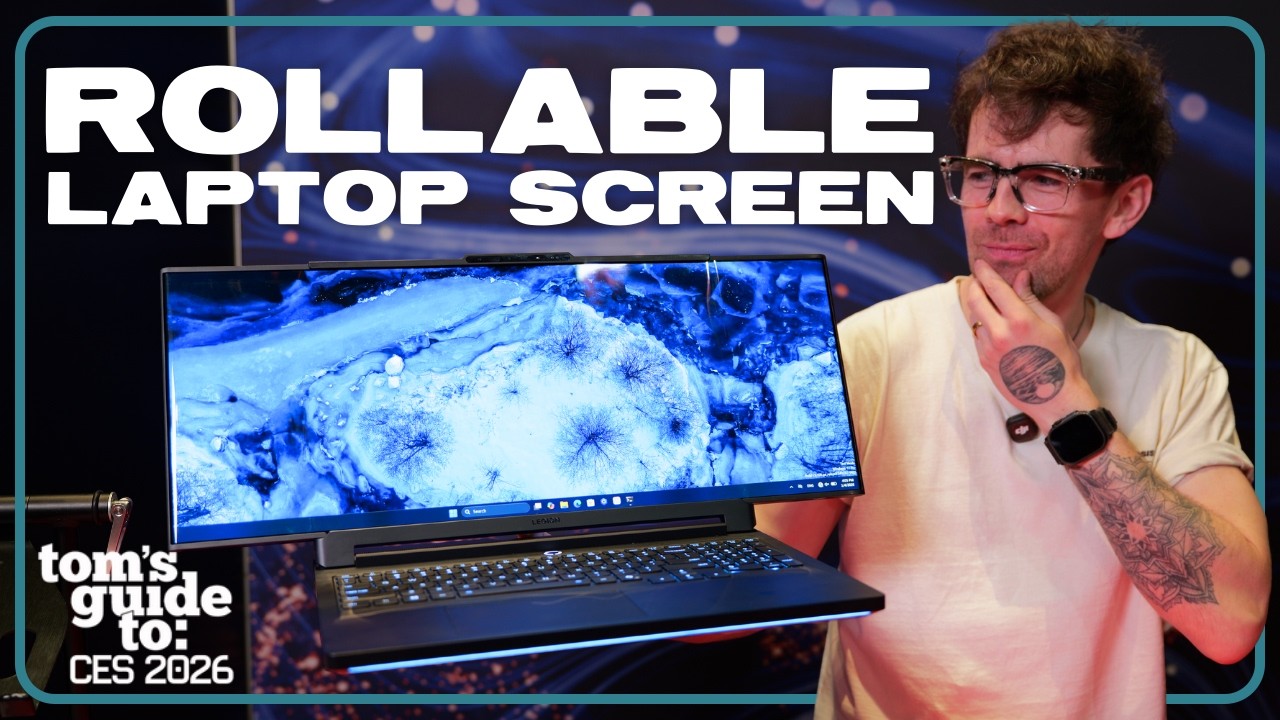
This isn't the first laptop with an expandable screen to appear, but it is the first (to my knowledge) that has expanded horizontally rather than vertically, and that's why it's got me all hot under the collar about TV applications.
Jason and the rest of the PC press are naturally focused on the gaming potential here – 'ultrawide' gaming is a massive thing these days, after all – but I can't help but see the potential to eradicate the black bars we all put up with at home most days.
As I'm sure you're aware, almost every TV currently on sale has a 16:9 aspect ratio, which is the one used for most broadcast TV. But most movies (and an increasing number of TV shows) are displayed in a wider aspect ratio, usually 2.39:1, hence the black bars at the top and bottom of the screen.
Most of us got used to these black bars a long time ago, but the disappointing truth is that your screen is essentially shrinking whenever you play typical cinematic content – i.e. exactly the stuff you want to look its best.
Philips gamely tried to solve this way back in 2009 with its Cinema 21:9 TVs which, as the name suggests, had a movie-friendly 21:9 aspect ratio.
The problem was that all of the 'normal' TV you watched was compromised, either by black bars on both sides or some warping/cropping. It was a bit of a weird TV for watching football and the like, in other words.
But what if we could buy a 16:9 OLED TV that could extend to 1.85:1, 2.39:1, 21:9 to suit a movie or TV show? No longer would the most important content result in TV shrinkage; it would instead be expanded for maximum cinematic impact. Plus, there would be no black bars in sight.
I'm incredibly impressed by the smoothness and seamlessness of Lenovo's rollable concept, and it seems like it could be perfect for TVs if it could be scaled up.
Speaking of which, the rollable OLED tech actually comes from TCL CSOT, the panel-producing arm of TCL.
While TCL CSOT isn't yet producing OLED panels for TVs, it has recently broken ground on a $4.15 billion factory that will manufacture OLED panels using new, cost-effective inkjet printing technology, and it seems likely that this will eventually be put to use for TV-sized screens.
And let's not forget that TCL and Sony have just announced their intentions to merge their TV businesses. Could a future version of the Bravia 8 II have an expanding screen for movies? It's certainly nice to dream.
MORE:
Enough future-gazing – here are the best TVs you can buy right now
Here are our (and your) thoughts on the proposed Sony and TCL merger

