
Televisions, where would we be without them? While viewing habits are changing – vertical videos are probably as popular as movies and TV shows – there is no replacing the large, glossy black rectangle that sits proudly in our living rooms.
Forgive our modesty, but we've tested more than a few TVs in our 50-year lifetime. We've charted everything from the rise of CRT TVs in the 1980s to handing out our first-ever TV Product of the Year Award in 2001, and testing every type of TV technology (and fad), including plasma, 3D, OLED, 8K and curved sets.
It's been a rollercoaster of a journey, and not every TV that we've tested has been perfect, but we're glad to say that there have been many, many good ones, and certainly some excellent ones that stand head and shoulders above the rest.
These TVs have left lasting impressions over the years; hence, we've made a list of the ones that have left the biggest impact over the last few decades...
Philips 28PW9512 (1997)

The big thing about Philips' 28PW9512 was its surround-sound capabilities.
It came with two external rear speakers that formed part of a seven-speaker design, consisting of four main internal speakers (two centre, left and right), and an internal subwoofer.
This configuration helped to accurately pan sound around a room, as well as digging up enough low-range information (thanks to that 19W sub) to deliver some meaty effects.
Picture quality was strong too (100Hz refresh rate for less flickering), but it was the 28PW9512's audio performance (and relatively reasonable £1200 price) that sees it make this list.
Toshiba 32MW7DB (1998)

Toshiba's 32MW7DB also included external rear speakers, and the result was a TV that sounded better than any we'd heard before.
The Toshiba was a great all-rounder, featuring excellent blacks and good contrast. Colours that were stable and natural.
Neither too expensive nor too big, back in 1998 the Toshiba fit the bill for a TV that delivered great sound and vision.
SIM2 RTX55H rear projection (2004)

Huge TVs weren't common in 2004, so if you wanted to go big your best option was a rear projection TV.
At a considerable 55in, and costing an even-more-considerable £8500, the SIM2 Grand Cinema RTX 55H offered an image of scintillating quality, thanks to its use of DLP (Digital Light Processing) - a technology more usually found in projectors. It sported a DVI-D connection too.
Blacks were rich and consistent - as good as, if not better than, a plasma TV - while screen noise was virtually eradicated. External speakers were needed though, as the TV itself didn't feature any.
But despite this, the Sim2 was arguably one of the best big-screen TVs of its time.
Loewe Concept L32 (2005)

Back in 2005, we called the Concept L32 "compact, discreet and stylish".
Whether you were watching in standard or high-def (the set had a 1366 x 768 panel and came with an HDMI port, just in time for Sky+ HD), it succeeded in producing a bold and realistic image, with an excellent range of colours and class-leading levels of picture detail for the time.
Even at £1800, we considered it a bargain in terms of performance.
Samsung PS-50Q7 (2006)

In the mid-2000s, 50in displays were the domain of rear-projection giants. But that was changing fast, with an influx of slim flatscreens available in bigger sizes.
Samsung's plasma was seen as rather modestly priced for a big TV - just £2200. Its forte was its ability with bright colours and fast motion - it served up a clean, refined image that really shone when fed HD pictures.
You could argue the emergence of TVs such as the PS-50Q7 provided the launchpad for the adoption of big flatscreens in the home.
Pioneer PDP-508XD (2007)

The PDP-508XD was one of Pioneer's first-generation Kuro TVs, a series that retains its place in What Hi-Fi?'s affections. It's in the What Hi-Fi? Hall of Fame for a reason.
The £3000 508XD's phenomenally deep blacks were better than any prior plasma or LCD we'd seen. For its time, it had amazing contrast and delivered rich and attractive images.
Though subsequent TVs would overhaul the 508XD in terms of quality, it remains one of the era's most remarkable performers.
Samsung UE55C9000 (2010)

Back in 2010, if you wanted a slim TV with the latest technology, Samsung's UE55C9000 was the set to have - provided you could spare £7000.
A depth of 7.98mm and an exquisite finish (brushed metal, no less) made it desirable, and the UE55C9000's picture was nothing to be sniffed at either. Images were sharp and clean, "full of contrast and low-light insight".
Its featured tech would soon become the norm, whether it was a Freeview HD tuner, support for Samsung's Internet@TV service or smart features that allowed for picture-in-picture images.
The UE55C9000 was a stunning technical showcase, and a glimpse of what was to come.
Read our Samsung UE55C9000 review
Bang & Olufsen BeoVision 11 (2013)

You might expect a £5250 TV with a motorised pedestal stand and customisable grilles to be an exercise in style over substance, but the BeoVision 11 refuted that suggestion with terrific picture presentation. It balanced rich, nuanced colours with strong contrast, whilst displaying a composed hand with motion-handling.
The sound was superb too, incorporating active stereo speakers that gave the audio a weight and authority rarely achieved by a flatscreen TV before or since.
An extravagant but excellent TV.
Read our B&O BeoVision 11 review
Panasonic TX-P50GT60B (2013)

One of the last plasma TVs produced by Panasonic, the GT range delivered high-end features at a mid-range price (an aggressive £1200), putting in an outstanding all-round performance. Arguably Panasonic has yet to match its success.
The GT60's picture quality was stunning, producing a well-balanced, natural colour palette that could pack a punch. Blacks were inky and detail levels astonishing, with 3D coming across as convincing too. Our only issue was the small selection of smart apps.
The GT series was one of our more lauded TV ranges from the early 2010s, and the TX-P50GT60B was perhaps its best model. A deserved Award-winner, with picture quality that was second to none at its size and price.
Read our Panasonic TX-P50GT60B review
LG 55EA980W (2014)

The first generation of full-size OLEDs took a while to appear, finally surfacing in 2014 after smaller efforts from LG and Sony in preceding years. They were rough round the edges, but LG's 55EA980W showed they had great promise.
Deep pockets were needed (£8000!), but what you got was a Full HD screen with black levels that were incredibly inky, punchy contrasts and a clean-looking image with a natural colour balance.
Motion issues, a lack of subtlety in its deepest blacks and brightest whites, plus that price tag provided a few gripes, but it also served as an indication of OLED's potential. This one left us excited about the new technology's future.
Read our LG 55EA980W review
Sony KD-75X9405C (2015)

We called the KD-75X9405C "Sony's best TV of 2015", and it absolutely deserved that tag. An exemplary (and huge) set that produced great pictures and remarkably good sound for a flatscreen.
Its audio performance was hard to ignore, thanks to the inclusion of speakers on each side of that could "properly go loud without hardening up".
Bass performance was good too - this was a rare example of a TV that didn't make us miss the presence of a soundbar.
Picture contrast was superb, and detail levels were staggering even for a £6000 4K TV, offering the sort of insight that revealed the most intricate of details.
Read our Sony KD-75X9405C review
Sony KD-55A1 (2017)

The promise of OLED has been most fully realised by Sony's KD-55A1, the company's first full-size OLED TV. It embraces a bold design (the stand contains the connections, the rear panel a subwoofer), an 'invisible' speaker system (four drivers vibrate the glass panel to produce sound) and comes with all the smart features we'd expect.
It's the picture that really grabs the attention though. Boasting the inherent qualities of OLED (deep blacks, uniform whites), it complements that with a vibrant picture and solid, almost three-dimensional image. A brilliant TV, even at £3500 - the OLED bar has been raised.
Read our Sony KD-55A1 review
Philips 48OLED806 (2021)

Name a better combination than OLED and Ambilight... we'll wait. Philips' mid-range OLED TV took home an Award at 65-inches in 2021, but it's the 48-inch version we're highlighting here, as it snapped up the coveted Product of the Year title.
It delivered top of the line picture performance at a screen size that was accessible for smaller living rooms, alongside support for Dolby Vision and HDR10+, as well as HDMI 2.1 connectivity; something that the rival Sony at the time was lacking.
Speaking of the competition, this quote from our review really sums up why we rated this TV so highly, and why we're enshrining it on this list:
If you’re looking for the big reason to buy the Philips 48-inch OLED TV over the other two major players, then this is it: its picture performance is simply the best. Sharper and more sophisticated in its use of light, it just feels a step above.
Read our Philips 48OLED806 review
LG OLED C2 (2022)
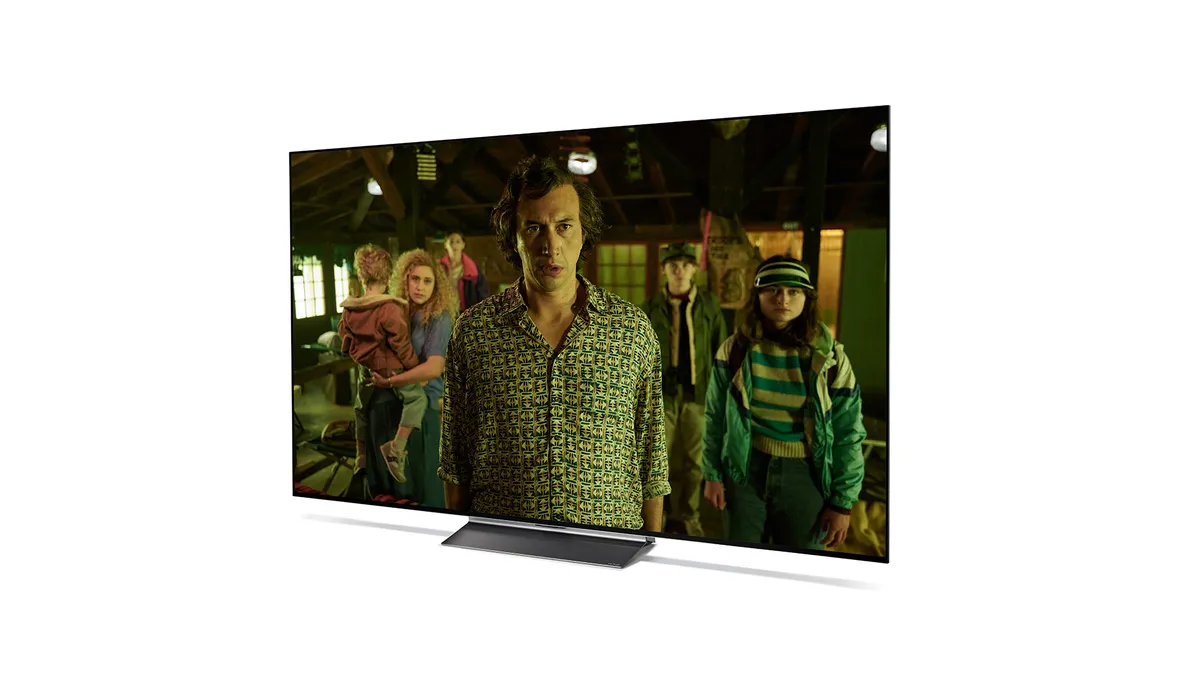
You'll notice that we haven't listed a specific screen size for the LG C2, and that's because we have to give kudos to this TV in all sizes. It took home no less than four Awards in 2022, including Product of the Year for the OLED65C2; but its legacy and impact are what really earn it a place on this list.
We know the LG C-series is incredibly popular, and the C2 is essentially the blueprint for the C-series models that followed, including the C3, C4, C5, and C6. What do these TVs have in common (aside from being LG OLEDs)?
That's right, they all bear an uncanny resemblance to the C2 in design and features, and they're all What Hi-Fi? Award-winners. The C2 is especially important as it was the first OLED TV to come in a 42-inch screen size option, which inspired the likes of Sony, Samsung, Panasonic and Philips to follow suit.
This influential and excellent OLED TV's impact is still felt almost five years on, which is why we have to commend it.
Read our LG OLED42C2 review
Read our LG OLED65C2 review
Sony Bravia 8 II (K55XR8M2) (2025)

It's rare that a TV strikes genuine awe upon first sight, and yet the Sony Bravia 8 II managed to do exactly that when we tested it last year.
Scoring Sony its third Product of the Year win in a row, the Bravia 8 II is an OLED TV of immense talent when it comes to picture and sound performance. It offers oodles of contrast, solidity and depth, making the picture feel immensely three dimensional and realistic, while the actuator-based sound system vibrates the display to create a crisp, detailed and dynamic sound that is very well matched to the action on screen.
Aside from only sporting two HDMI 2.1 sockets, the Bravia 8 II is an almost flawless TV, and to make it even more compelling, Sony somehow managed to slice the launch price in such a way that it was considerably cheaper than the outgoing A95L at the time.
This TV remains a fixture of our reference system in our AV testing room, and we can still vouch for it a year on.
Read our Sony Bravia 8 II review
MORE:
Check out our picks for the best TVs
As well as the best OLED TVs
And the best Mini LED TVs
