“The chip by itself is not really the story. The H2 from a few years ago is not the H2 that we’re introducing into the AirPods Max 2 today, because it’s been enhanced with so much embedded firmware that has really enabled this growth of features across the years.”
Tim Millet, Vice President of Platform Architecture at Apple, is explaining how the brand's most powerful H2 silicon chip has been "purpose-built for audio application", and has evolved over the years, along with the challenges of implementing it into an over-ear design.
First introduced in 2022 with the AirPods Pro 2 wireless earbuds, the H2 chip is now available for the first time in the new AirPods Max 2 over-ears. It's been the main focus of the second-generation model, as with that new chip comes plenty of advanced features such as Conversation Awareness, Adaptive Audio, and updated Adaptive EQ, as well as improvements to ANC and, of course, sound quality.
I've been using the AirPods Pro 2 and Pro 3 since their respective launches, and am familiar with many of these features – it seems almost strange that Apple's premium over-ears haven't had half of them until now. That they're finally available on the Max 2 is welcome news, especially to iOS fans.
But is it a simple matter of adding the same chip to the new headphones and calling it a day, or is there more going on beneath the surface to tailor the experience to the over-ear AirPods?
H2 chip: a constant evolution

The H2 also powers so many of the AirPods Max 2's features and performance; but these new additions and sound/ANC improvements aren't done in isolation.
As I speak to Tim Millet and Eric Treski, Apple's director of Audio Product Marketing, they both confirm that the various teams involved – the acoustic team, the hardware engineering, product engineering, software engineering, firmware teams – all work together, continually communicating to create and develop what they want to achieve in every headphone product.
That's possible thanks to the silicon base, which Millet says has "evolved and grown" from the first time we encountered it four years ago in the Pro 2.
"When we were imagining H2 many years ago," says Millet, "we appreciated that the team was going to be focused on this range of products, not just one product." And so the aim was to offer the acoustic team a rich platform that was extensible – one where new capabilities and functions could be added over the years.
"We really go down to the fundamentals," says Millet. "We go and sit down with the acoustic engineers and with our firmware engineers – the folks who live and breathe audio – and we try to figure out what are the essential tools [they] need to be able to deliver not only the short term version of what maybe your initial feature set might be, but how do we build an extensible platform on which you can build over time?"

Apple doesn't use off-the-shelf components or chips. The H2 chip is unique to Apple and custom-built for its products, with energy efficiency and the lowest possible latency being a big part of its architecture to offer a seamless experience.
On top of that, Treski says that in the AirPods, "the amplifiers, the drivers, the whole architecture system – all of that is custom-made. They're not taken off the shelf and pieced together – everything is purpose-built".
That's a very privileged position to be in compared with most of its rivals, meaning that Apple has full control and visibility over every element of its audio products, without having to rely on third-party suppliers.
Adapting H2 features from in-ears to over-ears design
In the AirPods Max 2, the H2 chip has allowed the brand's engineers the opportunity to tweak its existing features, and bring new ones in too. The 40mm custom drivers return, but powering them is a new high dynamic amplifier – the very same amplifier, Treski tells me, as the one used in the AirPods Pro 3.
Alongside that, the additional bandwidth of the H2 chip allowed Apple to deliver "next-generation" Adaptive EQ.
"The amplifiers, the drivers, the whole architecture system – all of that is custom made... everything is purpose built."
Eric Treski, director of Audio Product Marketing at Apple
Adaptive EQ might be the secret, silent ingredient of AirPods. This always-on feature uses the inward-facing microphone to constantly adjust the frequency in real time (48,000 times a second, in fact) to optimise the sound to the wearer's ear shape and fit of the headphones/earbuds at all times.
We've experienced Adaptive EQ in the in-ear designs of the Pro 2 and Pro 3 buds before, so surely it's a matter of simply sticking the same feature onto the over-ears? Not quite.
Treski explains that in an in-ear product, that inward mic crucial for Adaptive ANC is much more directed into your ear canal and towards your eardrum, whereas on the over-ear Max 2, that mic sits much further out of your ear. The mic is situated in the centre of the earcups (in the Max 2), so even though it is pointed right at your ear, it's much further away.
“So there are advantages to having bigger headphones and bigger drivers and such, but at the same time, it’s really tricky for the algorithms to get Adaptive EQ to work very, very well with a mic that’s sitting so much further away," he says. “So that took a lot of effort and work in a different way than it would with an in-ear product.”

It's one of the many examples of where the advanced features made possible thanks to the H2 chip – but so far only experienced on in-ear models – have been tailored to the over-ear performance.
“Getting these many familiar features to function in this new form factor requires a level of specialisation across all the algorithms and firmware," says Millet. "So yes, it is the same piece of silicon, but really, by itself, it's nothing without adding on all the layering of audio expertise that was put into the algorithms."
ANC improvements had a surprise inspiration
Active noise cancellation and Adaptive Audio were other areas that had their challenges.
The AirPods Max 2 claim to offer 1.5 times more ANC than their predecessor (a number measured "across an average of all frequencies," says Treski) and that was made possible by the additional computational algorithms made available inside the H2 chip.
What's more, Treski says a lot of the learnings for improving ANC in the Max 2 came from a surprising place: the AirPods 4 with ANC.
"That product was insanely challenging to do, to get ANC that good in a product that doesn't have ear tips. And that was a massive undertaking and challenge for our acoustic engineering team... So all those learnings essentially contributed to AirPods Pro 3, and then applying that into AirPods Max as well."
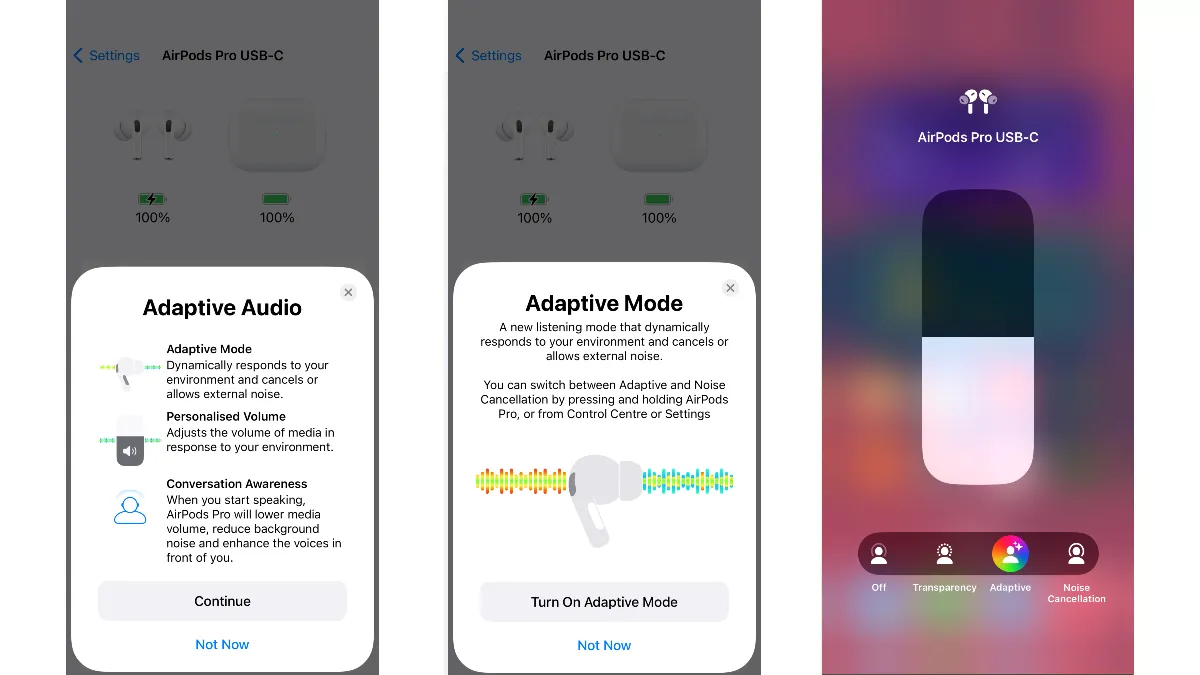
One of my favourite AirPods Pro features in recent years has been Adaptive Audio, which adjusts the level of ANC according to your surroundings without compromising the sound quality of what you're listening to.
I've found the effect to be so natural that it's almost invisible in use – the shifts in noise modes are so subtly done that you can't hear or feel the seams, and it works a treat in daily use. That experience is repeated with the Max 2, where you're able to stay aware of your surroundings – on your commute, for instance – while still being able to enjoy the music being played.
“Being able to do that from a technical capability is more or less pretty straightforward," says Treski. "What's challenging to do, is to do that in a way that's enjoyable. What’s interesting about that is, even though the tuning and how you do it between the in-ear product and over-ear product is the same, what's so difficult about that is making sure that it's actually a good experience. Because we need to ensure that we're doing it in a way that's not annoying, and in a way that you would like."
"By itself, it's nothing without adding on all the layering of audio expertise that was put into the algorithms."
Tim Millet, Vice President of Platform Architecture at Apple
There are rivals from Sony, Bose, Technics, Sennheiser and more that feature various different noise modes, especially Transparency or adaptive modes, but in my experience, none of them sounds quite as natural in their implementation as AirPods do.
While rivals might outdo the 'Pods in some areas, such as outright sound and ANC, the way Apple balances its sonic signature and deploys its noise modes so naturally is quite remarkable.
To me, it never sounds artificial or like it's working too hard – which is an accomplishment in its own right. It's gratifying to hear that, alongside the technical aspects, 'enjoyment' is high on Apple's list of priorities for headphones.
"A very balanced sound signature"

And what about sound quality? Apple has a stellar record in recent years of maintaining a similar sonic balance across its products, from the AirPods 4 with ANC to the AirPods Pro 3 buds, and even the AirPods Max over-ears.
“Ultimately, the goal is to find a very balanced sound signature that has very clear separation of frequencies, that’s enjoyable to listen to for all different types of media and (by) all different types of people,” says Treski.
Millet reinforces this statement by saying that his team's job is to create a flexible, programmable and adaptable platform that allows the acoustic and product teams to maintain that familial audio quality across the AirPods product range, and meet the big challenges across different form factors.
"I think Apple's silicon story is a really great secret weapon for us," says Millet.
"But there's no cheating on sound quality. You can’t stick a DSP in and go short on some other thing. It really does require careful engineering across the entire platform.”
Do the long-awaited second-generation Apple over-ear headphones live up to the hype? Read our AirPods Max 2 review to find out.
MORE:
Check out our five-star AirPods Pro 3 review
Apple AirPods Max 2 vs AirPods Max: what are the differences?
Best wireless headphones 2026: reviewed and rated by our in-house experts