
The new Apple TV 4K is better in terms of audio and visual performance, plus it has some genuinely helpful new features over its predecessor. But it is a lot more expensive, so you’ll have to weigh up whether these gains are worth the financial pain.
Pros
- Better picture quality, particularly lower-res content
- Cleaner, punchier and more dynamic sound
- More advanced Siri
Cons
- Substantial price rise
- No 4K HDR via BBC iPlayer
- Not the best option for those with Blu-ray rips

The 2022 model is still an excellent performer, it’s just that the sequel takes picture and sound quality on a step. Most movie fans will be more than happy with the older Apple TV, but for a futureproofed model with all the bells and whistles, and an upgraded AV experience, this year’s iteration is the way to go.
Pros
- Excellent picture
- Expressive sound
- Responsive user interface
Cons
- Limited physical connectivity
- No 4K HDR BBC iPlayer
A new Apple TV is always big news, especially when it has been four years between models. But, despite the picture and sound upgrades, the Apple TV 4K (2026) is notable for one rather less positive reason: the price.
The new model costs a whopping £299, which is about twice as much as its predecessor was available for at launch. So does it justify this higher price? Or would you be better off sticking with – or even seeking out – the now discontinued model?
Let’s find out
Apple TV 4K (2026) vs Apple TV 4K (2022): specifications
| Header Cell - Column 0 | Apple TV 4K (2026) |
Apple TV 4K (2022) |
|---|---|---|
Resolution |
Up to 4K HDR |
Up to 4K HDR |
Frame rate |
60fps |
60fps |
HDR formats |
HLG, HDR10, HDR10+, Dolby Vision |
HLG, HDR10, HDR10+, Dolby Vision |
Bluetooth |
6.0 |
5.0 |
Remote control? |
Yes |
Yes |
Dimensions (hwd) |
3.1 x 9.3 x 9.3cm |
3.1 x 9.3 x 9.3cm |
Weight |
217g |
208g (Wi-Fi), 214g (Wi-Fi + Ethernet) |
Apple TV 4K (2026) vs Apple TV 4K (2022): price

This is the big one. The new Apple TV 4K launched at £299 / $299 / AU$449, which is £100 / $100 / AU$150 more than its predecessor’s entry-level variant. That unit has recently had a price hike, too – it actually launched at £149 / $129 / AU$219 for the 64GB model.
Admittedly the new model comes with 128GB storage as standard, and we know, inflation has pushed up prices across the board in recent years. But still, a doubling in price in four years is particularly hard to swallow.
** Winner: Apple TV 4K (2022) **
Apple TV 4K (2026) vs Apple TV 4K (2022): design

As you can see from the specification table above, there really isn’t much difference between the two devices in terms of specs – and that’s also true of their designs. They look identical, both being discreet black boxes with the same dimensions and only very slightly different weights.
You might be tempted to tuck such a small, inconspicuous device away in a cupboard – but don’t. Because the new model has far-field mics, it needs to be able to hear clearly what you are saying in order for its new hands-free Siri feature to work. So it’s better off positioned on a TV cabinet or shelf with a clear line of sight.
Physically, the only real difference between the two boxes is the power light, which now sits in the centre of the front panel instead of in the lower-right corner. The light is also slightly dimmer, making it less likely to distract you while you watch TV.
The remote returns unchanged, but you won’t hear any complaints from us about that. It feels premium thanks to the aluminium build, the buttons are tactile and the touchpad intuitive and responsive. It’s still a great way to operate the Apple TV.
** Winner: Apple TV 4K (2026) **
Apple TV 4K (2026) vs Apple TV 4K (2022): features

Both models have the same content-matching feature which lets you play content in its original format (be it HDR or SDR) and frame rate, to avoid any unseemly upconverting or framerate-induced judder. Both also boast excellent app support, with Dolby Atmos and HDR compatibility where available.
It’s more than a little disappointing that BBC iPlayer still isn’t supported in full 4K HDR on the Apple TV 4K though. Given the device’s high price, and the fact that most other streaming devices do support the app in full, it’s a significant omission.
The big advantage over the old Apple TV is Siri AI, which makes Apple’s personal assistant much more helpful. It’s a lot more conversational for starters, lets you ask follow-up questions, and inquire for more information about what you’re thinking of watching. It can’t launch Netflix content directly (though it can still tell you about it and recommend it), and it does suffer the odd bug (it is still in beta), but otherwise it’s much more useful than the old Siri in finding you something to watch.
There are other new features, too. Precision Finding lets you more accurately locate the remote using Apple’s Find My app, while the new box works with up to four HomePod speakers as a Dolby Atmos surround system (the previous model supported only two, in a stereo presentation). Like its predecessor, it supports eARC too, so audio from your TV or Apple TV can be played through your HomePod speakers.
Inside, the new model boasts the A19 chip, which has 50 per cent faster CPU performance and twice the GPU performance of the A15 Bionic found in the 2022 Apple TV 4K. This makes the new model that bit nippier to get around menus, and that much more capable in reducing judder and lag while gaming.
Other new features are aimed more at future-proofing than immediate benefit. Wi-Fi 7 and Bluetooth 6.0 have potential, but won’t mean much to most people right now, while a dedicated AV1 decoder supports more efficient video compression which could make streaming more robust on slower broadband connections (if the relevant streaming services adopt it, that is).
** Winner: Apple TV 4K (2026) **
Apple TV 4K (2026) vs Apple TV 4K (2022): picture

These new features are all well and good, but they aren’t massively useful if they don’t also translate to performance. Fortunately, the new Apple TV 4K has an even better picture than its predecessor.
Native 4K content looks stunning, as you would expect. But it’s how the unit displays lower-resolution video that is particularly impressive.
“With Kiss Kiss Bang Bang in HD, the Apple TV 4K does a lovely job of making the most of the available detail,” we say in our Apple TV 4K (2026) review. “Edges are clean and well defined, while compression artefacts are kept in check. Colour gradients are also smoother, with less of the banding and blockiness that can make older or more heavily compressed material look rather rough. It’s a polished, convincing picture given the limitations of the source.”
Peep Show looks surprisingly good when upscaled from SD, noticeably more so than when watched through the 2022 Apple TV 4K. We find the new model to be consistently cleaner and smoother than its predecessor, “particularly around fine edges and subtle changes in shading”. If you’re an avid watcher of classic series, you’ll be much better served by the newer Apple TV 4K.
The differences between the two are more subtle when watching native 4K HDR content. The 2026 model has more nuanced shading, colours have more subtlety and edges are a tiny bit sharper with more fine detail. It all adds up to a richer, more three-dimensional image.
The predecessor is still an excellent performer, especially with top-quality content. We described it as “bold yet balanced” in our Apple TV 4K (2022) review, with impressive colour reproduction across the spectrum. Contrast is particularly strong, while the amount of dark detail uncovered adds an extra level to the picture. It’s just slightly outdone by the new model.
** Winner: Apple TV 4K (2026) **
Apple TV 4K (2026) vs Apple TV 4K (2022): sound
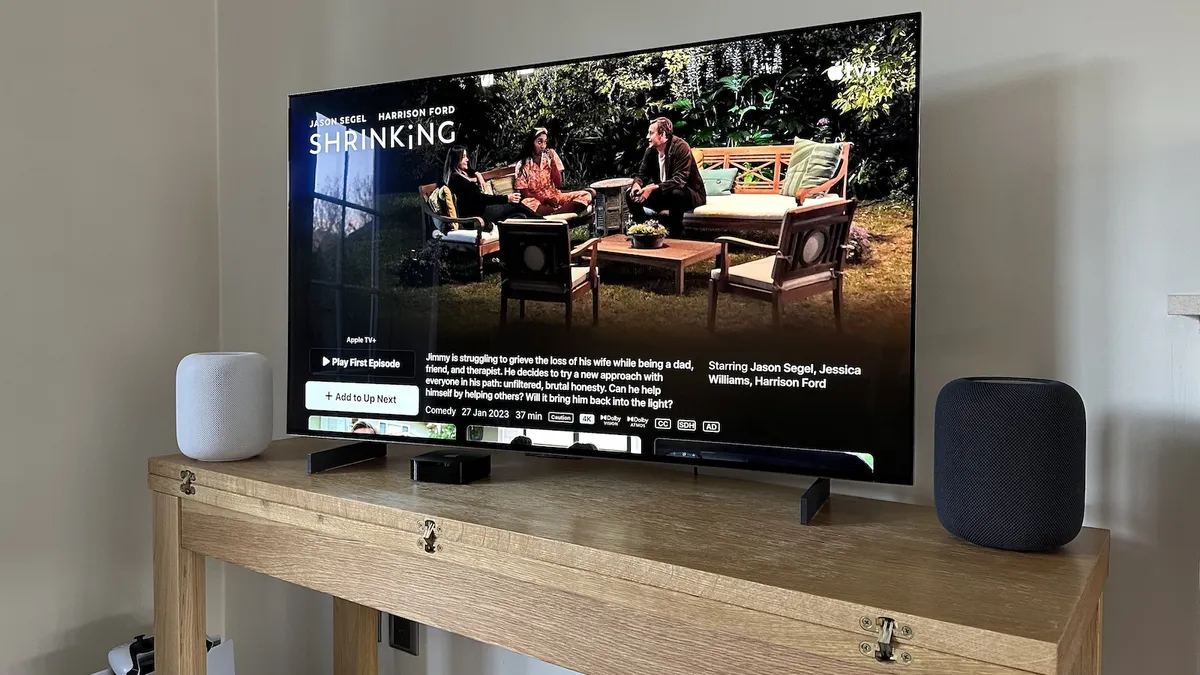
As with the picture quality, the new Apple TV 4K manages to squeeze a little more sonic quality out of its source material, but not a huge amount more. “Subtle but worthwhile” is how we describe the improvements in our Apple TV 4K (2026) review.
Overall, the audio is cleaner, more detailed and more dynamically assured. Elements are lent more clarity and definition, which is especially noticeable within a busy cinematic soundtrack.
The same can be said of its performance with music. Fontaines D.C.'s Marianne sounds “more upfront rhythmically and dynamically, giving the track extra drive without upsetting the nicely balanced, effortlessly listenable character of its predecessor.”
Even the busy chorus doesn’t challenge the new Apple TV, whereas its predecessor sounds a little flatter in comparison. The new model also has greater separation between musical elements, and a little more weight through the lower registers.
But its predecessor is no slouch. In our review, we praised its “warm and expressive approach” which produces a “rich and dynamic” feel. Timing is excellent, as is the sense of rhythmic drive and textured vocals. The new model just builds on those considerable strengths, making for a more insightful, precise delivery for both music and movie soundtracks alike.
** Winner: Apple TV 4K (2026) **
Apple TV 4K (2026) vs Apple TV 4K (2022): verdict
Subtle improvements to the picture and sound are enough to keep the Apple TV 4K the best performer around – but is it worth the extra outlay? With the previous model now discontinued, your options are limited, as unless you are happy with a secondhand model, you’ll struggle to find the 2022 box fresh.
It is undoubtedly pricey, but Siri AI, plus future-proofing specification and the AV upgrades make the Apple TV 4K (2026) superior to its predecessor. If it’s too expensive for you, we recommend waiting for a deal rather than buying the old one.
What if you are considering upgrading from the 2022 model, though? In that instance, you’ll have to watch a lot of old SD TV shows and/or really prize the Siri AI as a must-have to make the extra outlay worthwhile.
** Overall winner: Apple TV 4K (2026) **
MORE:
Read our Apple TV 4K (2026) review
And our Apple TV 4K (2022) review

