
If you are looking for a way to bring the big screen experience to your home but don't have the budget or space for a full-fat projector system, it might seem that there are no alternatives.
But, lucky for you, the portable projector category exists to fill that gap. These models are often much more affordable than their more premium counterparts, and come with the ability to take on the go if you are looking to host an outdoor movie night or simply watch a film in another room.

I am a Staff Writer here at What Hi-Fi? and, while I would love to have a full-fat home cinema projector set up in my house, real life makes that idea impossible. That's what makes portable projectors so appealing, as they can get you the big screen experience for a much lower price without taking up half the living room. Every projector on this list has been tested against the top competitors in the category, so you can rest assured each model is here for a reason.
Recent updates
- April 2026: Added Xgimi Vibe One as 'best cheap'.
- September 2025: Removed BenQ GV31 as 'best for flexibility' to reflect its lack of availability.
- July 2025: Replaced Anker Nebula Capsule 3 with the Xgimi MoGo 4 in 'best for portability' category.
- February 2025: Added the Anker Nebula Mars 3 Air, BenQ GV31, and Anker Nebula Capsule 3, updated sections on how to choose the best portable projector for you and also how we test them.
Best overall portable projector
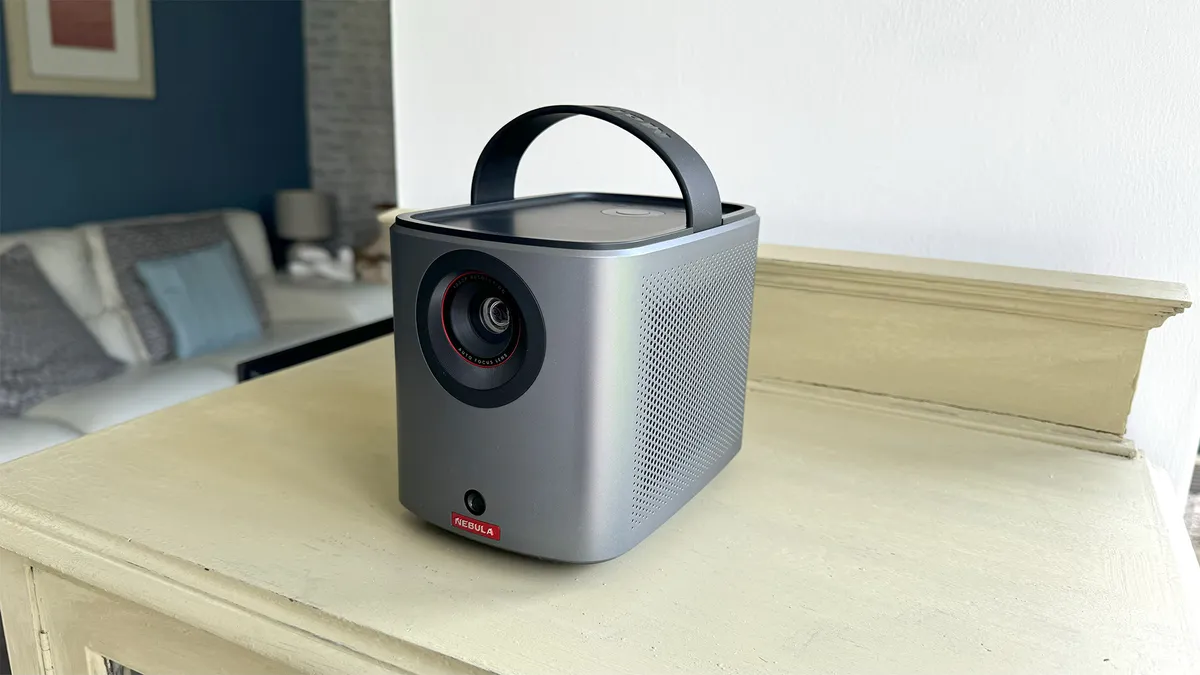


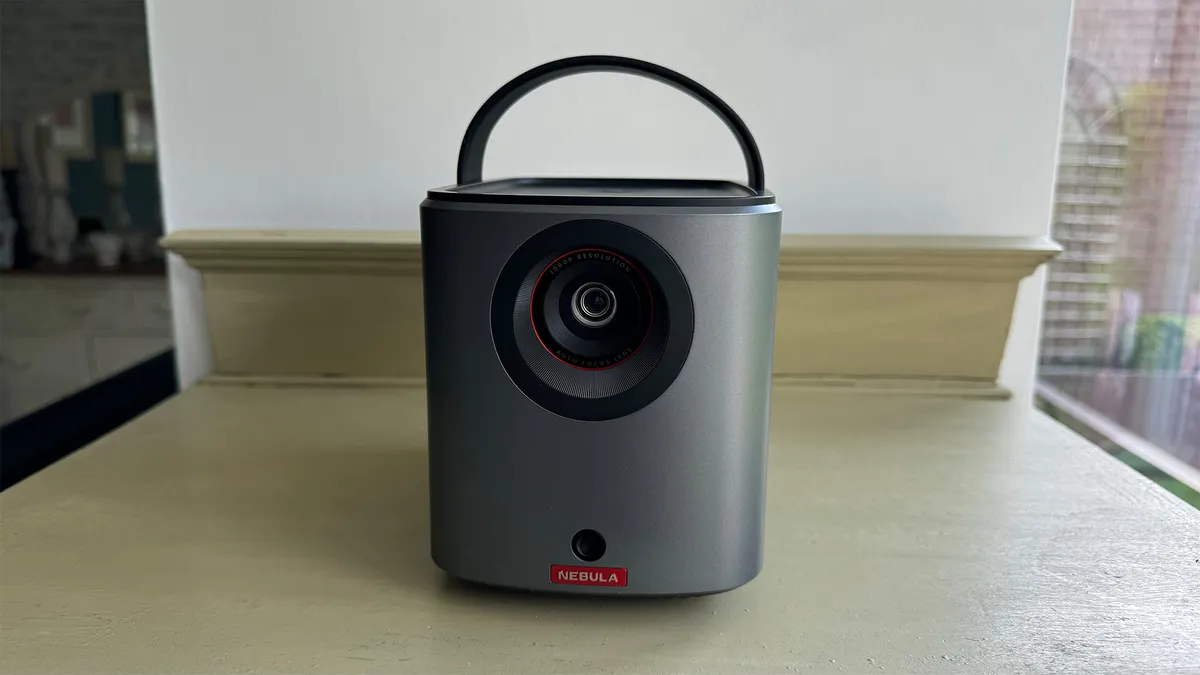


Nothing tells you that a projector is portable like a built-in handle, but that’s not the only thing that Anker’s Nebula Mars 3 Air is good at, which is why it’s our favourite overall.
While it’s certainly a long way from being pocketable, the handle makes this thing incredibly easy to haul around your home, and it’s so well-built and nicely designed that it looks good in any room of the house.
Setting it up is simple, with the ‘Intelligent Environment Adaptation 3.0’ ensuring that the picture doesn’t come out looking stretched, warped or out of focus, and built-in apps from all the major streaming services ensuring that this really is as plonk-and-play as a projector can get.
Turn the power on and its 400 ANSI lumens mean you can push the screen size beyond the 70 inches that most other portable projectors max out at, but it’s the quality of the picture more than its size that really raises the Mars 3 Air above the rest. Everything looks sharp and detailed, with colours that are both saturated and subtle. Its HDR performance is superior, too, although it does also reveal the limits of the projector’s brightness.
With a pair of 8-watt speakers onboard, the audio performance is also a cut above. Soundtracks are expansive and well-rounded, with a solid bass presence to underpin everything without distorting. A bit more volume wouldn’t go amiss, but for its size the Mars 3 Air doesn’t disappoint on the audio front.
As an all-round package, then, the Anker’s weaknesses are far outweighed by its strengths – and in a chassis that itself weighs just 1.7kg.
Read the full Anker Nebula Mars 3 Air review
Best for portability


With dimensions that are not dissimilar to a large water bottle, the Xgimi MoGo 4 manages to balance portability and picture performance the best we have seen at this size and price.
For those looking to take the home cinema experience truly on the road, the MoGo 4's built-in battery offers a claimed 2.5 hours of life when on Eco mode although this understandably darkens the image to a degree. It also includes a mini-remote hanging from the projector's body so you don't have to cart around the full-fat remote to navigate through the settings.
The MoGo 4 uses Google TV with built-in Netflix support, plus the usual streaming suspects. That includes Apple TV, Amazon Prime Video, ITVX and Disney+. An HDMI ARC port is also available on the side of the body.
When it comes to picture quality, the projector produces a pleasingly crisp and vibrant image. We add in our review when watching Glass Onion: A Knives Out Mystery in HDR10 that "the MoGo 4 manages to portray a nicely balanced picture, with the branches of trees in the background appearing crisp."
The vibrancy can look a little overcooked which is likely a decision that Xgimi has made to compensate for when users are watching films outdoors, but it is a flaw worth noting as we expect the MoGo 4 will be used more in the house than outside it.
The MoGo 4's two 6W speakers aren't to be sniffed at either. In the midrange, it produces a pleasingly detailed and clean sound. It does not go very loud, however, and struggles to make an impact with the lower frequencies.
Still, Xgimi's easy-to-use projector offers an impressively crisp image all wrapped up in an impressively small package.
Read the full Xgimi MoGo 4 review
Best cheap portable projector


If your budget can't stretch to the Xgimi MoGo 4, the Xgimi Vibe One is a great option with a much lower price tag.
The projector delivers a punchy image that digs up a surprising amount of detail. In our review, when watching Civil War, for instance, we find: "Skin tones also appear balanced and natural, without fading into the background or looking over-vibrant.
It can go impressively dark, too, considering its cost. This is most prevalent when watching Alien: Romulus and, although you can't make out the darkest elements of the scene, there is a good amount of black detail in the abyss of space at the start of the film.
Although the projector comes with a built-in battery, there is a catch. You get a maximum of 1.2 hours of battery life and, in our preferred brightness settings, we only get to the one-hour mark before it conks out. There's no option to use a battery pack via a USB-C connection, either, which is worth bearing in mind.
It offers an easy-to-carry, light design that resembles a lantern more than a projector. Plus, there's a sturdy handle at the top which makes it even easier to take on the go.
Google TV is built-in, giving you access to streaming services such as Amazon Prime Video, Apple TV, and Netflix.
While its battery life is an issue if you can't plug it into the mains, the Vibe One is a great candidate thanks to its low cost and balanced picture.
Read the full Xgimi Vibe One review
Also consider
Epson EF-12: Epson’s compact EF-12 needs to be plugged into the mains to work, which limits its positioning a little more than the models above, but it has a way with contrast and shading that's beyond the reach of most portable projectors, and the Yamaha-tuned 10-watt sound system is streets ahead of others, too. One to consider if portability is important but not paramount.
Samsung The Freestyle: The first-gen model of Samsung’s awkwardly named The Freestyle impressed us with its practical design and bright, colourful picture, but it has since been succeeded by an almost identical second-gen version that we’ve been unable to test as yet. The first-gen one is still available (just about) but with the newer model only costing a fraction more, you’re probably better off waiting for our full review.
How to choose a portable projector
The first thing to do when shopping for a portable projector is to manage your expectations. The technology isn’t yet at the point that it can compete with a TV for picture quality. But you can’t get a 120-inch television for much less than £2000 yet, and even if you could it would take up much more space.
What a portable projector does get you is flexibility and that’s probably the main thing that should inform your purchase. All of our choices above are battery powered, but some are more portable than others. Do you want a projector that’s just easy to move around the house, or one so small you can throw it in a bag to use in an Airbnb on weekends away?
The size won’t just affect how easy it is to move your projector from A to B. If a projector fits in the palm of your hand, it will not be particularly bright nor kick out top-notch detail, so consider that before taking the plunge. You will need a very dark room to get the best out of any of the projectors above and if you’re planning to use one outside in the summer, the brighter it can go the better.
With their TV-like interfaces and wireless connectivity, portable projectors can be used without needing to plug in an external source, but you’ll want to check if it has all the ports you might require just in case. The same goes for audio. Will the projector’s built-in speakers be enough, or will you want to connect a separate sound system?
There will always be some compromises to make when it comes to buying a portable projector, you just need to ensure you make the ones you’re happy with.
How we test portable projectors
Testing a projector usually involves lots of careful setup and many hours in one of our dedicated testing rooms, but portable projectors are a slightly different proposition.
These are, first and foremost, lifestyle products. If you’re interested in buying one it’s precisely because you don’t have the space at home to accommodate a standard projector, so while we will use our state-of-the-art testing facilities to see what a portable projector is capable of in perfect conditions, a lot of the testing process takes place in more normal day-to-day surroundings.
Having gone through the initial setup and calibration process, noting which streaming services and codecs are natively supported, we will use the projector in various lighting conditions and with a range of types of content, making sure to try out all available picture and audio modes and tweaking settings until we’re happy we’ve seen what it’s capable of.
Every product we test is compared to its immediate rivals, a process that allows us to determine which ones are the very best and put together lists like this one. All of our verdicts are reached after consultation involving the entire reviews team. This helps to ensure all products are reviewed consistently and no individual preferences are allowed to creep in.
You can read more about how we test and review products on What Hi-Fi? here
FAQ
How bright does a portable projector need to be?
This depends entirely on where you plan to use it but the brighter the better. As a general rule, the more portable a projector is, the less bright it’s likely to be and vice versa. That’s true of the 200-lumen Anker Nebula Capsule 3 above, which requires very dark conditions to perform at its best, but it is the most pocket-friendly option on the list. Aim for 400 lumens or above for more leeway when it comes to lighting conditions.
Why is Samsung’s The Freestyle projector not on the list?
It’s a good question, and we have included it in the Also Consider section because we gave The Freestyle four stars when we reviewed it in 2023, but it’s since been succeeded by a second-generation model and Samsung is yet to send us one to test. So while we stand by that four-star review we wouldn’t fully recommend buying one until we’ve had the chance to review the newer version.

