
The Sony lacks some of the Optoma’s flexibility and headline features, but counters with a more natural, detailed and authentically cinematic picture.
Pros
- More natural and authentic than the Optoma
- Sharper native 4K picture
- Superior motion handling
Cons
- Less bright than the Optoma
- Fewer HDR formats and gaming features
- Less flexible manual lens controls

The Optoma is brighter, better equipped and more adaptable than the Sony, particularly for rooms with lots of light. It can’t match its rival for outright picture accuracy, though.
Pros
- Far brighter than the Sony
- Broader HDR and gaming support
- Motorised lens controls
Cons
- Less natural and authentic than the Sony
- Can look overenthusiastic with HDR10 and SDR
- Occasional rainbow artefacts
Choosing between the best projectors isn’t always as simple as picking the model with the highest star rating. Your room, viewing habits and preferred content can all determine which projector will ultimately give you the better experience. We mention all this, because it’s particularly true of the Sony VPL-XW5000ES and Optoma UHZ78LV – two fine projectors worthy of your attention.
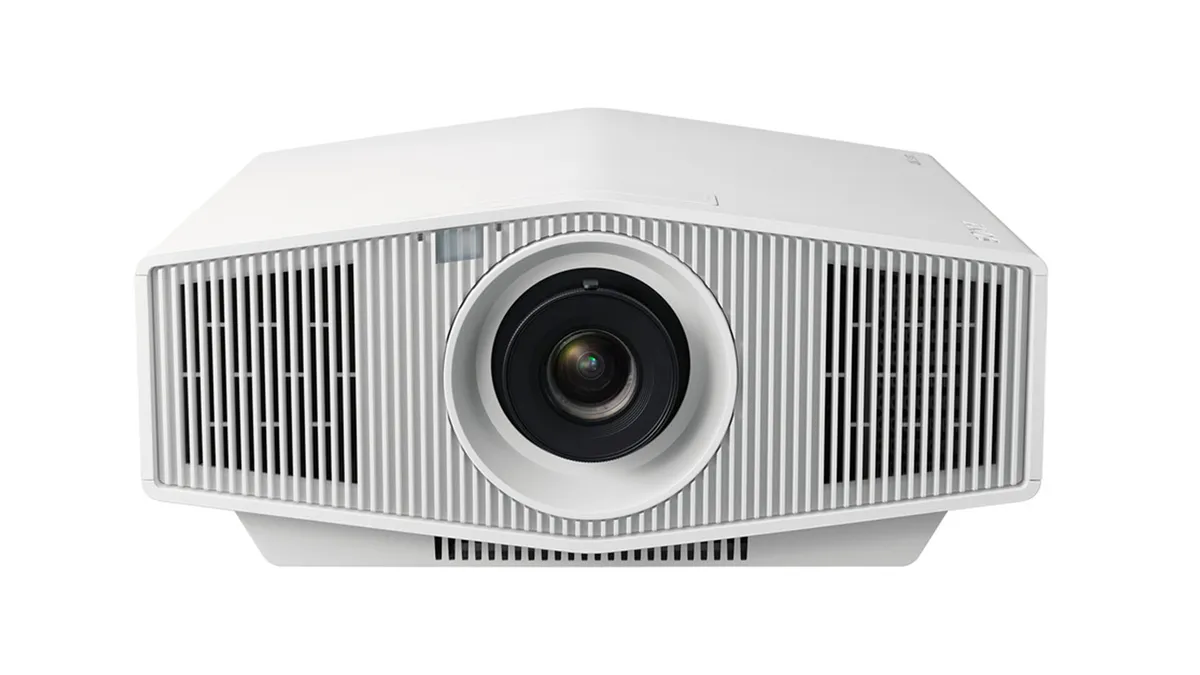
The Sony is a native 4K projector built primarily for serious movie watching in a darkened home cinema, while the Optoma combines much greater claimed brightness with broader HDR support, 4K/120Hz gaming and more accommodating installation features.
We’ve thoroughly reviewed both projectors in our dedicated testing rooms, assessing their design, features and picture performance using our established testing process. As a result, you can rest assured that by the time you’ve read everything below, you’ll know precisely which one deserves that coveted spot at the heart of your home entertainment setup.
Sony VPL-XW5000ES vs Optoma UHZ78LV tech specs comparison
| Header Cell - Column 0 | Sony VPL-XW5000ES |
Optoma UHZ78LV |
|---|---|---|
Projector type |
Laser SXRD |
Laser-lit DLP |
Resolution |
4K (native) |
4K (pixel-shifting) |
Screen size |
Up to 200 inches |
Up to 300 inches |
HDR support |
HLG, HDR10 |
HLG, HDR10, HDR10+, Dolby Vision |
HDMI inputs |
2 x HDMI 2.0 |
2 x HDMI 2.0, 1 x HDMI 2.1 |
Gaming |
1080p/120Hz |
4K/120Hz |
Dimensions (hwd) |
20 x 46 x 47cm |
18 x 49 x 43cm |
Sony VPL-XW5000ES vs Optoma UHZ78LV: price

Image credit: Sony

Image credit: What Hi-Fi?
The Sony VPL-XW5000ES launched in 2022 at £5999 / $5998 / AU$9990, while the newer Optoma UHZ78LV landed in the UK at the same £5999 price (it’s not due to be sold in the US and hasn’t yet made it to Australia).
The Sony has, at the time of writing, reached a price as low as £4249 in the UK. The Optoma, in contrast, currently costs full price. That gives the Sony a clear value advantage at the time of writing – though it’s only one part of the puzzle…
** Winner: Sony VPL-XW5000ES **
Sony VPL-XW5000ES vs Optoma UHZ78LV: design

Image credit: Sony

Image credit: What Hi-Fi?
Neither projector is compact, but the Optoma packages its considerable brightness into a surprisingly manageable chassis. It’s lower and shallower than the Sony, although it’s also a little wider. The Optoma weighs 11.5kg, so is lighter than the Sony too, which should make handling it during installation somewhat easier.
Its design is functional rather than beautiful. The blocky black chassis looks serious and suitably premium, but lacks the Sony’s more distinctive sculpting. That might not matter once the projector has been ceiling-mounted or otherwise placed out of sight, but a little more ambition in the design would still be great to see.
As if to prove that point, the Sony has a much more characterful design, with a pronounced, angled, roof-like top and a choice of black or white finishes. It also runs impressively quietly, even when working hard with HDR material, thanks to its effective cooling system.
The Optoma is similarly unintrusive in operation. Optoma claims a maximum noise level of 28dB, and we found that it remained impressively quiet even in its brightest modes.
Overall, both feel like substantial, purpose-built home cinema projectors. For us, the Sony is more visually distinctive, but design is subjective, and far from the most important factor of a projector to consider…
** Winner: Draw **
Sony VPL-XW5000ES vs Optoma UHZ78LV: features

Image credit: Sony

Image credit: What Hi-Fi?
The Optoma’s headline feature is its claimed peak brightness of 5000 lumens. That comfortably trounces the Sony’s 2000-lumen rating and helps the UHZ78LV produce a punchy, colourful picture even when there is a significant amount of ambient light in the room.
Its triple RGB laser system is also claimed to cover 98 per cent of the DCI-P3 colour space and 96 per cent of BT.2020 without requiring a brightness-reducing colour filter. Sony’s Triluminos Pro colour engine, meanwhile, is claimed to cover 95 per cent of DCI-P3.
The Sony counters with its native 3840 x 2160 SXRD imaging chips. The Optoma uses pixel shifting to produce the 8.3 million pixels required for a 4K image and meets the Consumer Technology Association’s definition of 4K, but it can’t match the innate crispness and solidity of a genuine native 4K system.
Sony’s X1 Ultimate processor, meanwhile, further strengthens its picture credentials. Its features include Reality Creation, object-based resolution enhancement, object-based HDR remastering and the Dynamic HDR Enhancer, which identifies bright highlights and boosts their intensity without adversely affecting other elements of the picture.
Having said that, the Optoma offers substantially broader format support. It handles HDR10, HLG, HDR10+ and Dolby Vision, while the Sony is limited to HDR10 and HLG. Dolby Vision is still rare among projectors and proves to be a meaningful advantage for the Optoma, rather than merely another logo on its specification sheet.
Optoma’s projector is also better equipped for gaming. Its three HDMI inputs comprise two HDMI 2.0 sockets and one HDMI 2.1 connection, with the latter supporting 4K signals at 120Hz. We measured input lag at 34.9ms in Low Latency mode and 18.1ms in Ultra Low Latency mode using a 60Hz signal.
The Sony’s two 18Gbps HDMI 2.0 inputs top out at 4K/60Hz, although it can accept 1080p at 120Hz. Its input lag was measured at 21ms with a 4K/60Hz signal and 13ms at 1080p/120Hz with its fast-response feature engaged.
Installation is another significant advantage for the Optoma. It offers motorised focus, zoom and lens shift, alongside a 1.6x zoom and a throw ratio of 1.25:1 to 2:1. The Sony’s zoom, focus and lens-shift controls are all manual, and we found its lens-shift wheels particularly loose and imprecise. Its lack of motorisation also means there is no lens-memory function.
Overall, Sony’s native 4K system and exceptional processing are hugely important, but the Optoma is brighter, supports more HDR formats, is easier to install, and offers 4K/120Hz gaming. Unsurprisingly, it wins this round fairly convincingly.
** Winner: Optoma UHZ78LV **
Sony VPL-XW5000ES vs Optoma UHZ78LV: picture quality

Image credit: Sony

Image credit: What Hi-Fi?
The Optoma’s brightness isn’t merely impressive on paper. In rooms with ambient light, it produces a bold, vibrant picture that retains far more colour and impact than most dedicated home cinema projectors.
Bright highlights have terrific intensity, while the combination of strong colours and deep shadows gives large-scale images a tangible sense of depth. During the battle for Washington DC in Civil War, blazing light sources and darker areas combine to create an arresting, cinematic image. It’s impressively crisp, too. Fine facial textures, environmental details and subtle lighting effects are reproduced cleanly, without the picture immediately appearing over-sharpened.
The Optoma also offers HDR, Filmmaker Mode and IMAX Enhanced presets for standard HDR material. We prefer IMAX Enhanced for viewing in a dark room, despite its initially darker and softer appearance, but the projector never entirely abandons its taste for spectacle.
Colours can look slightly more saturated and skin tones warmer than they should, while the overall picture sometimes feels as though it is pushing for impact rather than settling into complete neutrality.
Dolby Vision improves matters considerably. Dolby Vision Dark introduces a more restrained balance, while Dolby Vision Bright combines extra punch with impressive control and is our preferred mode overall, even in a darkened room. Dolby Vision Cinema works well in ambient light, although we recommend disabling its default motion processing.
The Optoma’s compromises become more apparent with SDR. Its Cinema mode is too bright and vivid for authentic dark-room viewing, while Reference looks somewhat cool and green. Careful adjustment produces a much better picture, but there remains a slight sheen and vivaciousness that doesn’t always suit the material.
Its single-chip DLP design can also produce occasional rainbow artefacts, particularly when bright objects appear against dark backgrounds. Motion is generally handled well, but there are rare traces of unwanted smoothing even with motion processing disabled.
In contrast, Sony’s offering delivers a fundamentally different kind of picture. It lacks the Optoma’s searing brightness, but in a dark room, its images are more natural, nuanced and authentically cinematic.
Black levels are excellent, with dark scenes appearing deep and neutrally toned. Sony’s Dynamic HDR Enhancer also gives bright highlights impressive impact without compromising the rest of the image, although its High setting can clip detail and is best avoided. We found the Middle setting offered the most satisfying balance.
Native 4K material looks exceptionally detailed, dense and three-dimensional as well. The combination of Sony’s SXRD panels, Reality Creation processing and Digital Focus Optimiser produces a solidity and natural crispness that the pixel-shifting Optoma can’t quite match. Upscaled HD material is excellent, too.
Motion is another major strength. Sony’s True Cinema setting gently reduces the distracting judder associated with 24fps content without introducing the excessively smooth appearance or processing artefacts found on many rivals.
Colours are beautifully balanced, controlled and nuanced, too, giving the Sony a sense of authenticity that the Optoma achieves only intermittently. There are rare occasions when the Sony struggles with very dark scenes containing extremely bright highlights, but these moments are uncommon and don’t significantly undermine its performance.
Overall, the Optoma is the stronger performer in a room with ambient light and can look superb with Dolby Vision material. For critical movie viewing in a dark room, however, the Sony offers superior sharpness, motion, colour accuracy and overall authenticity.
** Winner: Sony VPL-XW5000ES **
Sony VPL-XW5000ES vs Optoma UHZ78LV: verdict
This comparison is closer and more nuanced than the projectors’ respective five-star and four-star ratings might initially suggest.
The Optoma UHZ78LV has some significant advantages. It is vastly brighter, supports Dolby Vision and HDR10+, accepts 4K/120Hz signals and is considerably easier to install thanks to its motorised lens controls. In a room that can’t be fully darkened, it’s likely to be the more satisfying projector.
It’s also a hugely entertaining performer. Its pictures are bold, vibrant and packed with impact, while Dolby Vision helps it achieve a more controlled and authentic balance than it generally manages with HDR10 or SDR.
For a traditional dedicated home cinema setup, though, the Sony VPL-XW5000ES remains the better projector. Its native 4K system produces sharper and more solid images, while its superior motion handling, balanced colours and greater subtlety create a more convincing representation of the filmmaker’s intent.
At the time of this comparison, the Sony is also significantly cheaper in the UK. It’s officially available in the US, where the Optoma isn’t due to be sold, while Australian pricing for the Optoma has yet to be confirmed. Yes, Sony’s manual lens controls, limited HDR support and lack of 4K/120Hz are frustrating, but once it is installed and a film begins, its picture quality outweighs those shortcomings.
So choose the Optoma if you regularly watch with bright ambient light, need Dolby Vision, or want 4K/120Hz gaming. For the most authentic and accomplished movie performance in a dark room, though, the Sony retains its well-deserved crown.
** Overall winner: Sony VPL-XW5000ES **

