Turntables ruled the roost when What Hi-Fi?'s first issue landed in October 1976. As we're celebrating our 50th anniversary this year, we've been taking some lovely nostalgic strolls down memory lane, and looking back at some of the most iconic hi-fi and home cinema products throughout our lifetime.
Of course, turntables predate us considerably, with plenty of brands – Dual, Garrard, Pioneer – starting life long before we did, while many others, such as Rega, Linn and Michell, were still in their infancy during this decade. Here, we're looking back at the very first turntables made by some of the world's most legendary hi-fi brands; first efforts that, in many cases, continue to define each brand's legacy and products even today.
Our list below looks at the first record players made by Audio-Technica, Pro-Ject, NAD, Roksan, Wilson Benesch and more. Bonus points – and please comment below – if you ever owned one of these original models.
Rega Planet (1973)

In 1973, Rega’s co-founder Roy Gandy set out to make something structurally solid. According to Rega’s historical records, sound quality was secondary at that time (gasp!).
Gandy wanted to produce a reliable turntable that he knew would last, but would also look different. “Why can a turntable not have three outrigger points spinning round, that people might buy as a piece of sculpture?” he asked.
Thankfully, better overall performance was also soon the goal. And as Gandy took his prototypes to potential manufacturers, the outcome was the Rega Planet, with its three-spoke, steel and aluminium platter and Acos Lustre tonearm.
Linn LP12 (1973)

Still going strong 50-plus years after its inauguration, Linn’s debut turntable has some stamina – even if it has had more updates over its lifetime than Trigger’s broom.
The company’s very first product, designed by founder Ivor Tiefenbrun (who argued the source was always the most important part of any system), the LP12 is still one of our all-time favourite decks.
Interestingly, the first version came without a plinth, but soon moved to the more recognisable version (pictured). The LP12 remains arguably one of Scotland's finest hi-fi exports ever.
- We visited the company's Glasgow HQ for The Making of: Linn Sondek LP12
Michell Reference Electronic (1977)
While the 1982 GyroDec is probably the company’s signature deck, its first was the Reference Electronic. This deck was hatched from Transcriptor’s Hydraulic Reference, which famously appeared in Stanley Kubrick's A Clockwork Orange.
In the late 1960s, Michell GyroDec founder John Michell started manufacturing parts for Transcriptor turntables, eventually making them under licence.
When the companies parted ways in 1977, Michell began its own production. And so, the Reference Electronic, which came with a coloured mirror finish or marble plinth, was born.
- Read our recent Michell Gyro SE/Cusis S review
Wilson Benesch Turntable (1989)

It’s ironic a company now making loudspeakers costing six figures was founded on a shoestring less than 30 years ago. Wilson Benesch dedicated its first year to research and development, and the outcome was the Wilson Benesch Turntable. Clearly the creativity went into the design and not the name.
The Turntable featured two world-firsts: a carbon fibre composite sub-chassis and carbon fibre tonearm, the A.C.T. One. Carbon fibre was used for its torsional stiffness and damping of structural vibration within the system. The material now goes some way to defining the brand, having been used in its designs ever since.
The Turntable's success allowed Wilson Benesch to reinvest in new product development, paving the way for the company’s first pair of loudspeakers.
Pro-Ject 1 (1991)

The Pro-Ject 1 laid the foundations for what has been a virtually unblemished record of success for the company. The 1 was essentially a modified version of the Tesla NC-500, originally made as an affordable turntable for distribution in the Eastern Bloc.
After the fall of the Berlin Wall, Pro-Ject founder Heinz Lichtenegger modified a batch to sell in his shop in Vienna. When these proved a success, he re-opened production at the original factory in the Czech Republic. It’s the same factory Pro-Ject turntables are made in today, and still houses the original Tesla machines.
The 1 range still lives on today, the 1 Xpression Carbon being the latest version. Because of its legacy, Pro-Ject can still supply all the 1’s original parts – so, if anyone has one...
VPI HW-19 (1980)

With a suspended sub-chassis and an aluminium platter with lead attached underneath, the HW-19 was VPI co-founder Harry Weisfeld’s first work and marked the first chapter of the US company’s story.
Three versions followed over the next two decades, during which the design moved to an acrylic platter and acrylic-stainless steel sub-chassis. It's a far cry from the brand's impressive deck aesthetic today.
The HW-19 is no longer in production, but upgrades are still available for it.
- Read our VPI Prime Signature review
Technics SP-10 (1970)

The superb Technics SL-1000R, the company's “most premium turntable ever” (and also part of What Hi-Fi?'s reference system), is actually a reimagining of the company’s very first deck. Built in 1970, the SP-10 was the first to use a direct-drive system, and it spawned a long line of legendary turntables.
The motor rotated at the same speed as the record, therefore eliminating the need for a speed-reducing mechanism (such as a belt) and the mechanical vibrations it caused.
In short, direct drive meant lots of torque, instant start-up and excellent speed accuracy.
Clearaudio Reference (1993)

The Clearaudio name might conjure up the classy, matt-black aura of the multi-Award-winning Concept, but the German brand first entered the turntable market several years prior with the Reference.
The Reference’s chassis had a resonance-optimised shape, rather than the typical rectangular build. Made from acrylic, with brass metal parts (later stainless steel), distinctly placed feet, heavy arm pillars and resonance control weights, the Reference considered materials and geometry at length.
And a year later, the more advanced Clearaudio Master Reference brought a new power supply and tonearm, among other developments.
NAD 5120 (1983)

NAD’s turntable debut could possibly date back to a 1981 model, but this mystery proved beyond our detective skills – so the 5120 belt-drive turntable goes down as the company's first.
Instead of isolating the turntable from external vibrations by placing the rigid unit on rubber feet, NAD instead fixed the platter and tonearm on a separate sub-chassis floating on springs. Unusually, the 5120 originally came with a flat tonearm – though this was soon changed to a conventional design.
The NAD 5120 was notable for its interchangeable tonearm assembly, allowing use of more than one cartridge or arm, and its de-coupled, spring-suspended counterweight which absorbed resonance by vibrating at the same frequency.
“Despite its ugly ducking looks, this inexpensive deck gives a performance that far exceeds its price,” read the What Hi-Fi? review.
Pioneer PLA-1 (1955)

Pioneer is renowned for its DJ turntables, but the company's first deck appeared several years before the club disc-jockey was a thing.
Back then it was described as an ‘induction rim-drive’ (i.e. an idler-wheel drive) turntable, with a rubber wheel connecting the motor shaft to the edge of the turntable platter. This drive method was later replaced by the popular belt and direct drives.
The PLA-1 offered three speeds, weighed 13kg and was priced ¥29,900 (about £190).
Garrard 301 (1954)
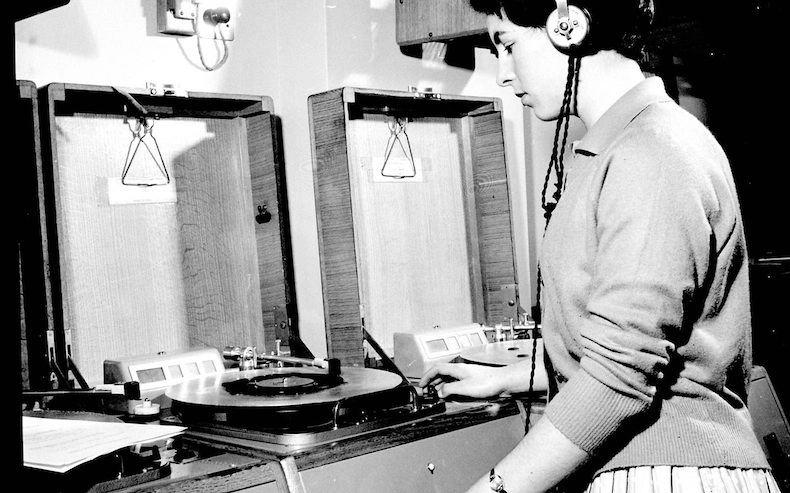
From 18th-century jewellers to manufacturers of military rangefinders in WW1 and, eventually, turntable manufacturer, Swindon-based Garrard Engineering & Manufacturing Company has some story.
Its first deck, the Garrard 301 Transcription Turntable, came in oil- and grease-bearing versions and was used by the BBC’s radio stations (pictured). The equally notable 401 followed in 1965, introducing a redesigned exterior, more powerful motor and different braking speed control and bearing.
In 1979, Garrard was bought by Brazilian firm Gradienete and production moved to the other side of the world. Today, British company SME owns the Garrard brand, and is looking to develop the brand further in the near future.
Roksan Xerxes (1985)

Despite being named after a Persian king, the Xerxes wasn’t the company’s most oddly-named product of the 1980s – that award goes to its 'Hotcakes' speakers.
The Xerxes was notable for a number of technical innovations. Its motor rotated on a spindle to even out speed irregularities, and it had a clever suspension system for the platter/sub-platter, using rubber blobs instead of springs. It also made its lightweight platter heavier on the outside, to maximise inertia.
Roksan entered a turntable market dominated by the Michell GyroDec and Linn LP12, but we boldly predicted it would give the latter a run for its money.
- Read our Roksan Xerxes 20 Plus review
Audio-Technica Sound Burger (1983)


It might surprise you to know that Audio-Technica's very first turntable was the very unconventional Sound Burger. Released in 1983 – just as compact discs and CD players were taking off – this battery-powered, compact "stereo disc record player system" was unlike any other deck we had seen. The slimline design had a 9cm platter, could play singles and albums, had a built-in phono preamp, weighed just 1.2kg, and came with a pair of foldable wired headphones.
We noted in What Hi-Fi?'s June 1983 issue (second slide, above) that the original Sound Burger looked like a toy at first, but it was "full of surprises" and the reviewer quickly warmed to its quirky but well-made charms. Despite a rich, "congested" midrange, and somewhat one-note bass, the sound was "exciting and clear" and could "give some conventional turntables a run for their money" – especially considering its great-value price of just £89.
While never reaching mainstream success, the Sound Burger was resurrected for Audio-Technica's 60th anniversary, this time with Bluetooth streaming powers. We found the styling and build quality to be well thought-out when we reviewed the most recent model, and its mid-forward sound has a lively, appealing sense of flow that is simply fun to listen to.
- Read our Audio-Technica Sound Burger review
Oracle AC (1979)

Oracle’s first turntable was simply called ‘Oracle AC’, but is often considered part of the long-spanning Delphi line launched the following year. There were eventually six variants, with the MkV in 1995 seeing bigger developments in its manufacturing.
This first belt-drive turntable was competing with the Linn LP12. At $800, they cost roughly the same, but Oracle didn’t use a two-piece platter. Instead the belt ran on a rim located underneath the platter, making it fiddly to change speed manually.
The Oracle's sub-chassis was suspended by a three-point mount on stretched springs and, to help eliminate horizontal movement of the suspended platter, its centre of gravity was moved to the same height as the suspension fixings. It also featured a screw-down clamp to pin the record firmly to the mat.
Dual 1009 (1964)

Considering Dual's long history with record players, it's surprisingly tricky to pin down exactly what Dual's first complete turntable was. Brothers Christian and Joseph Steidinger began the company in 1907 making precision parts for gramophones and watchmakers. But it wasn't until the "Dual-Motor" was created in 1927 – a combined spring-loaded clock mechanism and electrical motor – and became so successful that the company adopted the Dual name in 1935.
An early model most certainly would have been a portable gramophone, and we're told two complete 'turntable systems' called W1 and W3 both appeared in 1934. It's hard to track down more information about them. Much of the development of Dual products in the early ’30s was driven by two engineers, Emil Knecht and Herman Papst – they would go on to design the first European direct-drive turntable, the Dual CS 701, in 1973 – and by the '50s, Dual became the biggest manufacturer of turntables in Europe.
But the first modern 'hi-fi' turntable from Dual? That would be the legendary Dual 1009 from 1964 – considered to be Dual's first "audiophile" record player. This four-speed deck was fully automatic, and had a sterling reputation for its robust build quality and reliability of the automatic mechanism.
- Read our Dual CS 518 review
MORE:
How to set up a turntable and get the best sound
Forgotten gems: 8 unsung turntables that deserve to be celebrated