
Connectivity x 2 HDMI (x1 eARC), optical, wi-fi, Bluetooth 5.3, AirPlay 2
Format support Dolby Atmos, DTS:X
Streaming Tidal Connect, Spotify Connect, Amazon Music
Dimensions (hwd) 5 x 116 x 12cm (soundbar), 25 x 25 x 25cm (subwoofer)
Weight 4.4kg (soundbar), 4.8kg (subwoofer)

Connectivity HDMI out (eARC), wi-fi, Bluetooth 5.3, AirPlay 2
Format support Dolby Atmos
Streaming Spotify Connect, Tidal Connect
Voice control Sonos Voice Control, Amazon Alexa, Google Assistant
Dimensions (hwd) 7.5 x 118 x 11 cm
Weight 5.9kg
If you are looking to buy a Dolby Atmos soundbar, you will have seen the huge range of models on the market right now. Which is great – but that level of choice inevitably brings some tricky decisions.
Sure, you could go for the Award-winning Sonos Arc Ultra, which has been at the top of our best Dolby Atmos soundbar buying guide since its release in 2024.
But what about all those cool new systems doing the rounds? The Samsung QS700F, for instance, which also comes with a wireless subwoofer? That's gotta make it better, right? Not to mention its cheaper price tag, which makes it more tempting for those on a budget.
Here to help you answer that very question, this guide provides our definitive advice, after we have fully reviewed each model, running them head to head in our listening rooms.
While Samsung certainly puts up a solid fight, we can confirm that the Sonos Arc Ultra retains its position as a class-leader in the category.
Samsung QS700F vs Sonos Arc Ultra: price

The Sonos Arc Ultra launched at £999 / $999 / AU$1799, and has remained roughly the same price since then.
That is a fair bit more expensive than its Samsung competitor, with the QS700F first launching at £749 / $700 / AU$999. We have seen it drop regularly since then to £649 / $649 respectively.
Of course, that pricing makes these models rather different propositions as the Sonos Arc Ultra is at the higher end of the mid-range market, while the QS700F sits more in the middle.
That means the Samsung model comes out on top if you need to spend as little as possible. But, as ever, if performance is your main priority, things start to change.
**Winner: Samsung QS900F**
Samsung QS700F vs Sonos Arc Ultra: build

The two models differ significantly in their design. Where the Sonos Arc Ultra consists of just a single soundbar, the Samsung model is made up of a main bar and a subwoofer.
Samsung’s model boasts a versatile build with the use of the brand’s ‘Convertible Fit’ feature. This means the soundbar will automatically detect any change in position via a built-in gyro system. Then, the front and up-firing speakers will switch roles depending on what orientation the soundbar is in.
The Sonos can be wall-mounted as well, but it doesn’t offer the same smarts as the Samsung. Its rival feature comes in the form of Trueplay, which calibrates the bar by playing a range of beeps at differing frequencies. This has to be done through the app, whereas the Samsung model calibrates automatically.
The Arc Ultra, which is available in black or white, features a ‘ledge’ at the back of the top of the chassis, which houses the touch controls. These include play/pause and skip forward/back, a volume slider (that can also be tapped), and a button to enable or disable voice control. The HDMI and power ports are hidden in a niche around the back, which can be a bit tricky to access.
Speaking of HDMI, the Samsung has the edge there, as it features two HDMI ports, one of which supports eARC and supports signals up to 4K/60Hz (although there is no 4K/120Hz support on the cards). That’s compared with the Sonos’s single HDMI eARC output with no passthrough.
Measuring 7.5 x 118 x 11 cm (hwd), the Sonos is slightly larger than the Samsung’s main bar, which comes in at 5 x 116 x 12cm (hwd). This makes both models easy to fit in front of our 65-inch TV screen. The Samsung model’s separate subwoofer adds to its total footprint, but its reasonably compact stature should make it simple to fit in your living room.
While the Sonos model doesn’t include a remote control, the Samsung features a practical remote which provides various shortcuts, allowing you to change the volume, bass level, sound mode, power and input.
That all means the Samsung soundbar is more comprehensive, with physical connections and versatile positioning options giving it the crown when it comes to build.
**Winner: Samsung QS700F**
Samsung QS700F vs Sonos Arc Ultra: features

The Sonos model boasts a 9.1.4-channel configuration, consisting of seven tweeters, six midrange drivers, and one woofer.
That contrasts with the QS700F’s less beefy 3.1.2-channel system, which is made up of a front centre, left and right channels, two up-firing channels and the central bass from the subwoofer.
Both soundbars support Dolby Atmos, though the Samsung also offers DTS:X support, which will be a welcome addition for movie lovers, letting you watch (or listen to in this case) more films with a three-dimensional, yet precise, soundfield that the two technologies can deliver.
The Sonos and Samsung models can be controlled via the Sonos and Smart Things apps, respectively.
From here, both soundbars offer access to EQ controls and a Night mode, which reduces dynamics and bass so that the sound travels less readily between rooms. Sonos also has a Speech Enhancement feature, which has different levels so that you can control to what degree the dialogue is projected, but no preset sound modes are available here.
There are five sound options to choose from with the Samsung: Standard, Surround, Game, Adaptive Sound or DTS Virtual X. In our test room, we opt for the movie default, Surround, as we get the best level balance between each frequency while keeping the soundtrack clear and engaging.
Bluetooth 5.3 and wi-fi capabilities are on the cards for both models, which allow you to stream music from another device to the soundbars.
While Samsung’s DTS:X support is a big draw for movie lovers, the Sonos Arc Ultra’s 9.1.4-channel configuration is a clear advantage against the cheaper model.
**Winner: Sonos Arc Ultra**
Samsung QS700F vs Sonos Arc Ultra: sound
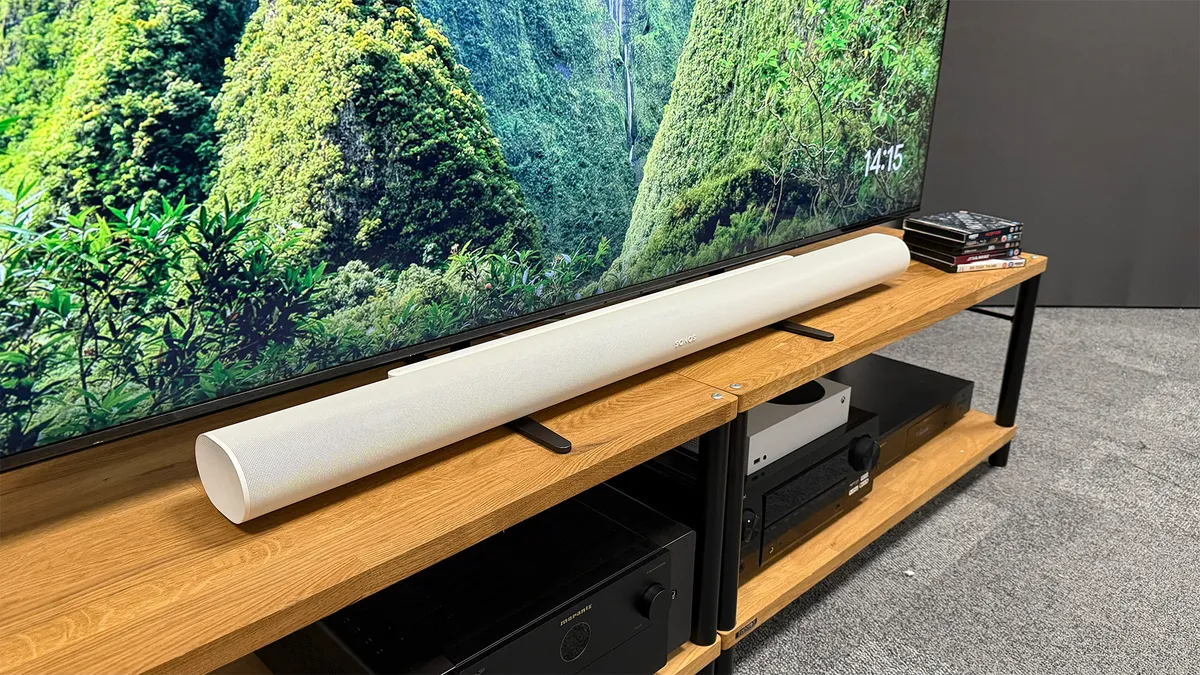
Kicking off with music, the Sonos Arc Ultra is immediately the more precise, tight and finessed performer against the Samsung HW-QS700F. When playing Tool’s Invincible, the Sonos delivers a rhythmic and organised sound, even when loads is going on, and the bass underpinning it all is impactful but still tuneful.
Samsung’s model goes for a different approach with a more bass-heavy sound from the subwoofer, which gives energetic tracks such as Tame Impala’s Dracula a great boost in the low frequencies.
It is not as subtle and finessed as the Sonos model, however, as the Samsung is missing that sense of delicacy that the more expensive bar masters.
When we move to the main course – their performance with movies – the Arc Ultra’s strong showing continues. We watch Unbroken with both models, and there is a clear outlier. As we follow our pilot protagonists as exploding shells surround their plane in the air, the Arc Ultra creates a remarkably precise soundstage, which allows you to place each explosion from the audio alone.
While the Samsung’s soundstage stretches just beyond the dimensions of the TV screen, it does not quite have the precision needed for the scene, so the shells explode in more of a vague area without a huge sense of accuracy.
That rather bass-heavy performance with music continues with movies as well. And that does give action scenes a thrilling boost. We say when watching Jurassic World with the Samsung, for instance: “the brilliant bass truly shocks the system and gives the scene a massive amount of punch, while still keeping the audience’s gasped reactions in the mix.”
Both soundbars also deliver clear vocals, although the Samsung does not sound quite as realistic and emotive as the Sonos.
Both the Sonos and the Samsung produce an exciting, energetic performance that is a huge improvement on the majority of TVs’ speakers. But the Sonos is able to outdo the Samsung model with its more balanced, tight and musical sound.
**Winner: Sonos Arc Ultra**
Samsung QS700F vs Sonos Arc Ultra: verdict

The Sonos Arc Ultra, overall, has more finesse than the Samsung HW-QS700F. It has more precise spatial skills, a better balance between frequencies and an airier, more spacious presentation overall.
Is it worth spending the extra £350 to go for the Arc Ultra when the Samsung model is still a truly solid choice for movie lovers? If your budget can stretch to the Sonos, then we recommend investing that bit extra to get a more complete audio experience with music as well as films.
If you want to save that extra money, though, the Samsung HW-QS700F is a brilliant alternative that will absolutely add some extra oomph to your movie nights.
**Overall winner: Sonos Arc Ultra**
MORE:
Here is our full review of the Samsung QS700F
And check out the best Dolby Atmos soundbars
These are our thoughts on the Sonos Arc Ultra

