

It being our 50th birthday year, it seems the perfect time to take a look at the stereo system that the What Hi-Fi? team uses most of all. This is, therefore, a somewhat unusual take on our regular system features, where we suggest products that blend beautifully together to perform spectacularly.
The systems we usually suggest, you will note, aren’t generally quite as pricey as the one you see here. But there are good reasons for us to invest in (well, okay, borrow from the manufacturers – but you know what we mean) a top-notch set-up.
This reference system, you see, needs to do more than simply sound brilliant. It needs to be able to perform day in, day out for months at a time – indeed, years in the case of some of the products – without letting us down. The best-sounding system in the world would be of limited use to us, after all, if vital parts of it needed to spend 10 per cent of their time back with the manufacturer in the repair shop.
The system
- Record player: Technics SL-1000R/Kiseki Purple Heart MC – £21,494
- Music streamer: Naim ND555/555 PS DR – £26,499
- Phono stage: Cyrus Phono Signature/PSX-R2 – £2590
- Pre/power amplifier: Burmester 088/911 MkIII – £36,150
- Stereo speakers: ATC SCM50 – £11,950
- Total price: £98,683
This, then, is a set-up that can withstand the rigours of extensive daily use and sound consistently good while doing so. Each component needs to be able to get on with doing its thing, without unduly affecting the other parts of the system. That way, the What Hi-Fi? review team can know, when they swap a product out with something new that has come in for test, that any changes to the sound they hear are coming from the new piece of kit and that there is no colouration from its system partners – or, at least, as little as is possible.
There are also, as we shall see, issues of practicality to take into account. A major requirement for a reference system is that it must be relatively easy to swap products in and out. There is no point having the perfect-sounding turntable, say, if it takes two hours to swap the cartridge each time we want to compare units.
On which note, we shall kick things off with the deck.
Commendable work ethic

The Technics SL-1000R sums up what we are looking for in a piece of reference equipment. There are other turntables out there that sound as good as this, but we haven’t encountered one that is as easy to live with. This is a real workhorse of a record deck – tough, durable and able to withstand plenty of day to day use.
We use it generally with the Kiseki Purple Heart MC cartridge, but we can swap things out really easily on this deck, and we have all our Award-winning cartridges and the likes of the Vertere Dark Sabre MM to hand to use as appropriate.
And of course – this is What Hi-Fi?’s reference system – it sounds superb. As we say in our review: “In short, we’re deeply impressed. It doesn’t matter what kind of music you play – it could be a large-scale classical work like Orff’s Carmina Burana or the highly charged Nevermind by Nirvana – this deck takes it all in its stride. It sounds impressively composed and displays an astonishing amount of control, no matter how complex the recording gets.
“The whole presentation is built on a wonderfully quiet noise floor, which speaks volumes for the quality of the massively built plinth and that highly developed motor design. A low noise floor helps with dynamic expression and the resolution of fine detail. The SL-1000R excels in both areas, delivering both large and small-scale shifts in intensity with ease. It digs up a massive amount of detail too, rendering the harmonic texture of instruments with clarity and confidence.”
Unrivalled digital sound

The second source for our reference system is Naim’s astonishing network music streamer. You should, one would hope, expect “astonishing” for almost 27 grand, but still, it’s gratifying to hear it. This is the best-sounding digital source we have heard. There are better specified, more flashy options out there these days, but none of those that we have heard sounds as good as this. What’s more, the app is one of the better examples we have come across.
Naim has been at the forefront of hi-fi streaming for years, and the basic digital streaming module used in this flagship player is essentially the same as that used in the company’s other, more affordable products. “So, essentially,” we say in our review, “this £27k high-end hi-fi streamer is using the same streaming module as a grand’s worth of wireless speaker – but here everything from the product’s structural design to the sophisticated power supply arrangement and purist analogue audio circuitry helps to get the very best sound possible.
“Take a look inside and things start to impress a lot more. The company has always taken a great deal of pride in its circuit design and it has thrown the book at this range-topper.”
And, importantly for the purposes of this system, this is a really accommodating streamer. Along with UPnP streaming with support for up to 32-bit/384kHz PCM and DSD128 files, Bluetooth in higher-quality aptX HD form is included, as is Chromecast. Tidal, Qobuz and Spotify Connect are embedded, and Apple AirPlay, Roon compatibility and the ability to work as part of a Naim-based multiroom set-up are also on the menu.
The ND 555/555 PS DR has Naim’s traditional DIN output alongside the more conventional RCA connection. There are digital inputs too – pairs of optical and coaxials – the latter offering the choice of both RCA and Naim’s preferred BNC option. Two USBs complete the list of connectivity options, with one each on the front and rear panels. We can’t think of a situation where an ND 555 is likely to be caught short in a typical stereo set-up.
Sonic substance

Cyrus’s Phono Signature/PSX-R2 phono stage is no longer available to buy. We at What Hi-Fi? are, therefore, looking to replace it at some point in our reference system. The fact that we are in no particular hurry to do so, however, should show just how high a regard we hold this product. Especially for the purposes of our testing process.
This is such a flexible product for our requirements. We can attach up to four turntables at a time and switch between them all easily and quickly. Cartridge loading can be adjusted by the remote control from your seat, so any optimisation that might be required is a simple process.
Not something that most users will have to worry about, of course, but for a What Hi-Fi? reviewer, it’s a godsend.
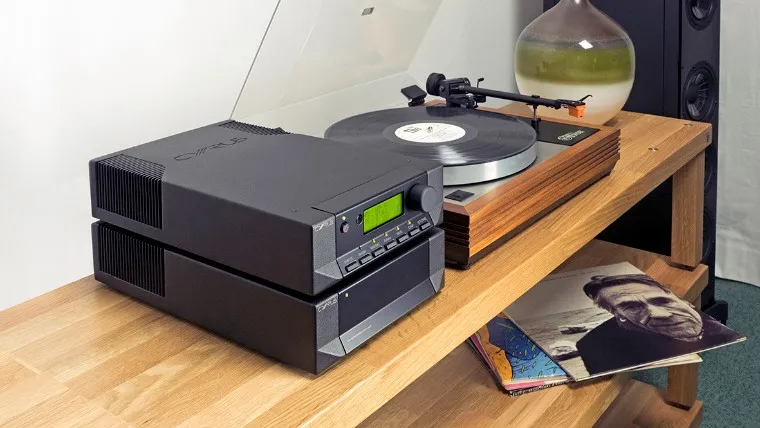
And, of course, it sounds great. “We play Bob Marley’s Exodus and it doesn’t take long to realise that the Phono Signature has some serious talent,” we report in our review. “This newly found sonic substance is as welcome as it is obvious.
“The song’s insistent low-end has good weight and plenty of punch, which gives the presentation a firm foundation to work from.
“The lows don’t dominate though, and still maintain Cyrus’s traditional values of precision and speed. Move up the frequency range and you’ll find fluid and articulate vocals and a crisp top end. It’s a lively, well-organised sound packed full of texture and insight.”
“If you want to analyse the recording it’s all here, laid bare. But if you want to sit back and enjoy, the Phono Signature/PSX-R2 combo is more than happy to oblige, its insightful delivery squeezing every drop of emotion from the music.”
The power behind this system is supplied by the remarkable Burmester 088/911 MkIII pre/power amplification pairing. This £36k duo sits in the middle of Burmester’s range of offerings: the 077 preamplifier with 159 monoblocs would set you back the best part of £180,000 – possibly overkill for a What Hi-Fi? reference system.
What we need from an amplification pairing in a system designed to review other individual pieces of equipment is enough power to be able to drive pretty much any loudspeaker without the load of the speaker affecting the amp’s sound. The amplifier, of course, needs to stay consistent so we can hear what the speakers are doing.
Talent with neutrality

This Burmester combination has plenty of power to allow our team to do a full range of testing. It has a decent phono stage built in, should that ever be required, and a good range of inputs. This sensibly designed package is electrically neutral, with no odd impedances – so the emphasis is on the product being tested rather than on what the amplifier is doing.
“This is a set-up that can withstand the rigours of extensive daily use and sound consistently good while doing so”
Although what the amp is doing is, naturally, really rather inspiring. It provides breathtaking detail, deeply impressive dynamics and, as we say in the review: “With such huge power reserves (180W per channel into 8 ohms), it comes as no surprise that this pairing delivers large-scale crescendos with so much confidence. There’s no element of strain or the sound hardening up, even at high levels.
But it’s during low-level dynamic shifts that the Burmesters pull ahead of similarly brawny rivals. Given a subtle variation in how a piano key is pressed, it’s these amplifiers that reveal those differences rather than ignore them.”
We add, “listen past the punch and power and you’ll find class-leading resolution and the composure to sound in control no matter how wild the music gets.”
And the Burmester duo achieves all that with superb build, and an impressively long, so far, service life. Perfect, then, for a hard-working reference testing system.
Before we come to the final part of the system, we should acknowledge the cabling that we use to link all the parts of the sonic puzzle together. We use a combination of premium options from Chord Company and Vertere Acoustics in order to give the discrete parts of the set-up their best chance to shine.
Years of service

We top this reference system off with the longest-serving members of the set-up. The ATC SCM50 have been stalwarts in the What Hi-Fi? two-channel test room for the best part of two decades now.
They require a touch more power than some to drive, but their impedance is relatively benign, so they aren’t particularly difficult to power. Relatively budget amps can still power them without any trouble, so we can use them to test a very wide range of products and get a good idea of what they are doing.
They are simply honest speakers and don’t add too much of themselves to the sound. And, of course, they are reliable, and solid enough that “We haven’t managed to blow up a pair yet,” according to our technical editor.
The SCM50s aren’t fussy about musical genre. “They have the dynamic punch and organisational abilities to make the most of Tchaikovsky’s 1812 Overture. They never sound fazed or stressed even when pushed hard.
“Move to the likes of Jay Z’s Blueprint and the ATCs take it all in their stride, punching out the album’s hard-charging rhythms with confidence. There’s an impressive amount of attack here as well as the ability to track multiple instrumental strands without getting muddled.”
There you have it: What Hi-Fi?’s reference stereo system is, first and foremost, a tool. And the components have been chosen for their practicality and robustness as much as their musical ability. But, of course, they sound superb in their own rights – and better together in a wonderful hi-fi set-up.
MORE:
Check out all of our 50th anniversary features
From legendary turntables to cutting-edge DACs: 33 debut products that defined hi-fi history
A more budget hi-fi system: This fantastic vinyl-friendly hi-fi system combines five-star floorstanders with an Award-winning amplifier and music streamer

